Monthly Archives: January 2025

12 Houses of Suffering—Revised Edition!

Intro by Author—

I am happy to present to you the new edition of my “10 Houses of Suffering” collection, which is now the “12 Houses of Suffering.” This revision includes two extra houses! 

I originally wrote these stories, some 20 years ago, as a way of introducing Buddhism to my college students. These short stories illustrate the many ways that ordinary people, living seemingly ordinary lives, make themselves suffer. 

The kind of suffering illustrated here may be called mental angst—which is exactly the kind of suffering Buddha was interested in. He called it Duhkha, and it forms the foundation for the Four Noble Truths, which starts by simply saying that Life Is Suffering. Indeed. 

As you will quickly see in these stories, the angst arises because of our unwillingness to come to acceptance with the inevitable twists and turns and changes of life. These people are all of us. We are them. Although we have our own unique versions of these stories… we all create our own hell within, often with just a single thought. like, “I’m not good enough.” This is the madness of the human situation, namely, the inability to accept the inevitable. And so, the pain we cause ourselves comes from persisting to look everywhere else but within, for our peace of mind. 

In other words, we are waiting for the world to be the way we want it to be and for others to be the way we want them to be.

To put it differently, we get “hooked” on our own agenda. And when life doesn’t go that way, it’s hard to accept. We ache for things to be as we think they should.

The good news is, though, is that there is a way out! That’s where Buddha’s Four Noble Truths direct us. If our attachment to all the “should be’s” is at the root of the problem, then letting go… or, accepting, is our ticket to freedom. 

Lead-in: Imagine a row of ten houses facing a creek. Each one is big and beautiful, except the last one – the tenth one, which is smaller and needs some fixing up.

1st House—

Inside the first house is a man who suspects his wife is sleeping with somebody else. He spends every minute of every day, in a state of paranoid suspicion. Right now, as he tries to listen to her phone conversation, he’s tiptoeing along in the corridor, hoping the floor doesn’t creek with his sneaky footsteps, giving him him away, and revealing his jealousy.

2nd House—

Inside the second house is a 25-year-old woman with an eating disorder. At least five days of every week are spent alternately binging and purging, and taking no pleasure from the compulsive acts. Her throat, her teeth, and her stomach are destroyed, and she lives with the fact that she is killing herself, and can’t stop. The other two days are spent in isolation, hunger, and vile self hatred.

3rd House—

Inside the third house is a mother too afraid to answer the phone, yet simultaneously too afraid to stray too far from the house because her son has received death threats while serving as a frontline journalist in the middle east, and news of her only son’s status might be delivered at any moment.

4th House—

Inside the fourth house is a 33-year-old aging cover model, losing jobs to 18-year-olds. She curses at her face in the mirror, and has lost her will to get out of bed in the morning. She is now 50,000 dollars in debt from lost pay, yet just accepted one more credit card offer to schedule plastic surgery on her neck and eyes, in the hope that it will restore her youthful appearance, and make her love herself again.

5th House—

Inside the fifth house is a meth addict. He is missing out on his children’s young years, but he can’t stop. Making it worse, is his wife, who calls him a loser, taunting him daily for his weakness. Every time he tries to give it up for good, he ends up giving in to the urge to light up again, even though he knows it is only a temporary thrill. It’s gotten to the point where he stands to lose his job, his wife, and the house. He no longer enjoys being straight because of the agonizing shame that eats him alive.

6th House—

Inside the sixth house is a 60-year-old woman who has just been diagnosed with incurable cancer. She knows her body will soon start to break down, and that she will have to face her death. She will have to come to grips with the fact that she will never see her grandchildren, or her husband, or her dogs, again.

7th House—

Inside the seventh house is an 85-year-old woman who lost her husband five years ago. Having lost her will to live, she lies in bed all day long, surrounded by the dusty antique knick-knacks she spent her life collecting. Her social security checks go entirely to the caretakers, who are paid to help her with housekeeping and other daily chores. She refuses to leave her home and she also refuses go to an elderly home, where she might take part in various activities, like swimming, painting or Tai Chi.

8th House—

Inside the eighth house is a 19-year-old boy with agoraphobia. Stepping outside the house is like hanging off a bridge, with sweaty fingers slipping, and no one there to catch you. So, instead of venturing outside, he takes his Xanax, and sits in front of his computer, wearing the mask of his artificial identity… chatting in forums, acting witty and sarcastic on screen, but hating himself all the while because he’s lonely and bored, and it never goes away.

9th House—

Inside the ninth house is a 30-year-old ambitious office worker, who just missed out on a promotion due to the fact that his scheming, and overly ambitious female colleague in the next cubicle, claimed his idea as her own, taking all the credit and accolades. He takes his seething hatred out on other women, in the form of abusive relationships that leave him feeling more empty and worthless, rather than potent, and valued.

10th House—

Inside the tenth house – the smallest house on the block – is a newlywed couple who bought this fixer-upper because it was the only house they could afford, given their loan qualifications. Because their house is at the end of the street, they are forced to drive past the other more glorious houses every day, as they go about their business. He imagines his neighbors’ luxurious lives, and all the pricey tools he must have; and she is filled with increasing bitterness toward him, for promising a new kitchen, a jacuzzi, and renovated bathrooms that she can decorate in coordinated colors, like in the magazines. Yet the months go by, and still her husband has done nothing to improve their house. Their relationship is quickly turning bitter.

11th House—

Inside the eleventh house is a thirty-something actress who won the academy award for best supporting actress two years ago. Despite the attention that followed that movie, she hasn’t gotten any exemplary roles since then and feels angry and rejected. The worst part of it is that her jealousy toward other upcoming actors and actresses is all-consuming, to the point where she is incapable of feeling happy for anyone else. She feels insecure and inferior to others, who she imagines must be much better than she is. Because of this bitterness, and because she talks bad about her peers, no one can stand being around her.

12th House—

Inside the twelfth house is a man whose son is gay. He had hopes that his son would follow in his own footsteps and become a football star. He also envisioned his boy as a ladies’ man, who would eventually settle down with a gorgeous wife, and kids, as he had done. He used to tell him to “play the field” and now feels disgusted when he sees his son with his boyfriend. He also can’t stand that his son is an interior designer, a profession he says is a “woman’s job.” He refuses to sit with them when they come to visit, and quickly disappears into the other room to watch sports when they come… leaving his wife, who is more tolerant, to do the hosting. 

I would love to know how you are using this article as an introduction to Buddhism!
Yours Truly,
~Donna Quesada
What Makes Art… Art?

Aesthetics has always asked, What does all good art have in common? Is there some common denominator? What is art, anyway? What is beauty? There may be more than one answer to those questions. Sometimes art does different things and serves different purposes. Andy Warhol’s Brillo Boxes stood as art (and not Brillo Boxes) because of what they were “saying” about consumer culture. I spoke of that here.

As Immanuel Kant said, art invokes within us, a sense of awe and deep pleasure. Like nature, it takes us where words cannot. 

This helps us understand what art does, but still feels inconclusive, as far as what art has. Or is.

Yet, after taking great interest in aesthetics as a philosophy student, through my 20s, I still couldn’t answer, at least to my own satisfaction, the question, What does all good art have in common? Even if there are multiple answers…or none at all. (Maybe it’s like asking what religions is… there is no common denominator. Only what scholars have termed “family resemblances.”) 

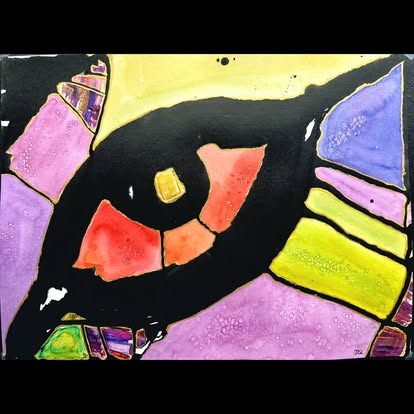
Nonetheless, it is only now, through direct experience, after 30 years of painting in watercolor, and writing poetry… writing in general, have I started to get a glimpse of what I feel to be a truthful response.

But first, indulge a memory with me… I promise, it’ll bring us back to the question of art!

The Storm Rolling In—

I remember running to the classroom window, pushing aside those heavy beige, vinyl drapes, to see the sky turning dark… and the sudden burst of light that illuminated the asphalt outside. Then the rumble. And the anticipation it brought on… how loud will it get? How close will it come?

It wasn’t merely because we rarely get ferocious storms in Southern California. My excitement, which I still feel when storms approach, reveals more than that. Alluding to Kant again, who recognized that nature most powerfully elicits that sense of awe, that all art is but a kind of exemplar of the sublimity we find in nature. And so, we can find the clue here as to what that thing is, that makes both art and nature riveting. And, the storms outside of LA were all the more so. 

It was in the Midwest somewhere… we heard it coming. Like a high speed train roaring. Getting closer. As we ran to open the door, the wind pushed it against the wall. Yet, we couldn’t resist and so we charged into the flurry and out into the middle of the street and it felt like the world was coming to an end. We stood and watched with wild hair and our arms outstretched against the electric jet stream of warm air. We were buzzing. Suddenly turned the heavens poured out a river and in 20 minutes, it was gone. 

Jason Bonham’s Led Zeppelin Experience—

I felt that frenzied excitement when I saw John Bonham’s son and his Led Zeppelin Experience last year. My own reaction was totally unexpected. But that’s the whole point, as I’ll explain below. A genuine reaction to art is, and has to be, totally uncontrived. And to do that, the art will possess some element that is wild, like the storms above. More on that in a moment. When those first notes of Immigrant Song exploded, I was at that moment, like a teenager… I remember jumping up out of my seat, straining on my tiptoes to see… at any cost and discomfort… perhaps managing to blurt out Oh My God a few times because I couldn’t say anything else. Because I couldn’t believe what I was seeing… hearing. Because teenagers do crazy things. Because teenagers have energy (except for when they can’t get out of bed). 

Presence (The location of Beginner’s Mind)—

More to the point, their sense of physical presence exceeds their mental ruminations. And since thinking is draining, the result is vitality… and there has always been an inverse relationship between presence and the degree to which you are in your head. Meaning, the more you are in your head, in the world of thoughts, the less present you are. It starts when we become adults. When we become rational. Teenagers haven’t gotten there yet… So, they are still a little bit wild.

That’s why we adults have so much fun at events like that, we don’t just act like teenagers for that moment in time. We become as kids again. Because we are in our bodies… not in our heads. The music (and all art… and nature) is a conduit for feeling. We are feeling the music, and leaving the world of thought behind for that moment. And thus, we have no sense of “should be’s.” We act naturally, in all our exuberance. In Zen, this is what it means to have a “Beginner’s Mind.” To be blissfully ignorant of the world’s ideas and judgments. And so, free to express oneself authentically.

Crazy… It’s The Same Criterion for Both The Artist and The “Feeler”—

It’s… not holding back. When a singer moves us it’s because she’s not holding back. She’s willing to sing at the edge, right at the place where her voice might crack. But she’s not concerned with that. She’s not playing it safe. She’s not tightened or constricted or self conscious. It’s what good writers do. It’s what good actors do. She’s doing in her art form, what we wish we could do in life. She’s purging emotions as we wish we could. And thus, there is a purification process in the art exchange, for both artist and viewer, through the feeling of release. 

And so, we’ve come around to what I feel answers the question… What does all good art have in common?

It could be said this way: It’s the element of crazy. Something wild and crazy has to happen in that painting, in the dance, in the routine, in the song, in the performance.

Why? Because art unleashes something that has been laid to rest in the depths of our soul… Ultimately, it’s fear. At the very least, it reveals what we wouldn’t do in “real life.” In that sense, it is therapeutic. It is revelatory. It reveals the capacity to let go and to abandon ourselves. It reveals possibilities we thought weren’t for us… to be whimsical, carefree and unguarded. To be fearless.

Which Ultimately means… To be FREE.

When asked, “what does freedom mean to you?“ the iconic singer Nina Simone simply said, “to be fearless.”

But we don’t dare, in our everyday lives. We were taught to be rational. We’re careful. We’re measured. We’re prudent. We’re tight. We don’t dare take a chance!

The Wild Stuff Makes it Special—

It’s the big, bold tree stroke in the foreground of a painting. The stroke that makes you think, as an artist, or someone watching from behind as you’re about to do it, “Oh no!… You’re going to ruin it!“ because the background was done so carefully. Reason will dictate… Leave well enough alone.

That’s where art steps in. Art messes it all up, like crazy hair. Like that sky that turned black before it opened up and flooded the streets for those 20 minutes.

Art is where convention is, ipso facto, irrelevant, since creativity is by its very definition, the birthing or the configuration of something new. And this process often looks weird or wild or simply… crazy. To be clear, this doesn’t and shouldn’t mean harmful. Nor necessarily loud. But it does mean bold… but in any number of myriad ways. Think John Cage in his silent symphony. Think Marina Abromovic, in her meditative, interactive art. Think Cindy Sherman in her performance pieces, which feature herself as objet d’art, in different guises. All pushed boundaries and convention in their own weird and wonderful way. In a more prosaic example, I remember seeing footage of Joe Cocker singing at Woodstock, as a girl… I asked my mom what was wrong with him… why was he shaking? Yet I couldn’t take my eyes off of him. 

Beginner’s Mind—

It’s that element of crazy, again. It feels like freedom—the most basic human requirement. It’s the quality of being uncontrived. The Zen masters call naturalness. And it springs forth from the “Beginners Mind,” which is a mind that is free of concepts. In plain terms, it is a mind that is free of the “should be’s”. Free from fear of failure. Free from the corruption of other people’s judgments and opinions. Free from the rules of convention that we spoke of. Totally spontaneous and totally yourself. Joe Cocker let the spirit move through him. Cindy Sherman had to disappear, in a sense, in order to become the characters she became. 

A Strange and Perfect Pairing of Chutzpah and Selflessness—

It’s chutzpah. It’s bold. It’s brave. It breaks the rules. It can’t be tamed. It’s why every new genre has to break from the past. It’s rock and roll. And by rock and roll, I don’t only mean rock and roll as we think of it today. Using it loosely at this moment, I mean that which possesses that quality of boldness that I have been speaking of… Vivaldi, by this standard, was as rock and roll as it gets, with his reputed flamboyance and innovative spirit. He just couldn’t “plug in.” He was wild, like all rockers, who do whatever the hell they want to do. They scream and yell and kick and move their hips, like Elvis. They growl like Gregg Allman and Leon Russell… just growl on tune! 

But, in some measure of paradox, the artist has to lose himself, through the boldness. Or, said differently, the boldness must not come from ego, lest it be contrived, which is the antithesis of beginner’s mind. And the same is true for the viewer. And together, the journey is taken into abandon. And this is freedom.

It’s what good acting does… The actor loses himself. He lets go of control, for that moment. He  becomes the character, as effort gives way to effortlessness. It’s why Joshua Bell, the violinist, once said that at the moment of performance, all practicing is let go of. He has to trust at that moment that it’s in his bones.

The Enzo Brings it Back Around—

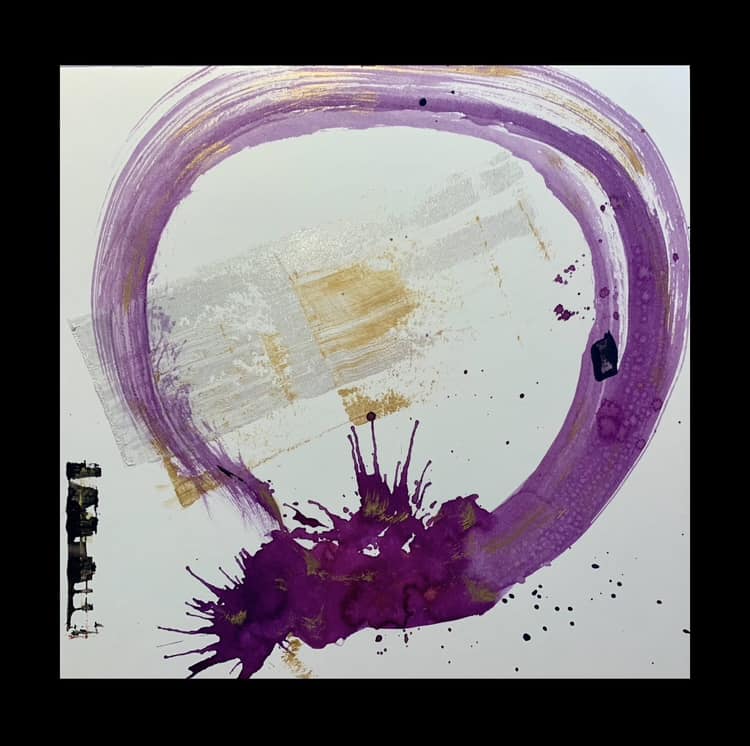
The Japanese Enzo displays this element of naturalness and spontaneity. Which is wild and irrational in its appearance of not-caring. And… free. Like all good calligraphy, you would never “go back over it.” Because perfection has nothing to do with it. Because perfection is in the head! The question is rather, is it “felt?” Not, “did you think it through?” Were you inspired at that moment? Was it free? Was it confident (and thus, bold)? Was it authentic? 

Like me, at that concert… when we act naturally, out of beginner’s mind, there is no limiting or constraining sense of “should be”… there’s no sense of embarrassment. There’s no sense of “not good enough.” 

For a plant or a stone to be natural is no problem. But for us there is some problem, indeed a big problem… The true practice of zazen is to sit as if drinking water when you are thirsty. Then you have naturalness. ~Zen Mind, Beginner’s Mind (Shunryo Suzuki)

In this way, art conveys what we wish we could be in “real life.” We long for that spirit of abandon. It’s why we love road trips; it’s why we love falling in love (“we are not in our right mind”… it’s been called a kind of temporary insanity, but we love it). That’s why we miss being children.