

20 years ago, I took my Zen Boddhisattva vows with my teacher, William Nyogen Yeo Roshi. I found out a few months back, that he had passed away. Known simply as Nyogen Roshi, he was a successor of Maezumi Roshi, who brought Japanese Zen to the United States in 1956 and was widely considered the foremost Zen master of the 20th century. Nyogen Roshi was the last of 12 students authorized by Maezumi Roshi to succeed him as a teacher, and was thus given the title “Roshi.”
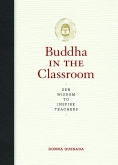
My teacher was a true teacher. He cared nothing about accolades or recognition. He was compassionate and simple. He also had a good sense of humor. Most of all, he cared about the Dharma and about preserving it well. In this light, I thought that the most beautiful way to remember him would be to share one of his teachings. This Zen lesson, which I have named with an acronym DER, came from a Dharma talk at the temple where we, the Sangha (community), used to gather on Saturday mornings for meditation, Dharma talk and lunch. To my knowledge, this teaching was never written down, except in my
own book, Buddha in the Classroom; Zen Wisdom to Inspire Teachers (2011). This passage is adapted from chapter 5, in which I am sharing my frustration with my students’ tardiness…
~ ~ ~
In his Dharma talks, my Zen teacher often repeats a three-part teaching: Don’t deceive yourself; Don’t make excuses; and, Take responsibility. Each time he transmits this message to us, he is keeping alive the flame of a living tradition, as did his own teacher, Maezumi Roshi, when he carried the very same lessons forth from his native Japan. The teachings are so pertinent that I remember them as an acronym, DER, for easy retrieval. I always find it appealing that the teachings start with the self, putting us face-to-face with the connection between our own states of mind and our subsequent treatment of others. But looking inward at our own state of mind requires courage. Don’t deceive yourself.
How often do we mask dishonesty? It takes courage to lay the armor of the ego down and to concede—even to ourselves—our true motives and agendas. This internal candidness transforms us, and in turn, everyone and everything else we come into contact with, either directly or indirectly, which is infinite in scale over the course of a lifetime. We go to great lengths to try to fool ourselves. I remember when I took some change from my father’s dresser as a kid. I told myself that if he had just given it to me in the first place, then I wouldn’t have had to take it. So, it was his fault. Psychologists call it rationalizing.
A couple of years ago, my son bought a vehicle that wasn’t as described in the ad. It was the first time he had handled a transaction of this magnitude on his own. He gave the seller the money and drove away with it, even though all the signs were there—no tags, an odometer reading that was higher than described, and other small peculiarities that were indications of a shady deal. Well, someone could have just stolen the tags, he said, and maybe the guy misread the mileage. He knew he had been bamboozled, and deep down he also knew he had participated in his own deception, telling himself that it was the perfect truck—that it was a good deal, and there was no other like it. He was spellbound, and ended up with undisclosed tickets and back fees on the vehicle. A good lesson, to be sure; but as adults, we’re just as willing to deceive ourselves, and we get ourselves into similar situations. We do it every time we spend money we shouldn’t under the guise of necessity and urgency, because the sale ends tomorrow, or because they might run out—only to look back and see we’ve participated in increasing our own debt. And when we’re truly honest, we can see that it was for things we didn’t really need.
I used to tell my students: If I had to sum up Buddhism in just one statement, I would call it the discipline of letting go. Letting go of what? The ego. The self. The idea of self, and the cloak of separateness the ego-self wears. Every time we deceive ourselves, we drive our ego’s agenda, and we reaffirm that abiding sense of separateness. The ego is normally associated with arrogance, but that narrow definition leaves out its many other masks—such as the one it pokes through every time we refuse to budge from that avowed agenda; every time we find ourselves so rigidly attached to our own idea that we will push it at any expense—even if it means deceiving ourselves.
Student tardiness conflicts with my agenda, so my ego goes to work to control it. But as the disagreeable situation continues, the ego simmers, and the frustrated desire for control and order intensifies. I am a pressure cooker. A look, a word, or a wrong gesture opens the valve and the pressurized steam floods the room. In my head, I blame them, the culture, and the world, and it shows in my demeanor. I deceive myself by thinking I play no role in it at all, and all the while, I exhaust my energy waiting for the world to change. When you blame, you open up a world of excuses, because as long as you’re looking outside, you miss the opportunity to look inside, and you continue to suffer.
Even as you employ different strategies for controlling the problem, there will always be the students that continue to trickle in late, every semester, for as long as you teach, forever. The idea of confronting yourself first, in the face of something so disrespectful, sounds ironic. Coming in late is clearly wrong, you may be thinking. It’s their fault, and they need to get their act together. Yes, but you don’t want to suffer until they do. You want to be liberated and at peace, able to smile as you deal with these everyday annoyances. The true irony is that when you flip the whole thing over in this way, the annoyances will probably stop being annoying. Pointing outward rather than inward prevents you from considering your own need to control, as well as your own sensitivity to minor provocations. To continue in the context of my teacher’s caveat, DER, it is thus a refusal to take responsibility, and to take your own foibles to task.
Some of my colleagues won’t admit students into the room after fifteen minutes. It’s a reasonable cutoff. One of my son’s teachers locks the door just one minute after the scheduled start time of his aviation class for aspiring pilots and air traffic controllers. One minute might strike you as downright unreasonable, until you hear his compelling and amusing analogy: If this was an airplane, the doors would be locked, and even if you were only one minute late, you would have missed your plane. Ask yourself: Where is your own balance point between “anything goes” and rigid intolerance? Curbing the compulsion to drive our agendas at any expense is part of finding that balance. And how expensive is it?
Does your inner disturbance ruffle the peace more than the tardies do? If so, that is a quite a tab. Zen’s answer is a compromise, which Buddha called the Middle Path. Just watch them without controlling them, Zen says. There’s an opening of the heart that occurs when you pull back for a moment, into the stillness—when you simply watch. In that space, there is room to turn the light inward and ask honestly, “Why does this bother me so much?” Ask, is this person doing something bad to me personally? The point is not laxity, but inner peace, which has to come first. You have to be peaceful before looking to external solutions.
Like those kaleidoscopes we all had as kids, consider the new shapes and colors that emerge with just a small adjustment. Yes, tardiness seems intolerable, and as convinced as I am that it’s a symptom of undisciplined youth, I can also laugh at myself because I’m starting to sound like the older generations who have always said the same thing. Anyway—and this is the real point—our own spinning minds that toss judgments around like batting machines are even more intolerable than the tardies. That incessant spinning ruins everything, so which is worse? They both cause suffering all around, especially to ourselves.











 Donna Quesada Schollhammer