
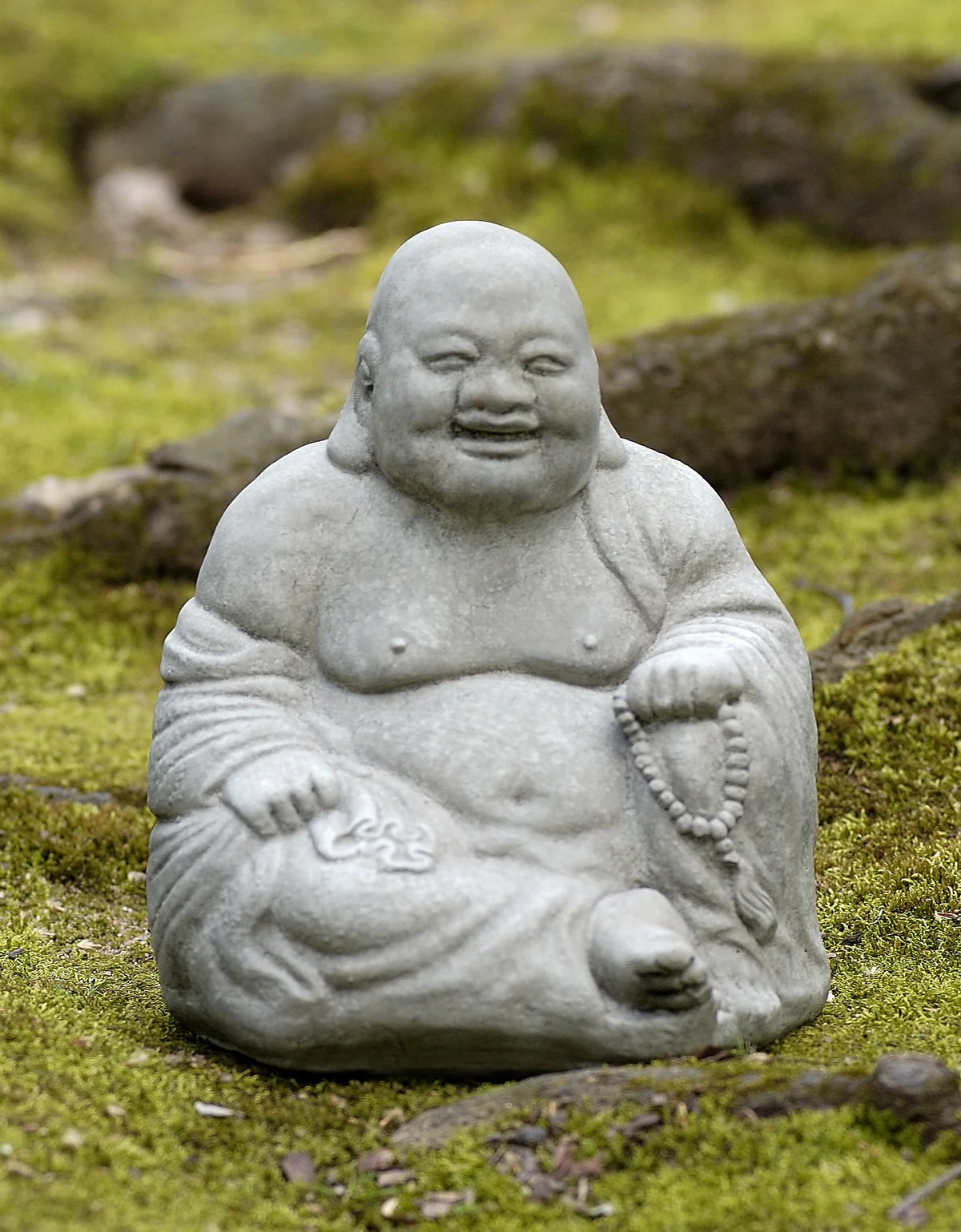
This is a Zen koan, called “Happy Chinaman,” with my commentary…
The Story of the Happy Chinaman (A Koan)—
Anyone walking about Chinatowns in America will observe statues of a stout fellow carrying a linen sack. Chinese merchants call him “Happy Chinaman” or “Laughing Buddha.”
This “Hotei” lived in the T’ang dynasty. He had no desire to call himself a Zen master or to gather many disciples around him. Instead he walked the streets with a big sack into which he would put gifts of candy, fruit, or doughnuts. These he would give to children who gathered around him in play. He established a kindergarten of the streets.
Whenever he met a Zen devotee he would extend his hand and say: “Give me one penny.”
Once as he was about to play-work, another Zen master happened along and inquired: “What is the significance of Zen?”
Hotei immediately plopped his sack down on the ground in silent answer.
“Then,” asked the other, “what is the actualization of Zen?”
At once, the Happy Chinaman swung the sack over his shoulder and continued on his way.
My Commentary—
I transcribed the story above exactly as it has been passed down, in Zen literature, since antiquity, despite the fact that the term “Chinaman” is now outdated. “Hotei” is the name of “The Laughing Buddha,” who actually existed and was a monk in China, in the 10th century. It is said that he was an incarnation of Maitreya, the Buddha of the Future.
This story conveys a central tenet of Buddhist teachings, which encourages us to focus not on philosophy, but rather, on direct experience. This emphasis on practical knowledge goes back to the original Indian Buddha, Siddhartha Gautama, who often responded to metaphysical questions with silence.
The Buddha rejected metaphysics because it was not helpful or practical in ending suffering, which was his sole focus. Following are the detailed reasons for Buddha’s rejection of metaphysics.
Why Buddha pushed aside metaphysics—
1.Metaphysical questions don’t lead to liberation
When people asked the Buddha questions like:
Is the universe eternal? Or, Where do we go after death? Or, Do we have a soul? …He would respond in unusual ways, such as remaining silent, or in one well-known example, by holding up a flower.
Siddhartha was a teacher until he left his body at 80 years old. He would always remind his students that these sorts of questions do not lead to nirvana, or freedom from suffering. They are irrelevant from the perspective of awakening.
2.Metaphysical questions keep us trapped in our heads
The Buddha compared metaphysical debating to being shot with a poisoned arrow:
Analyzing these sorts of philosophical questions would be just as silly as a person refusing treatment because he first wants to know… who shot the arrow, where the shooter lives, and what kind of wood the bow was made of… when all the while, he’s dying.
In the same way, metaphysical speculation has little practical value and only serves to distract us from the urgent task of freeing our minds from the attachments that keep us mired in discontentment.
3.Metaphysical questions reinforce our ego
Buddha recognized that many of the metaphysical questions that we get stuck on, revolve around the nature of the soul, death and the possibility of eternal existence.
In his commitment to help us find our way out of our own self-inflicted suffering, he always reminded his students that obsessing over questions of this nature would only strengthen the very thing they were trying to dissolve: the notion of a permanent self.
4.Metaphysical questions cannot be resolved through direct experience
Buddha always reminded his students to trust only their own direct experience on everything… to see for yourself how the mind works, how suffering arises and how it ends.
But, metaphysical questions tend to be unverifiable, as they are grounded in belief and speculation, rather than experience. So, for this reason, he preferred not to encourage them.
In summary—
At the heart of Buddha’s teachings is that our own attachments… to things, to ideas, and to our selves and our own immortality… keep us trapped in our own heads.
By swinging his sack over his shoulder, and carrying on with his day, rather than allowing himself to get ensnared by the questions posed by the other Zen master, Hotei was demonstrating this teaching, without saying a word.
Enlightenment is right here, right now! It is found in action, not in speculation!
As an aside, by posing those questions in the first place, the other Zen master was likely testing Hotei, as that kind of good-spirited “leg-pulling” is common in the Zen tradition. Surely, as the story identifies the petitioner as a “Zen master” and not merely a “student,” he would’ve known very well the caveat of sinking into metaphysical questions!
Simply put, Buddha avoided metaphysics because it doesn’t solve the problem of suffering. His focus was not on explaining the universe but on transforming the mind, which is the very source of this suffering.








 Donna Quesada Schollhammer