Author Archives: Donna Quesada

My Zen Teacher

Me, taking my Zen vows (2005)

20 years ago, I took my Zen Boddhisattva vows with my teacher, William Nyogen Yeo Roshi. I found out a few months back, that he had passed away. Known simply as Nyogen Roshi, he was a successor of Maezumi Roshi, who brought Japanese Zen to the United States in 1956 and was widely considered the foremost Zen master of the 20th century. Nyogen Roshi was the last of 12 students authorized by Maezumi Roshi to succeed him as a teacher, and was thus given the title “Roshi.”

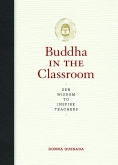
My teacher was a true teacher. He cared nothing about accolades or recognition. He was compassionate and simple. He also had a good sense of humor. Most of all, he cared about the Dharma and about preserving it well. In this light, I thought that the most beautiful way to remember him would be to share one of his teachings. This Zen lesson, which I have named with an acronym DER, came from a Dharma talk at the temple where we, the Sangha (community), used to gather on Saturday mornings for meditation, Dharma talk and lunch. To my knowledge, this teaching was never written down, except in my
own book, Buddha in the Classroom; Zen Wisdom to Inspire Teachers (2011). This passage is adapted from chapter 5, in which I am sharing my frustration with my students’ tardiness…
~ ~ ~
In his Dharma talks, my Zen teacher often repeats a three-part teaching: Don’t deceive yourself; Don’t make excuses; and, Take responsibility. Each time he transmits this message to us, he is keeping alive the flame of a living tradition, as did his own teacher, Maezumi Roshi, when he carried the very same lessons forth from his native Japan. The teachings are so pertinent that I remember them as an acronym, DER, for easy retrieval. I always find it appealing that the teachings start with the self, putting us face-to-face with the connection between our own states of mind and our subsequent treatment of others. But looking inward at our own state of mind requires courage. Don’t deceive yourself. 

How often do we mask dishonesty? It takes courage to lay the armor of the ego down and to concede—even to ourselves—our true motives and agendas. This internal candidness transforms us, and in turn, everyone and everything else we come into contact with, either directly or indirectly, which is infinite in scale over the course of a lifetime. We go to great lengths to try to fool ourselves. I remember when I took some change from my father’s dresser as a kid. I told myself that if he had just given it to me in the first place, then I wouldn’t have had to take it. So, it was his fault. Psychologists call it rationalizing.

A couple of years ago, my son bought a vehicle that wasn’t as described in the ad. It was the first time he had handled a transaction of this magnitude on his own. He gave the seller the money and drove away with it, even though all the signs were there—no tags, an odometer reading that was higher than described, and other small peculiarities that were indications of a shady deal. Well, someone could have just stolen the tags, he said, and maybe the guy misread the mileage. He knew he had been bamboozled, and deep down he also knew he had participated in his own deception, telling himself that it was the perfect truck—that it was a good deal, and there was no other like it. He was spellbound, and ended up with undisclosed tickets and back fees on the vehicle. A good lesson, to be sure; but as adults, we’re just as willing to deceive ourselves, and we get ourselves into similar situations. We do it every time we spend money we shouldn’t under the guise of necessity and urgency, because the sale ends tomorrow, or because they might run out—only to look back and see we’ve participated in increasing our own debt. And when we’re truly honest, we can see that it was for things we didn’t really need.

I used to tell my students: If I had to sum up Buddhism in just one statement, I would call it the discipline of letting go. Letting go of what? The ego. The self. The idea of self, and the cloak of separateness the ego-self wears. Every time we deceive ourselves, we drive our ego’s agenda, and we reaffirm that abiding sense of separateness. The ego is normally associated with arrogance, but that narrow definition leaves out its many other masks—such as the one it pokes through every time we refuse to budge from that avowed agenda; every time we find ourselves so rigidly attached to our own idea that we will push it at any expense—even if it means deceiving ourselves.

Student tardiness conflicts with my agenda, so my ego goes to work to control it. But as the disagreeable situation continues, the ego simmers, and the frustrated desire for control and order intensifies. I am a pressure cooker. A look, a word, or a wrong gesture opens the valve and the pressurized steam floods the room. In my head, I blame them, the culture, and the world, and it shows in my demeanor. I deceive myself by thinking I play no role in it at all, and all the while, I exhaust my energy waiting for the world to change. When you blame, you open up a world of excuses, because as long as you’re looking outside, you miss the opportunity to look inside, and you continue to suffer. 

Even as you employ different strategies for controlling the problem, there will always be the students that continue to trickle in late, every semester, for as long as you teach, forever. The idea of confronting yourself first, in the face of something so disrespectful, sounds ironic. Coming in late is clearly wrong, you may be thinking. It’s their fault, and they need to get their act together. Yes, but you don’t want to suffer until they do. You want to be liberated and at peace, able to smile as you deal with these everyday annoyances. The true irony is that when you flip the whole thing over in this way, the annoyances will probably stop being annoying. Pointing outward rather than inward prevents you from considering your own need to control, as well as your own sensitivity to minor provocations. To continue in the context of my teacher’s caveat, DER, it is thus a refusal to take responsibility, and to take your own foibles to task.

Some of my colleagues won’t admit students into the room after fifteen minutes. It’s a reasonable cutoff. One of my son’s teachers locks the door just one minute after the scheduled start time of his aviation class for aspiring pilots and air traffic controllers. One minute might strike you as downright unreasonable, until you hear his compelling and amusing analogy: If this was an airplane, the doors would be locked, and even if you were only one minute late, you would have missed your plane. Ask yourself: Where is your own balance point between “anything goes” and rigid intolerance? Curbing the compulsion to drive our agendas at any expense is part of finding that balance. And how expensive is it? 

Does your inner disturbance ruffle the peace more than the tardies do? If so, that is a quite a tab. Zen’s answer is a compromise, which Buddha called the Middle Path. Just watch them without controlling them, Zen says. There’s an opening of the heart that occurs when you pull back for a moment, into the stillness—when you simply watch. In that space, there is room to turn the light inward and ask honestly, “Why does this bother me so much?” Ask, is this person doing something bad to me personally? The point is not laxity, but inner peace, which has to come first. You have to be peaceful before looking to external solutions.

Like those kaleidoscopes we all had as kids, consider the new shapes and colors that emerge with just a small adjustment. Yes, tardiness seems intolerable, and as convinced as I am that it’s a symptom of undisciplined youth, I can also laugh at myself because I’m starting to sound like the older generations who have always said the same thing. Anyway—and this is the real point—our own spinning minds that toss judgments around like batting machines are even more intolerable than the tardies. That incessant spinning ruins everything, so which is worse? They both cause suffering all around, especially to ourselves.

Letter to My Dog Marcel (10/1/09-12/12/24)

AKA: Marcel the Terrier
AKA: Marcel Dupont
AKA: Mumu

It’s been a year. I can still hear your “double bark” in my head… It wasn’t really a bark. It was you trying to tell me something. You were a communicator. You used your voice and your eyes with such determination.

I can still see you looking at me with that sideways mouth, made crooked in your later years, from having teeth removed. You really were “a character.”

It didn’t take long to find out you were a rascal. Yet, at the same time, there was something very dignified about you.

I’ll never forget the day I took you home from the shelter… you were only six months old. You weren’t content to stay in the backseat, and you—little brazen you—somehow managed to poke your head through the two front seats, by standing on the floor of the backseat, in order to see where we were going.

From that point on, no more beating around the bush… You went straight to the front seat, where proper people sit.

You certainly weren’t just my “pet.” And to say that you were my “fur baby,” doesn’t quite capture it for me, either. Although you were. It doesn’t feel like enough to say that you were my “best friend,” either. Although you were. And companion isn’t quite enough. You were, in every sense of the word, my soulmate.

After I got you home that day, in 2010, I read the paperwork that the shelter had given me about your history. I learned that you had been adopted and then returned back to the shelter. It broke my heart. But perhaps it was because you were meant to be with me.

After all, you chose me, that day in the shelter. You were so smart… You licked my hand through the holding cage, then figured out where I would go next, and walked through to the backside, in order to capture my attention again, as I passed down the next aisle!

After a few weeks, I could see why the wrong family may have felt you were “too much,” as you would growl if you didn’t like the way you were approached, or if you felt intimidated. But I could handle you just fine and I even found your shenanigans charming. We would call that growling face “the uglies,” or as my Italian grandma used to say, “que bruto.” Then you would quickly become cute again. You were my angel, and still are. Your favorite place in the world was my lap.

When I was at work, you’d take your spot on top of the highest point of the sofa… because where else? That was “The King’s” spot.

You were entitled, that’s what you were.

You were content to let us think that it was you AND Kanoa getting into the trash, when we left the house, during those last few years. We now know perfectly well that it was you and only you, all along.

Kanoa was the perfect brother for you… he let you be who you were, even if it meant living in your shadow, a little bit. When it was time to go for a walk, or switch gears in any way, he waited for your cue.

He indulged your tomfoolery as much as I did. Like that day in Venice Beach, when you were both in the stroller. It was one of my first real dates with Thierry, and I tried to make light of your behavior toward the skateboarders, while holding you down with one hand, as you transformed into a Tasmanian devil. “Yeah, some dogs do that with skateboarders.”

Kanoa, meanwhile, squeezing himself behind you, as if he was trying to hide from embarrassment, while trying to preserve his dignity. I could almost hear him, “it’s my brother… not me!… I like skateboarders just fine!”

You were Robert De Niro to Kanoa’s Billy Crystal in that movie where he has trouble controlling his outbursts.

You should see Kanoa now… He has become the new little king! He has a Corgi friend named “Barkley” that lives in the back, and a Goldie friend named “Max” that lives next-door, along with his little Yorky brother, “Teddy.” Teddy is the one that likes to run loose through the neighborhood. I wish you had gotten to know this house. At least you were here for a month and a half, so you know where I am.

Yes, Kanoa has really come into his own… I think he likes being top dog now. I sometimes feel nostalgic for our beach mornings. Remember when we would get a bagel and coffee from Noah’s, sit in the car and share it, before taking our walk?

But Kanoa owns the forest… that is really his world. You should see him following all the delicious scents on the trails… a mix of damp earth, fungi, and decaying leaves… Heaven.

And guess what? He even comes to the table for cheese bits now, the way you used to. Of course, he’s not the foodie you were, but he has now discovered the pleasures of a good, stinky Camembert. I suspect you have instructed him from afar, how to hold the stare long enough ‘til we cave. He’s quite good at it now.

I’ll never forget that day we had to rush home from the movies because you had gotten into some Trader Joe’s chocolate. I had to make you throw up with hydrogen peroxide.

Getting used to being without you has been harder than I thought it would be. Non-dog people might not understand, but no matter where I was, if I couldn’t take you with me, then I started glancing at my watch after two or three hours… preparing my exit, because all I wanted to do was come home and be cozy with you.

You lived for me and I lived for you.

Even though I know your spirit has no dimension now, and you reside inside my heart, I miss your little “terrier head,” your funny, crooked little smile, and your rascally ways, so much.

Love, Mom

The Hindu Notion of God… How To Know Brahman Pt II

Experiencing or realizing Brahman isn’t about believing in an idea—it’s about directly knowing the ultimate reality through the transformation of consciousness. It’s the kind of knowing that can only come from experience.

How do we gain those experiences? Through the Yogas. Although the word “Yoga” is often associated with physical poses here in the west, its roots come from the Sanskrit “Yuj” and means “to yoke,” or rather, to connect to the divine that is within and without.

As I explained in Part 1 of this series on Brahman, in Hindu spiritual teachings, the divine is everywhere… there is nothing that is not divine. The Four Main Yogas highlighted below, explain the pathways to Self-Realization… to realizing that divinity within.

Note that I will interchangeably use expressions like “liberation,” and “Self-Realization,” to convey what can never be described adequately with words… the direct experience of Brahman.

Said more simply, these Yogas are the paths to God…

1.Jnana Yoga (Path of Knowledge)

This is the path of the intellect. It focuses on the philosophical ideas and meditative disciplines taught in the Upanishads and in the Advaita Vedānta.

An example would be Ramana Maharshi’s approach, which emphasizes self-inquiry to realize the Atman, or the little spark of Brahman that lies within. The central practice involves asking the question “Who am I?” to trace the sense of self back to its source and to prompt the realization that the sense of “I” is not a separate entity, but rather, just a stream of thoughts.

This method helps to dissolve the ego and to see the Self as the underlying, unchanging reality. Zen Buddhism is in many ways, a continuation of this path, with the Kensho experience of sudden enlightenment, being not unlike the realization experience of Jnana Yoga. The differences emerge in the context of Buddha’s skepticism of the permanence of the soul.

The idea is that when all identification with the body and mind falls away, the seeker awakens to Brahman — the infinite, formless consciousness — and to the unmistakeable knowing that it is none other than “I.” It was within all along. You are it and I am it and there is nothing that is not it.

2.Bhakti Yoga (Path of Devotion)

This is the pathway of the heart. It is the devotional path, which is emphasized in the Bhagavad Gita.

Here, Brahman is experienced as the personal God — whether we are referring to Krishna, Shiva, Devi, or any beloved form, including Jesus and Mary and all the saints. For the truly devotional, there is no distinction between traditions! They are all Bhakti traditions, and serve as portals to the divine.

I like to say that if Jesus and Buddha met at a gathering, they would find in each other, an instant kinship and would break bread together while talking and laughing into the wee hours of the night. It is we ignorant mortals that like to put a partition between the spiritual traditions.

In Bhakti practices, such as prayer, chanting, and silent devotion, the devotee surrenders his/her ego and experiences the feeling of oneness within.

Eventually, the sense of the separate “I” dissolves, and only divine presence remains, which is another way of realizing Brahman.

3.Raja Yoga (Path of Meditation)

This is the Yogic path described by Patanjali in the Yoga Sutras, and focuses in large degree on stilling the mind. To this end, Patanjali outlines the Eight Limbs of Yoga, which form a cohesive system that begins with lifestyle, then addresses the energies of the body, and ultimately tames the wild horses of the mind, so as to achieve Self-Realization.

In summary form, here are The Eight Limbs of Raja Yoga:

  • Yamas (ethical restraints): My teacher called these the “what not to dos” because they include instructions to avoid harming other beings, and to avoid greed. The idea is not so much to moralize, but rather, to stay away from behaviors that tend to reinforce the ego and the idea of the separate self.
  • Niyamas (observances): While my teacher called the Yamas (above) the “what not to dos,” he called these the “what to dos” because they include things like commitment and surrender, which all contribute to a calm, simple and disciplined life, and make liberation more likely.
  • Asana (physical postures): These are the postures that most people in the west identify as “Yoga” (although the postures are but one step, in a multifaceted approach to Self-Realization!). Patanjali’s inclusion of postures recognizes the body as a more approachable vehicle toward the ultimate goal of taming the mind. The body is more tangible and allows us to break through our physical resistance to stillness as we get better at focusing our attention inward.
  • Pranayama (breath control): One of my teachers would always remind us that “there is only one thing the mind will follow, and that is the breath.” Working with our breath is the most viable way to calm the nervous system and in turn, the busy mind.
  • Pratyahara (withdrawal of the senses): I like to think of Pratyahara as the discipline of managing our external distractions. It’s an application of what any elementary classroom teacher meant when he/she would tell us to mind our own business and stop worrying about what others are doing. We are cultivating the discipline to go inward.
  • Dharana (concentration): If Pratyahara (above) is the discipline of managing our external distractions, then Dharana is the discipline of managing our internal distractionsThe ability to concentrate is not always automatic. Our thoughts take us hither, thither and yon, and harnessing the frenzied energy of the mind takes practice.
  • Dhyana (meditation): This is the real objective. This is the ability to sit in meditative stillness. This is what it has all been leading toward. The word “Dhyana” eventually became “Chan” as Indian teachings made their way into China, “Seon” in Korea, and “Zen” as those teachings continued on their journey to Japan. Hence, Zen focuses on seated meditation as a vehicle to enlightenment.
  • Samadhi (absorption): Samadhi is the experience of being absorbed in the divine. In Zen, it is called “non-distracted awareness.” In this state, the individual mind merges with cosmic consciousness.
  1. Karma Yoga (Path of Selfless Action)

Taught in the Bhagavad Gita, this path transforms daily life into spiritual practice. The seeker acts without attachment to results, dedicating all actions to the Divine. The idea is that selfless service (seva) purifies the heart and dissolves the ego — allowing a gradual experience of God realization.

When a man sees, hears, touches, smells, and tastes what is real, and realizes that the Self is Brahman, he becomes free from sorrow.” ~Upanishads

The Hindu Notion of God… What is Brahman? Pt I

What is Brahman?: To be absolutely direct… everything… meaning, EVERYTHING that exists, is an expression or manifestation of Brahman. This means that all the Gods that are associated with Hinduism, are Brahman. Shiva, Krishna, Parvati, Durga, Lakshmi… all of them, are manifestations of Brahman. Humans are Brahman. The trees, rivers, and all the animals of the seas and forests are Brahman. Energy is Brahman.

Again, like the actors on a stage, Brahman just appears differently in different contexts.

Brahman is the universe and everything in it. Since Brahman is everything in the universe, the concept of the universe, and the universe itself… and since Brahman is divine, it is self-evident to simply say that the universe is not separate from the divine.

Pantheism

This is the pantheistic aspect of Hinduism… Everything is divine. God is everywhere and in all things. Pantheism just means that nature is inseparable from God. God is everywhere and in all things.

When you look into a creature’s eyes, you are looking at God. When you wrap your arms around a tree, you are embracing God. When the beauty of a sunset renders you speechless, you are experiencing God.

In a pantheistic universe, all of nature is sacred. In a pantheistic mindset, we feel a natural sense of unity and kinship with all beings, since all beings are Brahman. All beings are sacred.

Hinduism is often mistakenly described as “polytheistic” because of the appearance of so many deities. But they are all aspects of Brahman! So, then why have all the Gods? Because Brahman can seem too abstract to conceive of, and we need a tangible manifestation of source energy to relate to… and to embrace. The many manifestations present in the Hindu pantheon of Gods represent the many ways that God appears.

Like us, God isn’t just one thing. He is a she sometimes, and an it at other times. He is loving sometimes and harsh at other times. She is peaceful and then downright angry. This is very different that the western point of view, in which God is generally thought of only in the masculine form and described as all good all the time. Here, God is not so different from us… we have many aspects to our personality, rather than just one.

But, of course it’s no different than us… we are IT!

The metaphor used in the early Hindu scriptures, to emphasize the oneness of all, is the ocean. We feel so unique. We feel separate. But that’s just our ego. We are just waves on the surface of the ocean… for a while, our ego tells us we’re a big beautiful wave… and everyone, everywhere, would love to just lay their eyes on us… photographers would love to capture our perfect barrel, and surfers would travel near and far to take us on!

But alas, we will crash back into the same ocean from whence we came. Moreover, we were never any different!

Buddha’s Four Noble Truths: Part II… The Eightfold Path

The Noble Eightfold Path is the fourth part of Buddha’s Four Noble Truths. It is usually stated as Marga, which just means “Path.” Think of it as one path, that consists of eight interconnected practices, which work together to help us liberate ourselves from our own self-created suffering. 

As you’ll recall from the first part of this presentation, on The Four Noble Truths, the kind of suffering we’re talking about here, is the mental variety.

The intent of these eight steps is to habituate the wild-horse that is our mind, into a calm state of awareness. 

It is worth noting that in Buddha’s brilliance, he articulated these steps so as to apply to both the actual practice of Zazen, or seated meditation, as well as to our lifestyle, as a whole. This comes through in their organization: The first two steps capture the basic wisdom of Buddhist teachings, the next three steps all concern our conduct in the world, while the last two focus in on meditation. 

Finally, a note about the context… The Buddha, authentic child of India that he was, responded to the prevailing Vedic notion at the time, that if you practice asceticism—that is to say, give up everything—you could put an end to your suffering. Buddha felt that this was not the way because the “picking and choosing mind,” forever full of preferences will always dominate, so a better practice is to learn how to lean into those attachments, so to speak, rather than make the attachments go away. 

We might look at the eightfold path as the practice of leaning into our attachments, so as to neutralize them and remove their power.

1. Right Understanding (Wisdom). This first step is a reminder that all experience is part of an impermanent and conditioned cycle, driven by the law of cause and effect. 

That is to say, we are all connected and we all need each other to exist. 

Said differently… everything needs everything else to exist. 

Differently still… Everything is totally dependent on everything else. And everything really does mean EVERYTHING… the birds and the trees, the water and the clouds… everything.

This is known as Emptiness in Buddhism, which said in the simplest way possible, just means that every single thing is “empty” of self-sustained capacity (We need other things besides ourselves to exist). And if everything outside of us is just as vital as everything inside of us, then everything is “I.” Or, nothing is “I.” 

I am everything and I am also nothing.

The idea is that, until we see into the nature of reality clearly, we suffer trying to hold onto things (and situations), when nothing is ours to hold onto.

2. Right Intention (Wisdom). This step spotlights the importance of keeping our thoughts in a place of acceptance… because there’s nothing to hold on to! 

On a deeper level, it is also a reminder to check ourselves when we become too focused on our selves, at the expense of compassion for all… because if we’re always focusing only on our own gain, our mind will never be at rest. We’ll always be mentally calculating and clutching. Also, to focus only on ourselves is to forget how we all affect one another. 

The idea is to eliminate the seeds of what Buddha called the “Three Poisons:” Greed, Anger and Ignorance. Greed and anger need no explanation. Ignorance in this context, is to disregard our inter-connectedness. 

3. Right Speech (Conduct). This is the first of the three steps that deal explicitly with our actions in the world and how those actions affect others. The idea is to align our behavior with the quality of compassion. 

Whenever we speak unkindly, we tend to spin it around in our heads long afterward, and this impedes the overall intention of our practice, which is to be peaceful on the inside. We ruminate on all the “shouldas” and “couldas”… “I shoulda said this”… etc. If we become better habituated to speaking simply and truthfully, there’s never a need to second guess ourselves. 

But this requires presence and a keener sense of being conscious… conscious of ourselves, of what comes out of our mouths, and of how people are responding to us. 

How we talk to ourselves counts, as well! Be kind and encouraging with yourself, too.

4. Right Action (Conduct). This is where Buddha’s Five Precepts come in. But I like the way Thich Nhat Hanh refers to them better, as “Five Mindfulness Trainings.” 

Very simply, these are: 

Reverence For Life: Usually stated as “Don’t kill,” this precept is a reminder to be compassionate toward all life. Compassion entails that we regard the lives of all sentient beings, and the plant life that sustains us all, as precious. This is a reminder to align myself with actions and habits that support and protect life, rather than with actions that cause harm. This applies to our eating habits, shopping habits, and overall consumption.

As a side-note, sometimes people like to say that we will never eliminate our footprint here on earth. To this, I say that it’s true… none of us will ever be perfect… but we’re not going for perfection. We’re trying to do better. Honesty, compassion, along with genuine effort will guide us. 

True Happiness: Commonly listed as “Don’t steal,” this precept reminds us that the happiness and suffering of others are not separate from our own, so stealing something that belongs to others is an affront to our collective well-being.

True Love: This precept is commonly translated as “Don’t be promiscuous.” I much prefer Thich Nhat Hanh’s “True Love,” as it reminds us of the beauty and integrity of loving relationships, in which mutual respect is valued. It simply goes to follow that relationships that are not enriched by love and respect are more likely to be motivated by selfishness and to result in abusive or toxic relationships.

Loving Speech and Deep Listening: This precept is a reminder of the harmfulness of lying and gaslighting. The idea is to keep in mind the importance of not causing harm when we communicate. 

Nourishment and Healing: I really appreciate these words, in place of the usual “Don’t intoxicate.” To heal brings to mind the spirit of this precept, which is to remember the power of consumption on all fronts… we consume food, drink, movies, internet material, AI generated material, social media, video games, commercials, and on and on. When we consume in any of these areas, we should be guided by mindfulness, and always consider the impact all of this stuff has on our peace of mind and overall state of being. 

5. Right Livelihood (Conduct). This one is very clearcut, and serves as a reminder to align our work and livelihood with our commitment to reduce harm and suffering to all beings. Very simply put, try to find work that doesn’t involve killing or slavery. Don’t work in a slaughterhouse.

6. Right Effort (Meditation). Now we focus in on meditation. Right effort alludes to the steady commitment to practicing… which is no small thing. At any given moment, there’s always something easier or more “entertaining” to do than sit and face the wall. It takes dedication, to be sure, to get yourself onto the cushion. 

But that’s not the end of it… once you’re on the cushion, it takes constant effort to rein in those wild horses of the mind! Before you know it, they’re off and running, into the past, and into the future, and around in circles, spinning the same thoughts over and over again.

Right effort in meditation means we’re trying, but not trying too hard… which in the Buddhist sense, means we’re pulling ourselves back to the present moment again and again, but with softness and compassion. The result is relaxed awareness.

7. Right Mindfulness (Meditation). Mindfulness is a word that has been adopted into the modern day lexicon and has been used in different contexts to the point that its original meaning has been diluted. To be mindful is to watch. In meditative practice, often a “device” is adopted to help us focus our watchful awareness. Examples are the breath, mandalas for the visually oriented, bells or other sounds for the sonically inclined, or visualization, for those with highly creative minds. 

Sitting, with the sole purpose of watching, expands our capacity for awareness. We begin to see things that evaded us before… because we were distracted by a hundred things, or we were just in our heads

We begin to see the roots of our moods… the one thought that started the whole chain reaction of other thoughts, which made us angry. We see the kernel of discomfort… the restlessness, the desire to go lie down, or the impulse to check our e-mail for the tenth time. 

We come to see that with every observation, there is a choice. Whereas before, we never thought we had a choice. We were just operating out of unchecked compulsion and habit.

8. Right Concentration (Meditation). This is Samadhi… What in Zen, we call non-distracted awareness. If the previous step was still doing, this final step is being. Pure being. In Samadhi, our magical insights come spontaneously, the bliss that can only come from deep presence, sparkles forth. The trick is, not to grasp at it or try too hard to maintain it. Like sand, the harder you clench, the faster it slides away.  

*This article was originally posted on Awaken.com.

Buddha’s Four Noble Truths: Part I

Watercolor by me… Donna Quesada

Throughout the course of teaching Buddhism for 30 years, and authoring the book Buddha in the Classroom, I have thought a lot about how to present the basic tenets of the Four Noble Truths in not only the most concise and understandable way, but in the most relatable way. My first attempt to do that was in the “The 12 Houses of Suffering.” The mini stories presented there show every day situations where Buddha’s teachings apply.

Here is a summarized presentation of the Four Noble Truths…

1.Duhkha. Traditionally stated as “Life is suffering,” this basic declaration is more subtle than that, since what Buddha meant was more mental than physical. He was referring to a kind of chronic dissatisfaction that lies just below the surface most of the time, as we go about our lives.

It manifests as a perpetual restlessness, where we are trying to get something else, or get somewhere else, so that we can feel complete. But of course, it doesn’t work, and we continue reaching.

2.Trishna. This is the cause of the restlessness, which is usually stated as desire, or attachment. Said simply, it is the reason why we suffer… We are restless and we suffer because we are attached to something.

But, a better way to think about this second truth is in terms of lack of acceptance. We are not in full acceptance of what this moment is…

In the Zen tradition of Buddhism, there is an expression… “the picking and choosing mind.” The mind reacts habitually to everything with its preferences and aversions. We like this and we don’t like that. We want this but we don’t want that.

To preempt the natural objection here… which is to say, but what about when a situation really is intolerable? Of course, the capacity for discernment is a valuable one, and sometimes real change is needed.

To this, I will emphasize what my own Zen teacher used to say… “When it’s time to eat, you eat, when it’s time to sleep, you sleep, and… when it’s time to march, you march!”

And then you come back to the beauty that is all around you, in real time.

3.Nirvana. There is a way out of our predicament. Nirvana literally means to extinguish, and in this context, Buddha was emphasizing the importance of blowing out or letting go of the constant craving for something new. There is a beautiful logic to this; If our clinging is the problem, then it naturally follows that letting go would be the solution.

4.Marga. This is the path, or the way to do it. Letting go isn’t as simple as letting go of a hot potato, so we don’t burn ourselves. You see, we’re interesting creatures… even though we see that our constant craving for more and better, keeps us trapped, and thus, keeps the fire of dissatisfaction burning, we continue the pattern because habits die hard.

This is where “The Noble Eightfold Path” comes in. It is the detailed way to reshape our habits, by confronting the mind directly.

Because this fourth Noble Truth is laid out in eight parts, I will summarize it, in all its parts, in a separate article which will follow next…

*This article was originally posted on Awaken.com.

On the Zen Koan: The Tiger and the Strawberry

What Is a Koan?—

When I was a young Zen student, my teacher gave me a Koan to meditate on. A Koan may be thought of as a puzzling story meant to jar us out of our addiction to solution. They are often described as spiritual lessons, and are used to invite inquiry into the nature of the human condition. Historically, they have also been used to exemplify the meaning of Buddha’s teachings, by way of parable.

One of the most popular Koans is that of the man eating a strawberry on the edge of a cliff. The source of this story is thought to be the Pali Canon, which is the collection of texts in which Buddha’s doctrinal principles were first recorded.

The Koan—

A traveler runs into a tiger. The tiger chases him until he comes to a precipice. Holding on to the root of a wild vine, he swings over the edge. Looking down, the man sees another tiger far below, waiting to eat him. The vine is the only thing that is tethering him to life. But his problem does not end there. Two mice, one white and one black, are gnawing at the vine. Right at that moment, the man sees a delicious strawberry growing on a bush, within reach. Grasping the vine with one hand, the man plucks the strawberry with the other hand. How sweet it tastes!

My Commentary—

This Koan is an invitation to seize the moment. We tend to live as if “waiting for the other shoe to drop.” We worry about things we have no control over and we agonize over that which is inevitable, like death. 

The ability to totally give ourselves over to the present moment is more easily said than done, as we’ve been conditioned to plan for the future so as to stave off danger. And although the dangers are no longer in the form of tigers, the inner anxiety and fear is the same. 

We are reminded daily of all the things that we need to worry about, from our retirement plans, to our to our job security. We’re told to make sure we’ve slept enough, stepped enough, consumed enough protein, and made enough money. 

Sure, there’s good sense in planning, but at some point, good-planning turns into over-planning.  I remember a day in the Zen temple, when our teacher, the “Roshi,” was answering questions. He had been talking about things like this, and someone asked “But, isn’t planning important… what if you’re trying to get into Law School or something?” And he simply said, “Then fill out the application.” 

What he was saying is that while there’s certainly a proper place for planning and preparing, it often becomes obsessive, especially when “mapping out our future” takes the place of living our lives. Fill out the application and then go on with your life. The extra worry is like “wearing two heads,” as we say in Zen.

We are that guy hanging from the vine! Our fears and obsessions are the tigers. Our minds are on call, all the time, for potential emergency. 

Watching our thoughts, in meditation, we are amused to find ourselves vacillating between disaster preparedness and dreams of excitement to come. But then we slip into the past, repeating scenarios from days gone by. In the course of a moment or two, we’ve skipped over the timeline of our lives, jumping from past to future until we can’t recall how we got onto the current train of thought. We catch ourselves playing out fantasies of what did happen, how it might’ve happened, if it will happen and how to prevent it from happening.

We want to be ready for “when it happens,” but if and when it does, we continue to look ahead toward the next “what if.” Because our minds are habituated to reaching and striving.

We become obsessive “problem solvers.” As if that was the point of existence. But in Buddhist teachings, the ups and downs aren’t something to be solved. They’re just part of life’s ceaseless movement. Like the tides, problems come and go. And inner peace is only found when we allow these natural shifts to occur of their own accord, in their own time… and when we allow for all of it—the the joy, as well as the grief.

The most important activity in authentic Zen practice is no activity at all… ”just sitting,” with no goal, no expectations, and no judgments. Just sitting is called Zazen. The only job to do is to watch your thoughts. Just be fully present without trying to achieve anything. Not even enlightenment.

There will be certain fleeting moments… a flash perhaps, where you will catch yourself enjoying the here and now… which is to say, delighting in the strawberry without being distracted by anything else… without worrying about all the tigers hiding in the past and in the future, waiting to get you.

To put it simply, the Koan asks us: Can you be totally surrendered? Can you live in a state of acceptance? Can you let go of control? Can you enjoy the fruit, even though disaster could strike at any second?

Pema Chödrön used to have a sign on her wall that read: 

Only to the extent that we expose ourselves over and over to annihilation can that which is indestructible be found in us.

That guy on the cliff is on the precipice of the unknown, totally exposed to this possibility of annihilation. The point is that all of us are, as well, but we choose to run from it. We’re lost in our stories. We’re distracted… we’re busy.

But when we stop and confront this moment, exactly as it is, our fully surrendered state opens us up like a flower to the sun. No longer tethered to our stories, our fears or even our fantasies, we are vulnerable. And something new is born from this erasure. 

In this way, as we say in Zen, we are born and we die every day… every moment. Birth and death, birth and death, continually. 

This is why we are encouraged by our teachers to “sit with the fear.” Because if we’re courageous enough to sit and not run, something beautiful will reveal itself. But don’t go looking for it!

Of course there are things to do and plenty to worry about. And when it’s time to do it, we will do it. This way of living requires having faith in yourself. When it’s time to eat, we eat. When it’s time to sleep, we sleep. And when it’s time to march… we’ll march! 

But, apart from that, worry will only destroy the present moment. And this moment, like every passing moment, is a gift that we will never get back again. This strawberry might be the last strawberry we’ll ever eat.

*This was originally posted on Awaken.com.

Meditation On Silence

All of humanity’s problems stem from man’s inability to sit quietly in a room alone.”
~Blaise Pascal


About Silence—

Silence is defined as the absence of sound. I think of it as a tool for personal healing and reparation.
It is the way to maintain sanity.

Silence is also where creativity thrives. By this, I don’t just mean making art, but also, solving problems without force… because in the silence, is a field of endless possibilities, where solutions just pop up, like daffodils in the spring.

Silence enables you to regulate your emotions, also without force.

But, silence is all the more rare, as the world is increasingly saturated with noise.

Thus, true silence is a luxury.

That’s why it’s important to make the time to find a quiet place and just sit. It won’t find you. And if it did, you would likely fill it up with something, anything, to avoid confronting the void.

We all do this, unless we make the conscious decision to sink into it and explore its infinite curiosities.

Like anything of true value, it’s a discipline… a decision to make it a priority and honor the commitment to sit in silence for a chosen amount of time.

Silence is a place to reconnect with your own self… with your own internal world.

The time might be found early in the morning, before everyone else gets up… Or perhaps, if you’re a natural night person, it might be found late at night, after all the early birds have retired.

Some people think that silence is a time to reflect, and to clarify… to think.

But really, it’s a time NOT to think.

You see, thinking is part of the noise. It’s the noise on the inside.

You Can Call it A Meditation, If You Want—

Just watch your thoughts. Take five. But, if you’re too busy, take 10!

I wanted to say, “It doesn’t matter how you sit,” but that’s not true.

It matters. Because when you sit, and not slouch, it communicates an important message to your psyche… that this time is important. Essential. Vital… It’s a part of my mental health regime… a necessary part of my daily ritual, and of no lesser value that other indispensable daily rituals, like going to the bathroom, or brushing my teeth.

The act of sitting says, “This is my time.”

And in that time… and space… you simply sit. Thoughts will bombard you. But that doesn’t mean you’re
thinking. Thinking is when you engage with the thoughts. But, you’re not… you’re just watching them… and also ignoring them. You’re watching them, in the same way I watch the birds gather around the feeder, in the morning… from a distance, through the window, and with love. I stay out of the way and let them do their thing.

They come and they go… the big ones and the little ones. And sometimes they don’t come at all.

A Worthwhile Challenge—

Everyone is looking for “action,” and running from silence. Action means “fun.” Or so we’re conditioned to believe. We ask each other, “What did you DO last night?” And, “What are you DOING this weekend?”

And after a while, we develop a complex… We better DO something!

So, we get busy and make some plans.

We never articulate it in this way, but we resist silence.

We bathe in a world of hyper-stimulation… social media… notifications.

So, part of your silence-discipline might be to Turn Off Notifications on your phone for a designated period of time. Put your phone on the charger with the sounds off for a while. And then sit.

We are like our phones… we need to recharge, too.

Like our phones, we are ON all the time… running… always running, from one activity to the other…

There’s never enough time. The TO-DO list is endless.

But time is relative. There IS time.

The perceived lack of time is all the more reason to STOP. Because then… time stops. You suddenly have more time than you thought, like magic. The lack of time was all an illusion. That “busy-ness”… he’s a trickster!

Taking time brings more time. And space, too… because time and space are ONE.

12 Houses of Suffering—Revised Edition!

Intro by Author—

I am happy to present to you the new edition of my “10 Houses of Suffering” collection, which is now the “12 Houses of Suffering.” This revision includes two extra houses! 

I originally wrote these stories, some 20 years ago, as a way of introducing Buddhism to my college students. These short stories illustrate the many ways that ordinary people, living seemingly ordinary lives, make themselves suffer. 

The kind of suffering illustrated here may be called mental angst—which is exactly the kind of suffering Buddha was interested in. He called it Duhkha, and it forms the foundation for the Four Noble Truths, which starts by simply saying that Life Is Suffering. Indeed. 

As you will quickly see in these stories, the angst arises because of our unwillingness to come to acceptance with the inevitable twists and turns and changes of life. These people are all of us. We are them. Although we have our own unique versions of these stories… we all create our own hell within, often with just a single thought. like, “I’m not good enough.” This is the madness of the human situation, namely, the inability to accept the inevitable. And so, the pain we cause ourselves comes from persisting to look everywhere else but within, for our peace of mind. 

In other words, we are waiting for the world to be the way we want it to be and for others to be the way we want them to be.

To put it differently, we get “hooked” on our own agenda. And when life doesn’t go that way, it’s hard to accept. We ache for things to be as we think they should.

The good news is, though, is that there is a way out! That’s where Buddha’s Four Noble Truths direct us. If our attachment to all the “should be’s” is at the root of the problem, then letting go… or, accepting, is our ticket to freedom. 

Lead-in: Imagine a row of ten houses facing a creek. Each one is big and beautiful, except the last one – the tenth one, which is smaller and needs some fixing up.

1st House—

Inside the first house is a man who suspects his wife is sleeping with somebody else. He spends every minute of every day, in a state of paranoid suspicion. Right now, as he tries to listen to her phone conversation, he’s tiptoeing along in the corridor, hoping the floor doesn’t creek with his sneaky footsteps, giving him him away, and revealing his jealousy.

2nd House—

Inside the second house is a 25-year-old woman with an eating disorder. At least five days of every week are spent alternately binging and purging, and taking no pleasure from the compulsive acts. Her throat, her teeth, and her stomach are destroyed, and she lives with the fact that she is killing herself, and can’t stop. The other two days are spent in isolation, hunger, and vile self hatred.

3rd House—

Inside the third house is a mother too afraid to answer the phone, yet simultaneously too afraid to stray too far from the house because her son has received death threats while serving as a frontline journalist in the middle east, and news of her only son’s status might be delivered at any moment.

4th House—

Inside the fourth house is a 33-year-old aging cover model, losing jobs to 18-year-olds. She curses at her face in the mirror, and has lost her will to get out of bed in the morning. She is now 50,000 dollars in debt from lost pay, yet just accepted one more credit card offer to schedule plastic surgery on her neck and eyes, in the hope that it will restore her youthful appearance, and make her love herself again.

5th House—

Inside the fifth house is a meth addict. He is missing out on his children’s young years, but he can’t stop. Making it worse, is his wife, who calls him a loser, taunting him daily for his weakness. Every time he tries to give it up for good, he ends up giving in to the urge to light up again, even though he knows it is only a temporary thrill. It’s gotten to the point where he stands to lose his job, his wife, and the house. He no longer enjoys being straight because of the agonizing shame that eats him alive.

6th House—

Inside the sixth house is a 60-year-old woman who has just been diagnosed with incurable cancer. She knows her body will soon start to break down, and that she will have to face her death. She will have to come to grips with the fact that she will never see her grandchildren, or her husband, or her dogs, again.

7th House—

Inside the seventh house is an 85-year-old woman who lost her husband five years ago. Having lost her will to live, she lies in bed all day long, surrounded by the dusty antique knick-knacks she spent her life collecting. Her social security checks go entirely to the caretakers, who are paid to help her with housekeeping and other daily chores. She refuses to leave her home and she also refuses go to an elderly home, where she might take part in various activities, like swimming, painting or Tai Chi.

8th House—

Inside the eighth house is a 19-year-old boy with agoraphobia. Stepping outside the house is like hanging off a bridge, with sweaty fingers slipping, and no one there to catch you. So, instead of venturing outside, he takes his Xanax, and sits in front of his computer, wearing the mask of his artificial identity… chatting in forums, acting witty and sarcastic on screen, but hating himself all the while because he’s lonely and bored, and it never goes away.

9th House—

Inside the ninth house is a 30-year-old ambitious office worker, who just missed out on a promotion due to the fact that his scheming, and overly ambitious female colleague in the next cubicle, claimed his idea as her own, taking all the credit and accolades. He takes his seething hatred out on other women, in the form of abusive relationships that leave him feeling more empty and worthless, rather than potent, and valued.

10th House—

Inside the tenth house – the smallest house on the block – is a newlywed couple who bought this fixer-upper because it was the only house they could afford, given their loan qualifications. Because their house is at the end of the street, they are forced to drive past the other more glorious houses every day, as they go about their business. He imagines his neighbors’ luxurious lives, and all the pricey tools he must have; and she is filled with increasing bitterness toward him, for promising a new kitchen, a jacuzzi, and renovated bathrooms that she can decorate in coordinated colors, like in the magazines. Yet the months go by, and still her husband has done nothing to improve their house. Their relationship is quickly turning bitter.

11th House—

Inside the eleventh house is a thirty-something actress who won the academy award for best supporting actress two years ago. Despite the attention that followed that movie, she hasn’t gotten any exemplary roles since then and feels angry and rejected. The worst part of it is that her jealousy toward other upcoming actors and actresses is all-consuming, to the point where she is incapable of feeling happy for anyone else. She feels insecure and inferior to others, who she imagines must be much better than she is. Because of this bitterness, and because she talks bad about her peers, no one can stand being around her.

12th House—

Inside the twelfth house is a man whose son is gay. He had hopes that his son would follow in his own footsteps and become a football star. He also envisioned his boy as a ladies’ man, who would eventually settle down with a gorgeous wife, and kids, as he had done. He used to tell him to “play the field” and now feels disgusted when he sees his son with his boyfriend. He also can’t stand that his son is an interior designer, a profession he says is a “woman’s job.” He refuses to sit with them when they come to visit, and quickly disappears into the other room to watch sports when they come… leaving his wife, who is more tolerant, to do the hosting. 

I would love to know how you are using this article as an introduction to Buddhism!
Yours Truly,
~Donna Quesada

What Makes Art… Art?

Aesthetics has always asked, What does all good art have in common? Is there some common denominator? What is art, anyway? What is beauty? There may be more than one answer to those questions. Sometimes art does different things and serves different purposes. Andy Warhol’s Brillo Boxes stood as art (and not Brillo Boxes) because of what they were “saying” about consumer culture. I spoke of that here.

As Immanuel Kant said, art invokes within us, a sense of awe and deep pleasure. Like nature, it takes us where words cannot. 

This helps us understand what art does, but still feels inconclusive, as far as what art has. Or is.

Yet, after taking great interest in aesthetics as a philosophy student, through my 20s, I still couldn’t answer, at least to my own satisfaction, the question, What does all good art have in common? Even if there are multiple answers…or none at all. (Maybe it’s like asking what religions is… there is no common denominator. Only what scholars have termed “family resemblances.”) 

Nonetheless, it is only now, through direct experience, after 30 years of painting in watercolor, and writing poetry… writing in general, have I started to get a glimpse of what I feel to be a truthful response.

But first, indulge a memory with me… I promise, it’ll bring us back to the question of art!

The Storm Rolling In—

I remember running to the classroom window, pushing aside those heavy beige, vinyl drapes, to see the sky turning dark… and the sudden burst of light that illuminated the asphalt outside. Then the rumble. And the anticipation it brought on… how loud will it get? How close will it come?

It wasn’t merely because we rarely get ferocious storms in Southern California. My excitement, which I still feel when storms approach, reveals more than that. Alluding to Kant again, who recognized that nature most powerfully elicits that sense of awe, that all art is but a kind of exemplar of the sublimity we find in nature. And so, we can find the clue here as to what that thing is, that makes both art and nature riveting. And, the storms outside of LA were all the more so. 

It was in the Midwest somewhere… we heard it coming. Like a high speed train roaring. Getting closer. As we ran to open the door, the wind pushed it against the wall. Yet, we couldn’t resist and so we charged into the flurry and out into the middle of the street and it felt like the world was coming to an end. We stood and watched with wild hair and our arms outstretched against the electric jet stream of warm air. We were buzzing. Suddenly turned the heavens poured out a river and in 20 minutes, it was gone. 

Jason Bonham’s Led Zeppelin Experience—

I felt that frenzied excitement when I saw John Bonham’s son and his Led Zeppelin Experience last year. My own reaction was totally unexpected. But that’s the whole point, as I’ll explain below. A genuine reaction to art is, and has to be, totally uncontrived. And to do that, the art will possess some element that is wild, like the storms above. More on that in a moment. When those first notes of Immigrant Song exploded, I was at that moment, like a teenager… I remember jumping up out of my seat, straining on my tiptoes to see… at any cost and discomfort… perhaps managing to blurt out Oh My God a few times because I couldn’t say anything else. Because I couldn’t believe what I was seeing… hearing. Because teenagers do crazy things. Because teenagers have energy (except for when they can’t get out of bed). 

Presence (The location of Beginner’s Mind)—

More to the point, their sense of physical presence exceeds their mental ruminations. And since thinking is draining, the result is vitality… and there has always been an inverse relationship between presence and the degree to which you are in your head. Meaning, the more you are in your head, in the world of thoughts, the less present you are. It starts when we become adults. When we become rational. Teenagers haven’t gotten there yet… So, they are still a little bit wild.

That’s why we adults have so much fun at events like that, we don’t just act like teenagers for that moment in time. We become as kids again. Because we are in our bodies… not in our heads. The music (and all art… and nature) is a conduit for feeling. We are feeling the music, and leaving the world of thought behind for that moment. And thus, we have no sense of “should be’s.” We act naturally, in all our exuberance. In Zen, this is what it means to have a “Beginner’s Mind.” To be blissfully ignorant of the world’s ideas and judgments. And so, free to express oneself authentically.

Crazy… It’s The Same Criterion for Both The Artist and The “Feeler”—

It’s… not holding back. When a singer moves us it’s because she’s not holding back. She’s willing to sing at the edge, right at the place where her voice might crack. But she’s not concerned with that. She’s not playing it safe. She’s not tightened or constricted or self conscious. It’s what good writers do. It’s what good actors do. She’s doing in her art form, what we wish we could do in life. She’s purging emotions as we wish we could. And thus, there is a purification process in the art exchange, for both artist and viewer, through the feeling of release. 

And so, we’ve come around to what I feel answers the question… What does all good art have in common?

It could be said this way: It’s the element of crazy. Something wild and crazy has to happen in that painting, in the dance, in the routine, in the song, in the performance.

Why? Because art unleashes something that has been laid to rest in the depths of our soul… Ultimately, it’s fear. At the very least, it reveals what we wouldn’t do in “real life.” In that sense, it is therapeutic. It is revelatory. It reveals the capacity to let go and to abandon ourselves. It reveals possibilities we thought weren’t for us… to be whimsical, carefree and unguarded. To be fearless.

Which Ultimately means… To be FREE.

When asked, “what does freedom mean to you?“ the iconic singer Nina Simone simply said, “to be fearless.”

But we don’t dare, in our everyday lives. We were taught to be rational. We’re careful. We’re measured. We’re prudent. We’re tight. We don’t dare take a chance!

The Wild Stuff Makes it Special—

It’s the big, bold tree stroke in the foreground of a painting. The stroke that makes you think, as an artist, or someone watching from behind as you’re about to do it, “Oh no!… You’re going to ruin it!“ because the background was done so carefully. Reason will dictate… Leave well enough alone.

That’s where art steps in. Art messes it all up, like crazy hair. Like that sky that turned black before it opened up and flooded the streets for those 20 minutes.

Art is where convention is, ipso facto, irrelevant, since creativity is by its very definition, the birthing or the configuration of something new. And this process often looks weird or wild or simply… crazy. To be clear, this doesn’t and shouldn’t mean harmful. Nor necessarily loud. But it does mean bold… but in any number of myriad ways. Think John Cage in his silent symphony. Think Marina Abromovic, in her meditative, interactive art. Think Cindy Sherman in her performance pieces, which feature herself as objet d’art, in different guises. All pushed boundaries and convention in their own weird and wonderful way. In a more prosaic example, I remember seeing footage of Joe Cocker singing at Woodstock, as a girl… I asked my mom what was wrong with him… why was he shaking? Yet I couldn’t take my eyes off of him. 

Beginner’s Mind—

It’s that element of crazy, again. It feels like freedom—the most basic human requirement. It’s the quality of being uncontrived. The Zen masters call naturalness. And it springs forth from the “Beginners Mind,” which is a mind that is free of concepts. In plain terms, it is a mind that is free of the “should be’s”. Free from fear of failure. Free from the corruption of other people’s judgments and opinions. Free from the rules of convention that we spoke of. Totally spontaneous and totally yourself. Joe Cocker let the spirit move through him. Cindy Sherman had to disappear, in a sense, in order to become the characters she became. 

A Strange and Perfect Pairing of Chutzpah and Selflessness—

It’s chutzpah. It’s bold. It’s brave. It breaks the rules. It can’t be tamed. It’s why every new genre has to break from the past. It’s rock and roll. And by rock and roll, I don’t only mean rock and roll as we think of it today. Using it loosely at this moment, I mean that which possesses that quality of boldness that I have been speaking of… Vivaldi, by this standard, was as rock and roll as it gets, with his reputed flamboyance and innovative spirit. He just couldn’t “plug in.” He was wild, like all rockers, who do whatever the hell they want to do. They scream and yell and kick and move their hips, like Elvis. They growl like Gregg Allman and Leon Russell… just growl on tune! 

But, in some measure of paradox, the artist has to lose himself, through the boldness. Or, said differently, the boldness must not come from ego, lest it be contrived, which is the antithesis of beginner’s mind. And the same is true for the viewer. And together, the journey is taken into abandon. And this is freedom.

It’s what good acting does… The actor loses himself. He lets go of control, for that moment. He  becomes the character, as effort gives way to effortlessness. It’s why Joshua Bell, the violinist, once said that at the moment of performance, all practicing is let go of. He has to trust at that moment that it’s in his bones.

The Enzo Brings it Back Around—

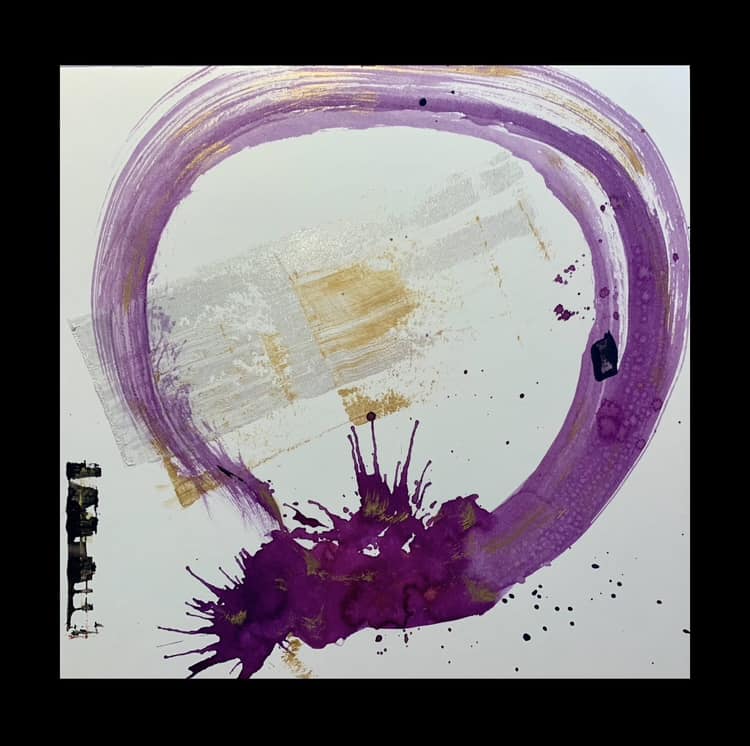
The Japanese Enzo displays this element of naturalness and spontaneity. Which is wild and irrational in its appearance of not-caring. And… free. Like all good calligraphy, you would never “go back over it.” Because perfection has nothing to do with it. Because perfection is in the head! The question is rather, is it “felt?” Not, “did you think it through?” Were you inspired at that moment? Was it free? Was it confident (and thus, bold)? Was it authentic? 

Like me, at that concert… when we act naturally, out of beginner’s mind, there is no limiting or constraining sense of “should be”… there’s no sense of embarrassment. There’s no sense of “not good enough.” 

For a plant or a stone to be natural is no problem. But for us there is some problem, indeed a big problem… The true practice of zazen is to sit as if drinking water when you are thirsty. Then you have naturalness. ~Zen Mind, Beginner’s Mind (Shunryo Suzuki)

In this way, art conveys what we wish we could be in “real life.” We long for that spirit of abandon. It’s why we love road trips; it’s why we love falling in love (“we are not in our right mind”… it’s been called a kind of temporary insanity, but we love it). That’s why we miss being children.