Author Archives: Donna Quesada Schollhammer

An Insightful & Honest 10-Day Meditation Journal

One of my students turned in a 10-day journal, chronicling her first sustained attempt at meditation. It was one of their options for a 50-point feature project. This particular journal was penned by a Japanese girl of about 18 years old. She presents such an amusing, accurate and insightful account—with all her struggles and modest rewards delightfully narrated—that I am reproducing it here without edit, as some of the awkwardly translated phrases only add to its overall charm.

First Day.
Sitting still for ten minutes was the toughest thing in meditation. After five minutes, my legs started to feel numb and my concentration faded away. Breathing is what humans do without even realizing, but I could not breathe well when I tried to focus on my breathing. Moreover, I felt difficulty to even hear the sound of my breath. Another thing I realized was that something that never bothers me could really bother me during the meditation. Sounds of people talking, noise of my neighbors, things in nature really tick me off during the meditation. The more I tried to focus, the more I became distracted. During the ten minutes of meditation, my hatred towards meditation grew and I even started to blame the existence of meditation itself. After the meditation, it made me realize how immature I am.

Second Day.
As I expected, today’s meditation was as tough as yesterday’s. During the meditation, I was wondering how I can improve my concentration during the meditation. I know that meditation helps to purify my foul mind, but only disturbing thoughts came up during the meditation. I just remembered what professor said, that people are rushing and rushing. I think this is a necessary practice in the life. To shorten the time makes more time that I can do other things. Therefore meditation gives me more relax and steady.

Third Day.
Still meditation is not enjoyable for me but I believed that I could find something through it. Today I meditated while listening to music from Youtube for meditation. I could relax and hold steady mind. I used to understand what meditation is, but it was so irritating to my existence on the first day. I read the text book to feel Buddha’s spirit more deeply. It said bodies and minds are strongly related. I feel like I understand the meaning of this. For example, we say “pain is from the mind,” in Japan. For example, if someone trod on my foot and the person was who I like, probably I would not mind and the pain would go away soon, but in the case of someone who I hate, I would feel pain longer than in the previous case and with hatred. Moreover, I might give the same back to the person. I felt that I have to practice meditation in order to control my devil spirit.

Fourth Day.
I don’t feel pain with sitting anymore, although sometimes I started thinking and can not focus on being empty and my mind moves around. 10 minutes passes more quickly than before. It may just be my imagination, but I feel I’m able to be kinder to others than I was. Because I can rethink how I am after meditation.

Fifth Day.
On the fifth day, my attitude towards meditation finally became positive from negative. I was willing to start to meditate to find out what kind of outcome I will be getting out of this session. Once I started to meditate, I realized how clear my mind was. To be honest, I was not thinking about anything during the meditation. I was not enjoying the moment nor hating the moment. I was neutral. When I opened up my eyes and checked how long I had been meditating, I found out that I was meditating for 20 minutes without any thoughts. My mind was so clear that I felt like my brains were washed out. My breathing was so natural and smooth that I could not even tell if I was really breathing. I was so happy with the effects of meditation that I finally started to look forward to the next mediation session.

Sixth Day.
I had a bad day at school and I felt like I didn’t want to do anything. I was chilling on the bed all day after school because fortunately I didn’t have any homework for tomorrow. Still, since I continue to meditate, I did so before I go to sleep. Then I came to realize that meditation gives me opportunities to face myself when I become deflated or have an anxiety. At times like that, I tend to escape from the matter and try to get them away from my mind; though I have learned the importance of facing my problems, not turning away from them. My feeling has become great, even though I was depressed before meditation.

Seventh Day.
Period of wax and wane of the moon.
Cycle of period.
Period of revolution of the moon.
Period of rotation of the sun.
28 days.
28th is cycle of the time of the universe. After I meditated, I was just muddling about the universe, and I came up with these. If we live the life according to the rhythm of nature, physical and mental would be healthy more and more. Live along with universal providence. It is beautiful.

Eighth Day.
I did meditate on the eighth day. I felt great and refreshed. By listening to the sound and wind of nature, I realized I was part of the universe. Human beings are not the center of the universe. If everyone can realize that, confusion and worry would be diminished in the world because all human beings are connected by a big bond.

Ninth Day.
I assumed happiness was always felt when we achieve some difficult goal, though actually, it was not. Truthfully, happiness is always nearby; in addition, it costs nothing and is fuss-free. I was meditating for 30 minutes today. Meditation makes me comfortable, and I can see myself from the third person. If I can keep this sense, I would be able to act with making transgressions because I believe people make transgressions only when they can not see themselves. There is really a lot to learn about meditation.

Tenth Day.
Today is the final day for meditating for this assignment. Before I started the final session, I was thinking how far I’d come already. I could not even stand the idea of meditation on the first day, but I was already addicted to the idea of meditation on the tenth day. I was surprised at how clear my mind was before the last session started and how good I felt about my achievement. Finally, I started my last meditation. Everything was going well until I realized the strange noise my neighbor was making. At first, I tried to shut it off and concentrate again. Funny, I could not. After I failed to concentrate, I started to get mad at the noise because it is ruining my precious last meditation session. I was surprised at the fact that I got ticked off so easy again, just like the first day. I was satisfied with my mental growth just before this session started, but here I am acting like myself as I was on the first day. After I finished meditating, I was embarrassed and decided to be more humble. Another lesson taught by meditating. I have to be humble. A lesson is something we are taught by others. It is amazing how meditation can create a lesson out of myself. The lesson is coming from the deep part of my mind. I really think that is beautiful. I am fascinated with meditation now and I will practice meditation more and more in my life.

Teaching Kundalini Yoga

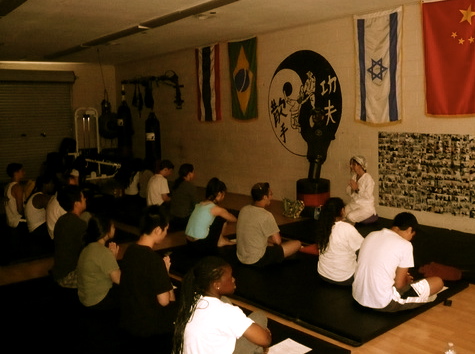
I have been grading papers this week. Earlier I came upon a passage written by a student who has also taken my Yoga class. My heart swelled with gladness as I read the description of this girl’s first experience in a Kundalini Yoga class. It touched my heart to know that the class had so touched hers. Here is a portion of the endearing note:

On July 8th, I attended Professor Quesada’s Yoga class at Machatz Self Defense Studio. I am not a morning person, especially when it is not a school day. Thus, I entered the studio rather grumpy. However, the lights were out, so that was a plus. I sat on the mat and we were told to sit with our legs crossed, a diamond-like pose. The tuning-in mantra was “Ong Namo Guru Dev Namo,” meaning, I call on divine consciousness. It calmed me down…We began some deep breathing and gradually sped up the pace…we flexed our bodies…I couldn’t have begun my day better…Professor Quesada had us lie on our backs while she played the gong. This was my first time having this experience. It felt as if my heart was beating along with the sound. As I closed my eyes I felt as if I was in a whole different world, a world of emptiness, a world free of strain and frustration. To conclude the Yoga, we all began to sing Long Time Sun, which I found on Youtube that night and played on my laptop. It just puts a smile on my face, and the fact that we all sang along made it so much more beautiful…

At the Hazy Moon

There is a short excerpt from my book and an interview with me here, at the Hazy Moon Zen Center.

This old three-story, Victorian house is where I practice Zen-style meditation with my Sangha, or Zen Community, and where I meet with my teacher, at various steps along my journey back home.

“Zen Buddhism is a 2,500-year-old oral teaching carried forward one-to-one from teacher to student. It is rare to encounter a real Zen teacher. William Nyogen Yeo—our teacher, or Roshi—spent nearly three decades studying with the late Taizan Maezumi Roshi, who was widely regarded as the foremost Zen master of the twentieth century. Nyogen Roshi was the last of only a dozen disciples authorized by Maezumi Roshi to succeed him as a teacher.” (Hazy Moon)

I am fortunate to have found my way to Nyogen Yeo Roshi and to the Hazy Moon Zen Temple, where we practice meditation as a community.

Independence or Interdependence?

I am wearing beautiful cotton clothing stitched by sun-beaten hands in a faraway place where the Buddha was born. The dyes used to color them come from ground up plants and a broth of chemicals. The bright blue bag sitting next to me that holds my books comes from Germany and is made from old truck tarpaulins. As I write, I am sitting in an elevated wooden chair in my favorite coffee shop, with a steaming cup of tea within reach of one hand. The tea leaves are left to dry under a distant sun. Millions of trees are ground into pulp to make the disposable cup I drink from. Gigantic steel ships traverse the seas, every day of every year, to deliver these goods, leaving hundreds of miles of smoky, black trails in their wake. After crossing the invisible line of arbitrary borders, they are waved in to dock by the welcoming flag of good relations.

Is patriotism a symbol of a false sense of division? Does it reflect what we might think of as communal ego, that serves only to separate—as if we could? Do we find solace in it and a sense of belonging, security and community? Or is it through political obedience? Are either valid?

Imagine there’s no countries 
It isn’t hard to do 
Nothing to kill or die for 
And no religion too 
Imagine all the people 
Living life in peace 

You may say that I’m a dreamer 
But I’m not the only one 
I hope someday you’ll join us 
And the world will be as one …

~ John Lennon

The Mystery Realm

The philosophy of art was always one of my favorite classes, as a grad student. One evening, my favorite instructor was talking about the sublime—that quality of utter resplendence that so wholly defeats our capacity to contain it, describe it and formulate it in any way, that we find ourselves awestruck. It is a quality that supersedes language entirely.

In art, it is not found by examining the techniques of the artist. Vivaldi can give away his method and his tricks, but still no one will compose like Vivaldi. Renoir can explain his brushstrokes and color mixtures and still, all we’ve got is a good copy, which only makes good foodstuff for the philosophers, who can argue about whether a good copy is really art or not.

The understanding and the employment of technique can only, ever, take us so far. I was thinking about these things one night when I caught an interview with Jason Alexander, of Seinfeld fame. To the question of whether “technique can make you a good actor,” his reply was to the point: “No, it’ll make you a good technician.” It’ll make you a better actor, to be sure, but there’s a sort of magic to good art. There’s an indefinable something about the truly good artist.

Like the sublime, itself, there’s something you can’t explain about it. It’s the “it” factor. There’s a distinctiveness about the great artist that lies outside the qualities that we can enumerate.

Every instance of it is unique, like the finger print, every one of which looks the same to an untrained eye. But of all the billions of people that have ever existed and that will ever exist, there will never be two identical prints. Or the voice—each of which has its own resonance and tone.

Maybe that’s the key for the philosophers, as to the mystery of the good copy and the problem of calling it art. There is always the suspicion that something is missing. And I would suggest that it’s because the missing component is intangible—it too, is beyond the paint mixtures and brush strokes and techniques. It is creation itself. It is the idea behind it, it is the inspiration to do it and finally, it is the act of unfolding it into reality.

You are the universe unfolding, Zen says.

The artist unfolds a new reality by expressing the world in her mind’s eye, transcending all the while, her own experience, by revealing the one we share. She affords us a glimpse of our collective experience—she catches the ephemeral, like a dancing butterfly, and puts it to form as a subject for our gazing eye. She is a story teller. And it doesn’t much matter if it’s true, for our remembrance of anything is but a construction, subject entirely, to what we were able to apprehend and comprehend, at the time, to our maturity level, to our attention span and to our mood at the time. And as the future has not yet happened, what we take as true is always a creation in some sense.

It is the ineffable creative element that stops us short. It is the sublime. It is the realm of mystery.

Are Zen and Kundalini Yoga Compatible?


I shared some of my favorite Kundalini mantra music with a Buddhist friend the other day. He loved it, but then gingerly asked whether I “consider it to be compatible with Buddhism.” He asked about the music, but he was really asking about the paths, in general. “Maybe I should just forget about all that and just enjoy it for what it is,” he then mused. And did I have any thoughts?

Of course, I did! And he already knew the answer—”you said it,” I told him. “You should absolutely enjoy it because only the dualistic mind sees a difference. “All paths are one and truth is truth.”

I have another Buddhist friend—a musician—who grew up with gospel. To my best knowledge, he would never consider shunning this inspirational music that he loves so much, just because it’s Christian. What an idea! So, why wouldn’t it be fine to listen to Kundalini mantra music, as a Buddhist?

One thing is certain; gospel is Americana. It’s part of our cultural heritage and we look upon it with nostalgia. On a wider note, Buddhists, like any one else, listen to a variety of music, much of which has no spiritual association at all. So, I would propose that if music with no spiritual connotation is fine, that music with some spiritual connotation would be even better—even when that tradition differs from one’s own—because uplifting vibes are, well…nice.

The question of compatibility between two spiritual traditions smacks of the guilt many people still carry around from their childhoods, when their intimidating family religions forbade even a cursory glance at some other religion’s holy book.

But, both Buddhism and the Yogas are “inclusive,” rather than “exclusive,” which means one may practice alongside any other religious practice without conflict. And many do. Consider the many Buddhist meditation teachers who still consider themselves Jews (there is even a name for them: “Jubus”)—Joseph Goldstein, Jack Kornfield and Sharon Salzberg are but a few. And everyone knows about Leonard Cohen, Steven Seagal, Robert Downy Jr., Richard Gere and Goldie Hawn. And with regard to Yoga, a better question would be: Who hasn’t tried at least some form of it?

Buddhism, and Zen in particular, is not predicated on any beliefs and if there’s no belief, there’s nothing to contradict. Thus, Zen complements any practice, spiritual or otherwise, like basketball—which is why Phil Jackson used Zen-style meditation as part of his training methods with The Lakers. Zen is, in the most basic sense, just meditation. It is the practice of waking up to the present moment; it is to “eat when we’re hungry and sleep when we’re tired.” So, it’s not surprising that training in such a discipline would improve performance in anything.

Perhaps my friend’s concern had more to do with the power of Kundalini mantra music. Known as Naad Yoga, it is spiritually potent. It is held that the human body is designed for transformation through its proper practice, but even if you don’t happen to believe that, it certainly won’t hurt you if you go ahead and chant anyway! (And less so, if you’re just listening.) It is understood, in all forms of Yoga, that we have a central energy channel, known as the sushmuna, by which prana flows. This energy is our life force, it is consciousness itself, and to awaken its flow is to awaken to our own infinite potential as humans. In Kundalini parlance, it is to awaken to the divine within. At the heart of this practice is mantra meditation, in which we vibrate that central channel as well as every cell in our body, as long as we are chanting from the heart and with the belly. It is understood that everything is vibration—even our state of mind, so we can either choose sounds that elevate, or not. Naad Yoga is the technology of doing just that.

And so, if it’s potent: all the better! 

Even though Zen is not oriented around vibrational technology, it does have another point in common with Kundalini Yoga Practice: mindful meditation. One of my teachers, Guru Singh, talks endlessly about the importance of staying in the “what is,” rather than in the “should be,” which is his way of reminding us to keep our heads out of the “picking and choosing mind.”

Sounds a lot like Zen talk to me!

Our outlook toward spiritual practice doesn’t have to be polemic. It’s not Zen versus Kundalini Yoga, any more than it’s Zen versus Judaism; they’re only separate in the divisive mind! One of the things I always liked about the Zendo was that there were Christians practicing next to Jews—at this level, none of that matters anymore. While one path is not necessarily better than another, one may be more appropriate for an individual, at a certain time, than another—that’s the idea behind the various Yogas, or spiritual paths, in India. The great sages recognized that no one path is “one size fits all.” We each have different temperaments and innumerable karmic circumstances that make up our lives. And it’s all in flux. Funny enough, if we weren’t allowed to grow and evolve, there’d be no Buddhism at all! Buddha himself, born a Hindu, wouldn’t be pigeonholed. He embraced his truth, and left the rest behind, settling himself somewhere in the middle of it all.

If acclimation and adaptation are necessary for a religion’s survival as a whole, how much more so for an individual in his own evolving, personal practice? Sometimes that means strands of different traditions get intermingled, the way Taoism and Buddhism did, in the hearts of the mystics in old China, creating the birth of Ch’an (Zen).

In this light, the whole idea of a “forever home” is questionable. But even so, only the seeker gets to choose. And with the right to proceed along the sequence that is right for her. The well-known American spiritual teachers, Ram Dass and Bhagavan Dass, both traveled along paths that were ever-expanding, each having received initiation from Buddhist and Yogic teachers—and the former started off Jewish. In Zen, as well, it’s not uncommon to venture into different forms of meditation, as found in the various schools of Zen, as well as in other Buddhist traditions, such as vipassana.

As a fun and hopefully useful analogy, look upon Zen as a wonderful broth—the foundation of every soup that ever was. Like broth, Zen is simple (which doesn’t mean easy) and unembellished. But, when you add potatoes, celery, spices and salt, you’ve got something different. Some will dig it, some won’t. To play with analogies further, Zen may be seen as an essential strand in the fabric of a rich spiritual life, as a concomitant part of a whole. And further still, think of it as a no-frills wooden boat, which, like any other boat, will carry you just fine to the other shore. Some boats are fancy, some are not, some go fast, some don’t and some rock more than others. How wonderful the differences are!

Through these analogies and commentary on my friend’s innocent question, I hope to have shown the beauty of each tradition, but most of all, that there’s no conflict between them—or with any other path.

On the Notion of a Perfect Teacher

   I watched a documentary about the American spiritual teacher, Ram Dass. His Be Here Now, has long been one of the staples on my book shelf. Now 80 years old, he talks candidly about the struggles he’s faced after his stroke. He confessed the moment when, on the verge of death, he failed to orient himself toward God. That’s the ultimate test, he explained, and according to him, he flunked it. “I still have a lot of work to do,” he says.

His honesty touched me. It is often assumed that those on a spiritual path don’t slip and fall. But as my Zen teacher has said, it’s not whether you fall or not, it’s how quickly you can get back up. In Yoga, we look at growth as it manifests in degrees and stages, the real measurement of which is entirely internal, and rarely consistent. Progress in anything, including life itself, is never a straight line. But what we do have, as seekers, is an ever keener insight into the difference between what our minds have concocted and reality itself; the tools needed to snap out of our delusion; a willingness to laugh about our own folly, and with time, perhaps, the courage to make things right.

As teachers, we can be hard on ourselves when we do find ourselves splashing around in the dark waters of old habits. At our final Yoga teacher-training weekend, Joey told us he had had an altercation with someone just before arriving. I was listening. I had just exchanged words with a demanding student.

We had both been rocked off center and we shared our feelings with the group. We were disappointed in ourselves. We were about to graduate as teachers of Kundalini Yoga. We both share a feeling of responsibility for maintaining the dignity and excellence of this tradition and part of how we do that is through our own conduct.

What happens, Joey asked, when this sort of thing happens and we’ve got to teach a class? Do you cancel? Of course not—what an idea! You go and you teach, our teacher said. And in this tradition, what that means, is that first, we “tune in.” You never know who will be there and what they will take away from the class. There might be someone in your class that day who will decide to become a teacher herself, or who will be so moved as to make some positive life-change. And chances are, you too, will forget all about whatever it was you left outside the door before you took your place on the teacher’s bench. And you did leave it outside the door!

Tuning in means going beyond ourselves to align with the greater wisdom we deliver as teachers. In this way, the teacher is more like a messenger than an originator. The teachings come through us, rather than from us, and have nothing to do with our individual personality or quirks. They go beyond the words that are spoken and are communicated subtly through our own presence.

The conventional, or western, or academic, notion of a teacher is of one that dispenses information and data. From our perspective as Yoga teachers, this reduces teaching to nothing more than a “professional trade.” As our own founding teacher, Yogi Bhajan, quipped, if we look upon teaching in such a shallow way, as merely a profession, “we will train many preachers, but no teachers.”

Our focus should be on getting out of our own way and on uplifting and guiding others, rather than on our own success or failure. Our obsession on perfection is just another ego trip. And that doesn’t mean we stop striving toward excellence—our very ability to develop excellence is directly proportional to our ability to stop striving. At least where that striving is tied up with our ideas and notions of who we should be. We had better simply let go of ourselves.

When we begin to do this, we begin to manifest a certain grace when we teach. Ironically, the very shift in the way we understand our duty as teachers, from one in which we recite information, to one in which we serve, is the first step toward inner transformation. But it takes faith and trust to relax into this role as a conduit of truth. To be entrusted with the task of serving, of being a source of light, makes it, most surely, a noble profession. As such, “to be a teacher is the ultimate human end,” Yogi Bhajan concludes.

Anyone who teaches to be a teacher rather than to serve, will fall. ~Yogi Bhajan

An Interview!

Interview with Donna Quesada
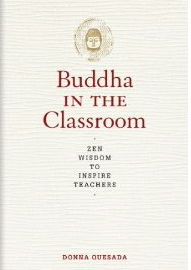
Author of Buddha in the Classroom; Zen Wisdom to Inspire Teachers

AJ: So take us through the process of this book. When did you first conceptualize the whole idea and how did it flow from there?

DQ: It was the fall semester of 2008. My spirit was declining and I was dragging myself to class each day. I started envisioning a series of vignettes in which I would consider burnout from the point of view of Zen. Little did I know, the coming semester would be the worst yet! It was almost serendipitous, though, because I had just bought a voice recorder, so I started recording myself on the way back to my car each day after class, and the stories just kept coming. Through them, my vision started to transform and as my vision transformed, so did my frustrations. In this book I share what turned out to be a collection of entertaining anecdotes—of the “clicky” girls that never stop talking, the angry guy, the iPod guy, etc., all of which are followed by the treasured eastern wisdom that inspired and lifted me out of my burnout.

AJ: It seems to me that you use the stories as a vehicle through which to intimate these zen lessons. Was that how you saw the book coming together?

DQ: Exactly! I don’t think I could have written it any other way because my spiritual practice is such a huge part of who I am and how I look at problems. Even the very notion of a “problem” makes me think of a famous quote by a Zen master: “Of course I have troubles—it’s just no problem!”

AJ: Can you go into a bit of detail about your background as a Zen Buddhist?

DQ: It was an instant love-affair. It started when I spied the cover of an Alan Watts book, sitting on a friend’s kitchen counter. It was The Wisdom of Insecurity, which at that time, had a groovy green and purple cover which caught my eye, while the title captured my imagination. I was intrigued by its ironic and surprising promise. I started temple-hopping and then got lucky enough to land myself in the classroom of a Japanese professor who taught zazen. The nine of us in the class actually got credit for staring at the wall for nearly an hour each day. But then again, it’s more challenging than the typical academic work my friends were doing in other classes. Years later, I would find my way to The Hazy Moon and to the last disciple of Taizan Maezumi Roshi, in a charming little zendo in Los Angeles, where I finally took my Zen vows. My Yoga practice was deepening alongside my Zen practice all the while—the two are an interwoven and integral part of my life today.

AJ: I was particularly struck with the non-religious feel of the book. It felt more like you and I were having a conversation over coffee, sharing fun stories here and there. Can you speak to that feel of the book for a bit?

DQ: I’m happy it feels that way to the reader! And I’m glad you mentioned the non-religious feel. It’s as I say in the preface, the wisdom is for everyone! Zen expects nothing and insists on no beliefs at all, so it doesn’t matter what the reader’s religious background (or lack thereof) is. That’s one of the interesting things about Zen temples—you walk in and find Christians practicing next to Jews! What Zen asks of you is that you be present for your life, and any discipline that helps us do that is doing us a great service.

AJ: Did you have a particular reader in mind as you were writing the book?

DQ: It’s funny. Everyone, but me, seemed to peg this book right away, as a book for teachers. But, I never thought of myself as someone who had a right to write a book for teachers. I never thought of myself—and still don’t—as an education expert. I only wanted to share these special, golden-nuggets of Zen and Yogic wisdom, alongside entertaining stories. I thought Zen enthusiasts would appreciate the elements that have only been heard in Dharma talks. But it is being marketed as a gift for teachers, and I now see that it can be of great service to teachers that are feeling the same way I felt. My hope now is that it inspires many!

AJ: What would you say is the “take home message” of your book?

DQ: To remember that we’re here to uplift others and that goes beyond the words and the whiteboard and even the grades. And we do that by shifting our perspective and by doing the opposite of what we’ve always been told to do in the west—by getting out of our heads and out of our own way! Our presence itself is a great teacher.

Interview with Amy Jacobowitz
freelance marketing
www.amyrose.us.

Excerpt from Buddha in the Classroom (Our Fixation on Passion)

Excerpt from Chapter 19—Passion; Accept, Adapt, and Abandon Hope

The real problem with our fixation on passion is the near certainty that even a blazing fire will dim with time.

Then what?

Even when passion is pursued and found, the affair won’t last forever. Passion changes. We change. A dancer friend recently shared with me the common experience among the cast members of a famous musical. Far from reveling in prideful accomplishment for having been part of one of the longest-running shows, they’re sick and tired physically, and mentally jaded. Many are dancing on old injuries, and are scarcely able to find the motivation to go onstage night after night; yet somehow they manage to put themselves into their postures and glissade, on tiptoe, onto the stage, one more time, because it’s how they make their living. It is the same motivation that gets most of the world to work every day.

It reminds me of the ancient Greek myth about Sisyphus: He is condemned by the gods to push a gigantic boulder up a hill, over and over, all day long, even as it continuously rolls to the bottom of its own weight as soon as he gets it to the top. The gods understood the futility of wasted labor, so assigning it was the perfect, wicked punishment. In retelling the story, the French philosopher Albert Camus likens the absurdity of the task to the everyday predicament of every single one of us, pushing our rocks in our own way, as we struggle to meet deadlines, deal with coworkers and bosses, and solve the problems that are part and parcel of any workday, anywhere.

But Camus was an optimist.

Despite his fate, it is Sisyphus himself who decides to be happy. He can whistle and hum happy songs while he pushes his rock, or he can lament and endlessly curse his fate. The irony is that as soon as he realizes the power inherent in his own reaction, he is liberated. He makes his fate his own. It is he alone who decides to be happy or miserable. In a nod to our own capacity for liberation, Camus says, “We must imagine Sisyphus smiling.”

Dharma: The Lesson for Teachers

Sisyphus’s existentialist smile resonates with the Buddhist reminder to let go. Sisyphus smiles because he accepts his fate. To let go is to accept. And through acceptance, Sisyphus liberates himself from his sentence. To accept is to simultaneously stop resisting. When you stop resisting, you are able to enjoy your experiences, which is to say, your life.

Accept, adapt, and abandon hope, Zen says…

Mindfulness vs Distraction

Mindfulness vs Distraction

Seventh on Buddha’s eightfold path, Zen buzzword, and greatest hit of Buddhism in general, is mindfulness–which is simply the practice of being here. It at least sounds simple, and it is, but simple is not always easy. Which is why it takes practice. With slightly more elaboration, it is the deliberate, but nonjudgmental, attention we place on the present moment.

A student asked me one day about it, and why it was preferable to distraction, especially in the face of something unpleasant. For example, if you have a headache, what’s wrong with watching TV just to zone out? In brief, distraction immediately separates us from the situation, which might sound desirable, but the problem is, the discomfort remains, and worse, we rob ourselves of the opportunity to surrender, and worse still, of the opportunity to recondition ourselves out of old patterns. And as life is full of discomfort, we’ll simply continue to suffer as a result, as we try in vain to run, time after time, and find, time after time, that wherever we go, there we are.

The question is a bit like the one I was considering the other day.

Presence vs The Big Picture

During the first few days following my book’s release, I found myself checking sales statistics obsessively, looking for sales info and any other sign of excitement that would signify, what was to me, an important event. But, this kind of narrow focus only sets us up for disappointment. I reminded myself how fortunate I was just to be published and how wonderful it is that my book is finally available. Moreover, I reminded myself of the real purpose, which is to inspire other teachers. I marveled at how strange it is that being published—every author’s dream—suddenly wasn’t enough. We are funny creatures that way, endlessly grasping for the next thing while missing everything. This reminder to myself, of what is essentially at the heart of Buddha’s Noble Truths, engendered a swelling of gratitude that left no more room for frustrations.

Funny enough, the very next day, one of my Yoga masters told a story about pain. He described a midwife he knew, who had the habit of telling her screaming clients, while in the grips of agony, to remember that they are having a baby! It might sound like a silly reminder of the obvious, but it indicates importance of putting the pain into perspective.

But, isn’t this a departure from presence? You might ask. After all, the pain is as present as it gets!

But in neither case—my obsessive checking nor the laboring woman—does the reminder to see the big picture negate the importance, or, if I may, the presence of presence. It’s not obvious at first, but the fact is that seeing bigger means seeing more, and seeing more means nothing other than more presence!

You’re looking at everything, you’re in tune with all that is, rather than merely your own hang-up. And by getting in tune, you’re dropping your resistance to the current situation, and since resistance is what magnifies all discomfort and suffering, by dropping the resistance, you’re lessening, at once, your suffering.

As the Taoists would say, don’t push the river.

By coming back into reality, as it is, you’re losing the AVERSION to the discomfort, you’re with what is, rather than fighting what is…and you’re in peace.