Author Archives: Donna Quesada Schollhammer

The Importance of Self Love

self-love-KundaliniI decided to repost this short article about Self-Love. I added the third notation, as well as the meditation, that follows. It is a meditation that I just did recently, at a training retreat. I loved doing it—I hope you try it and that you love it, too! The way I see it, the words are for our understanding (for our head) and the meditation is for our realization of Self-Love (for our heart).

For the Head…
We are so often told, in spiritual teachings, as well as in self-help manuals, that in order to love others, we have to love ourselves first.

Is this true?

It is!

Why?

Firstly, because if we are angry and hateful on the inside, we have only those emotions to project. Your body and mind respond to those feelings, consciously and unconsciously, and this negative reverb squeezes the joy out of life. What can you bring the world if there is no joy behind what you are doing?

Secondly, because if we’re angry and hateful on the inside, the object of those emotions is automatically set upon ourselves and this sets in motion, a mechanism of victimization. By directing negative energy onto ourselves, we make ourselves the object of our own discontent. Then, our mind gets to work to find a source of blame in opposition to that object. Simply put, when we make ourselves into victims, the rational mind, in its inherent dualistic structure, will then seek a culprit.

Unable to find one, everyone becomes an offender and those negative emotions are then displaced outward unto the whole world—we become angry at the world.

Thirdly, when we do not find within ourselves, a cozy sanctuary to come home to, we tend to relate to others from a place of neediness—a need for approval, validation and affirmation of self-worth. But, when we begin to nurture a connection to our own divinity, we begin to heal within. This kind of love has nothing to with egoism—it is where compassion begins. We forgive our faults and accept ourselves as whole and complete, as we are, before we can do the same for others. In this wholeness, we feel centered, empowered and no longer need to place blame on others or look to external sources for fulfillment. And when we take our power back, in this way, we begin to truly heal.

We feel love, which when real, needs no object at all—it’s a projection and an opening of the heart space.

For the Heart…
Meditation: Affirmation For Self-Love

Posture: Sit straight in a cross-legged position.

Mudra/Movement: Place your right hand on your heart and say, “My heart, I love you.” Place your right hand on the eyes and say, “My eyes, I love you.” Move to the top of your head and say, “My head, I love you.” At the navel point say, “I love you.” And placing your hands on both your knees say, “I love you.”

*Find your rhythm and continue on, for at least three minutes.

Reconciling Free Will with Destiny (and how about fate?)

free-willIt’s hard to imagine Pavarotti or Maria Callas not ending up as singers. It’s as if they came to uplift, inspire, heal and delight the world with their voices. Each soul is incarnated to fulfill its destiny, according to Yogic philosophy, and when we awaken to that purpose, we are living according to our destiny.

A poetic expression of this idea is found in this passage:

Your mission is to vibrate higher in your vessel so you awaken completely to your sacred purpose. ~Dror B. Ashuah

This awakening is the key to our sense of fulfillment. But it is a huge challenge in a society, which would tempt us, left and right, to seek fulfillment from external sources and all things pinned to appearance—from the allure of a sexy body to the amusement of a new gadget, to the promises of the perfect dream vacation. Profit is made by keeping us trapped in a cycle of codependency and separateness. The tragedy is that we are kept from our own inner power. The result is a never-ending cycle of unrecognized addictions of every sort, in which, fueled by a vague neediness, we go on supporting this infrastructure—a mega-system that thrives on our insecurities.

How can we wake up from this codependency and align ourselves with our destiny? This wisdom, this sense of knowing is already within. It is the little spark of light that shines forth from within. But because the fog of our emotions and obsessions is so thick, we often miss it. But when we pause for a moment to let the fog settle, we find it. And we delight in its warmth. And sometimes we summon the courage to trust that light and let it guide us along our path.

Where does free will fit into this?

The minute we come to center, we find ourselves nourished. Like drinking from the nectar of our own internal fountain of bliss, we feel full. Those things on the outside seem to lose their appeal. We realize that what we tend to call free will, is but a confused mix of desires shaped by others and meant to mask insecurities. We have taken the reins of our life. But this requires the choice to wake up from those things that have held us hostage for too long—the things on the inside, like unhealthy emotions and insecurities, as well as the things that keep us wobbling around on the outside. As soon as we stop believing that there’s a quick fix “out there” in the world of pills and thrills, we begin to take steps on our true path. And we begin to resist those things that take us off our path. This is the beginning of waking up.

So, what is fate?

Fate, according to Yogic wisdom, is the black hole of other people’s opinions and ideas. It is the nowhere land, in which we get lost in the web of expectations and pressures set by others, be it society, parents, or personal delusion. These pressures drown out the voice of the spirit and over-ride our own sense of self-authority and purpose.

Every time we come to center, we have made a choice. We have honored our commitment to align with our sense of purpose. This is free will.

Walking our path, guided by our ever-brightening inner light, we encounter our karma (which doesn’t mean punishment). Think of karma as the residue of our actions, either in the here and now or in the here to fore. It is everything we have inherited, assumed, absorbed and adopted—from our DNA, to our zodiac sign, to our first kiss, to our first break up. It’s the record of all the patterns and habits that are embedded in our mental, physical and psychological selves, right down to our very cells. Why bother about it? Because that which would transform has first to be exposed.

And this process of transformation is strengthened by our moment-to-moment commitment and through the tools of practice—which we may call “spiritual,” since the desire to come back to center and to wholeness is a spiritual one. These tools include, but are not limited to, the uplifting presence of community, meditation, movement, and especially, intention.

Waxing philosophical.

Am I, as the western philosophers would say, pre-supposing the existence of free will? To that, I extend a brief summary of Sartre’s position, that as conscious beings, we are innately free. Where I differ (and where I differ from my earlier position, as expressed in my book, Buddha in the Classroom), is on how this relates to destiny. Diehard existentialists, like Sartre, reject any suggestion of a deterministic universe, one which would open up a world of easy excuses that render us helpless, like puppets on the strings of our inherited tendencies. Typical of the western tendency to polarize beyond repair (and even more typical of an existentialist like Sartre, who was allergic to any species of God-talk), destiny and free will are seen as irreconcilable.

But, what if we instead, look upon destiny as a flexible journey, in which my will and God’s will (or universal will…or divine will) are one and in sync?

To be clear, free will, as it is typically defined, is the ability to choose from among genuine alternatives. In the world of eastern mysticism, we go further here, too; while existential freedom describes our conscious choosing, the Yogis were more interested in our state of consciousness, itself.

The difference is subtle but immense, since it is our state of consciousness that structures what we see as choices, in the first place. What most people think of as freely choosing is nothing more than habit patterns and uncontrollable desires for things that aren’t necessarily good for us. The more conscious we are, the more inclined we will be to investigate those ingrained tendencies (what the Yogis call samskaras), and the more adept we will be to change what we can and reconcile ourselves lovingly with those we can’t. This happens through those Yogic tools and through all meditative practices, which temper our reactive mind while taming the twin dragons; fear and anger.

Ultimately, the more conscious we are, the more freedom we have.

The Power of Positive Thoughts

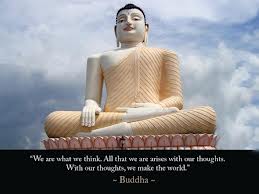
Buddha ThoughtsIn the Dhammapada, Buddha speaks of the power of thoughts when he says, “all that we are is the result of what we have thought.” Yet, Zen master Suzuki seems to dismiss that power, when he likens those same thoughts to passing waves, urging us to learn to let them go, for, they are not who we are.

It seems contradictory. But we can look upon this delightful little enigma as an invitation to reconcile both aspects of the polarity. It’s kind of like light…now it’s a particle, now it’s a wave.

Where thoughts are concerned, the catch is that they can and do pass…when we let them. As weary travelers pass continuously through the revolving doors of the grand hotel, so our thoughts go flooding through our minds. As Yogi Bhajan says, thoughts erupt at the astounding rate of 1000 per blink of the eye. At this rate, it’s hard to imagine we could catch any of them, but this is exactly where it gets tricky.

The problem happens when we get stuck on a thought. Like gum stuck to our shoe, we then begin to wear it, exude it, transmit it. And then, it wears us.

What are we to do?

Through the simple practice of mindful meditation, we practice letting thoughts come and then letting them go. We practice non-attachment to those thoughts. Like anything worthwhile, it takes a lot of practice (which is why the monks and Yogis have traditionally retired to their caves for a life of seclusion and long hours on the cushion)…because let’s face it—most thoughts only get us into trouble!

But as we become more comfortable with this process, we learn how to work with our thoughts in more skillful ways. MRI screening now confirms what Patanjali told us 2000 years ago in the Yoga Sutras, namely, that through focus and conscious intention, we can convert pesky thoughts into more uplifting ones. Cultivate counteractive thoughts, he said.

What it all boils down to, is living a more fulfilling life because when our thoughts have got us by the nose (to use an expression my Zen teacher once used with me), we become too engrossed in our internal battles to truly enjoy life.

This is where positive affirmations come in. By learning how to actively work with our thoughts in a more purposeful way, we can affect our physical, mental and emotional well-being, as well as usher in the kinds of positive changes in our lives that may have once seemed out of reach. In other words, by learning to work with affirmations, we may even open doors to the realms of the miraculous.

Two Stories: An Opportunity for Growth Rather than Grief

forgivenessHere are two situations which I present as examples of ways we allow ourselves to be negatively affected by others. But I show that they may be seen as opportunities for liberation, rather than suffering. Although I have fictionalized them by changing the details, they both resemble recent events in my own life.

Situation #1: You work in an office. You came up with a wonderfully creative idea that you’re sure will be adopted by management. This plan is likely to win a new contract with a highly sought-after company and will also guarantee your upward mobility in the company. But, to your shock and distress, you learned that as soon as the new guy obtained one on one time with the boss, he represented your idea as his own. You feel betrayed and disappointed.

“Wisdom Balm for Situation #1:
” Convert your anger, your hatred and your betrayal into compassion. Suppose somebody betrays me. I feel that god is very kind because he has given me the energy to tolerate it, and I am not the one who betrayed.” ~Yogiji

Situation #2: You wrote a screen play over a year ago. You just got word from your agent that a well-known film producer has made an offer to buy the rights to it. You always had faith in this project and knew in your heart it was a story that needed to be told. You also know how hard it is to get this kind of recognition here in L.A., where the market is so saturated and competitive. When you sent out a celebratory e-mail to your friends and family, most everyone responded with accolades, except the people that matter most to you. You feel hurt and unacknowledged.

“Wisdom Balm for Situation #2:” Happiness is your birthright. It cannot be taken away from you.” ~Yogiji

The first situation portrays an action that is taken as a betrayal. The second is rather, the omission of an expected course of action. What these two stories have in common — for the spiritual practitioner — is the need for forgiveness, or as I like to say, “forth-giveness,” since, as implied in the word, it is through the process of forgiving that we allow ourselves to go forward.

If we permit ourselves to feel victimized us, we are giving away our power. This is especially poignant in the first situation. So, when you see the occasion as an opportunity to practice and go higher in your way of looking and ultimately, in your spiritual awareness, you unchain yourself, at once. Say, thank you for this blessed challenge. And you come away feeling lighter. And lightness is closer to the divine.

In the second situation, the wisdom quote is deceptively potent. Just as we give away our power when we allow ourselves to feel victimized, we do it still, when we wait for someone’s approval to validate our sense of worth and accomplishment.

What difference does it make who notices?

No matter who notices, there will always be plenty who don’t, so this becomes a fruitless concern. You can authorize yourself to enjoy it. Besides, it is likely that the others don’t understand. Especially in a situation like this one—a family in the midwest, for example, simply wouldn’t understand how huge it is to sell a script in Hollywood! They’re probably just waiting for you to get a real job, anyway. The point is that your celebratory moment was never about others’ recognition, at all. It’s about you serving the world in a way only you can. That takes it to a higher level.

And higher still, is to realize, in both cases, that the perceived wrong isn’t about you. It’s about them. It’s a betrayal of their own consciousness. It indicates where they are in their own evolution. They are driven by their own demons, their own fears and insecurities. Far from making us more bitter, this recognition enables us to have compassion for them, since we’ve all been there. To this end, there is a teaching in our Yoga tradition that urges us to recognize that the other person is you.

This way of seeing brings us immediately into humility, as we begin to understand that everyone is ourselves at a different stage. And when we’re humble, we stop fighting and we heal.

So, we become at once, empowered and humbled. Empowered because we let go of our own victimization while authorizing our own experience of joy. Humbled because we come to see that our mission is less about impressing the world than it is about serving it.

A Prayer Called “Krishna’s Flute” (What Is Devotion?)

Krishna and RadhaThis is a picture of a vintage print. It is from my personal collection and hangs on the wall in my meditation room. The actual size is 18″ by 18.” It depicts the Hindu God, Krishna and his beloved, Radha. He stands behind her, seducing her with the enchanting sounds of his flute. Yet she looks away. Why?

Krishna the Amorous
All the girls in Krishna’s town of Brindavan, loved Krishna. Upon catching a distant high-pitched note or two from his flute, carried by the wind, through the open windows of their homes, the cowherding girls would escape into the night to follow him. He was irresistible and delightfully mischievous. For example, he would hide the clothes that they had hanging to dry—anything to rouse them into play. They would suddenly find themselves overtaken by an unbearable need to follow him, along the river and through the forests, and where ever he may lead them. As his notes transformed into the most delicious melodies, they would lose themselves in irrepressible bliss. And they would all dance together in mutual joy and delight.

Heartbreak & Longing
Because everyone loved Krishna so much, it was unendurable to withstand his absence. And so, whenever he would leave the village for any reason, his beloveds, especially his most adored Radha, would ache from the pain of his separation.

Merging
Their sadness and despair were inconsolable until they realized that his love was within themselves, all the while. He was never separate, at all! With his song, He led their souls to Spirit. This is why Radha looks away. She is in the ecstacy and bliss of divine communion—a love so great, so pure and so all-encompassing that it is beyond the confinement of the body of her lover.

The Role of Krishna
To borrow a phrase from Paramahansa Yogananda, each spiritual path is part of an all-encompassing “divine highway,” leading to union with our true Self. Each path invites us into the stillness of the sacred space that lies within—the wordless tranquility that emerges when we quiet the noise. The challenge is always the same, no matter how we refer to it—to become empty like the hollow reed Krishna brings to his lips. To become empty of resentment and distrust. To transform ourselves into a clean and beautiful vessel fit to receive God’s light. (Would you want to live in a dirty house?)

Just as Krishna’s breath blows softly through his flute, Spirit expresses itself through our selfless surrender to the divine will. Here is a prayer I wrote, as a gift to you, that you may use to give voice to this inner longing and purpose, if you find it helpful:

Prayer: “Krishna’s Flute”
Oh, that I may become like Krishna’s flute—an instrument for the melody of divine song…Oh, that I may see through your eyes, hear through your ears and know through your heart…Oh, that I may vibrate at such a high frequency that my absorption with the infinite becomes inevitable…Oh, that I may recognize in my heart and in every cell of my being, the spark of divinity…Oh, that I may see through my temporary role in this grand play and know that I am really an eternal soul—and that I am perfect, as I am…Oh, that I may have the courage to live as a witnessing consciousness, disabused, finally, of my illusions as a do-er.

What Is the True Role and Meaning of Devotion?
It brings us into grace and ease. As my own Dear teacher explains, “when you get a sense that you have to hold everything together, you’re not living in trust.” We all feel overwhelmed at times, but we forget that struggle is the ego’s game. We feel we are more productive if we fight everything at every step. Letting it go requires trust. It doesn’t mean we stop putting in the effort, it just means we detach from the outcome. This is what it really means to live in a state of devotion. And it requires no object. It’s simply a state of being and a way of living. It is not a matter of being devoted to something any longer. It is, rather, a matter of surrendering, in humility, the false illusion of doing. It is allowing whatever needs doing, to get done.

Judge Not Lest You Be Judged (Here’s Why)

This teaching is part of the common thread that runs through all wisdom teachings. Here, I explore the reasons why.

1. Because we don’t have access to the Akashic records. The universal perspective is not always revealed or in accordance with our clock, our limited perspective or our expectations. Life and its workings are too vast.

Case Study. Consider the old story of the Taoist farmer whose horse runs away. His neighbor is quick to come and appraise the situation: “What bad luck!” he declares. The farmer just shrugs his shoulders. When the horse comes back with another horse, the neighbor comes again: “What good luck!” The farmer just shrugs. When the farmer’s son tries to saddle the newly acquired, wild horse and breaks his leg in the process, the neighbor comes again: “what bad luck.” The farmer shrugs. Finally, when the army comes, ready to haul the kid off to a bloody war, they take one look at his broken leg and decide to leave him behind. “What good luck! Your son sure picked a good time to break his leg!” the neighbor proclaims.

A broken leg is generally not seen as a “good” thing, but in this case, it saved the kid’s life.

The farmer was too wise to get involved with these assessments. He knows he doesn’t know what’s good or bad in the big picture. He is able to let it unfold and is willing to honor the process. This takes wisdom, humility and courage. Wisdom to know we don’t know. Humility to yield to the unknown and courage to be fine with it, regardless of the outcome.

It’s a willingness to live in trust, rather than in fear.

2. Because everyone has lessons to extract from each and every event that appears in their lives. And as my teacher often puts it, the messenger will keep coming back until the message has been delivered. Everyone has their karma (which doesn’t mean punishment).

3. Because, by judging, you now take the karma. (Doubly: for interfering and because you have demonstrated need for the lesson and compassion for that perspective.)

4. Because the judging is more a statement about you, than the object of your criticism. Our reality is shaped and limited by our thoughts and experiences, meaning, our perceptions provide us with a very limited viewpoint. This means, further, that it’s guaranteed we don’t have the whole story. Only at the end of time can we make over-all assessments. Who will be here? This is why the wise know better than to speak.

Those who say don’t know and those who know don’t say ~Tao Te Ching

But in the guise of “being concerned,” we speculate, condemn and as Zen author Karen Maezen Miller is wont to say, we run commentary. The base assumption is that the other—even when (especially when) the other is a family member—needs our concern. That energy could be better directed inwardly, toward our own needed improvements, for we are all a work in progress.

If you have reached a state of human perfection and have no need for continued work and improvements…Congratulations! Your work here on earth is complete.

Here is an example that both highlights the absurdity of making judgements about others and at the same time, illustrates the workings of truly turning the pointer to the inside, rather than toward others:

Case Study. Your aunt tells you your wife needs to dress differently because her way of dressing, she feels, will influence her daughter to dress in a way that solicits male attention and fosters promiscuity.

But, in your reflections, you note that when it comes to alcoholic beverages, your aunt tends to serve herself generously, sometimes to the point of excess. If we look from a wider lens, and follow her own logic to the end, we see that this, too, might be setting an undesirable example—it may foster alcoholism, or at the very least, irresponsible drinking in her children. Of course, the whole thing is absurd and endless, for, everybody has “stuff.”

I have a dear friend who now avoids a member of her own family for habitually starting sentences with “You need to…” As we become more conscious, we also become more aware of how often our words express this kind of judgmental attitude toward others.

Here’s what it boils down to:

❖ Everybody is a mixed bag, with aspects that we might label as “good” and others as “bad.” And everybody has a history, complete with skeletons and dregs of many varieties. Acceptance of people as evolving entities, like ourselves, fosters better relations.

❖ We are shaped by countless influences, from our Zodiac sign, to our favorite TV show growing up, to our first kiss, our first best friend, our first broken heart, to more obvious, genetic and social factors. Meaning, we are a confluence of infinite influence.

❖ We don’t know how others will perceive us (The young girl in my example will probably only see the good in her aunt. As in The Little Prince, only adults discriminate. Children see through, to the heart of a person.)

ACCEPTANCE; Life in the balance – accept it all. Nothing is good or bad but thinking makes it so. It is the nature of the universe to establish balance; thus, trying to prevent perceived bad will also block desired good. Instead, welcome challenge and difficulty, enjoying the indicated activity, and growing in each situation.” ~Guru Rattana

The Paramedic Has a Lifeline, Too

Every once in a while, a student sends me something that is not only heartwarming, but serves as a reminder of why I do what I do. Here is a story of a modern day medic and an ancient Yogic technique. I hope you are just as touched by my student’s story, as I was.

My Sadhana (Daily Practice)

As a young man living in the 21st century my brain is constantly being rushed with all sorts of stimuli. It is quite difficult going about my day with out being affected by social media, subliminal messages, and other avenues of gaining my attention. Due to all of this my mind is essentially never present or clear. I am always thinking about what to do next and move ahead. However, about two weeks into this class, I was introduced to a breathing technique that quickly brought me back into the present.

This technique is called alternate nostril breathing. The first time I tried this in Professor Quesada’s class, I did not fully feel the effects. My brain was not used to being in the present moment, so I started to feel a little restless. At first, I had no faith in this technique because I did not see results immediately. Again, my brain was used to getting things done fast and seeing results quickly. Later that day I went home and looked up the benefits of this ancient breathing technique; everything that was listed was what I needed.

I have had a problem with anxiety for many years. I can now say that alternate nostril breathing has significantly helped me with that.

alternate nostril breathing
About a month or so ago when I started alternate nostril breathing, I started doing it for 15 minutes every morning to get me ready for the day. Those first few days were pretty challenging – it was difficult to stay focused because after sitting for 5 minutes my mind started wandering. Eventually my brain was able to stay focused for longer periods of time. I eventually figured out that this technique could be used any time I feel stressed or anxious. I currently practice alternate nostril breathing multiple times throughout the day in addition to the 15 minutes I do every morning.

I work as an Emergency Medical Technician for a private ambulance company where I deal with life and death constantly. There is a very high level of stress everyday and I take on a huge responsibility while the patient is under my care. Prior to learning this breathing technique, I would get butterflies every time I was dispatched and they would last the whole ride to the scene. The lights and sirens just made me more tense and even though the adrenaline rush was too much at times, I thought I had no choice but to force my body adapt to the stress and disregard it.

However after becoming comfortable with alternate nostril breathing I now use it when responding to calls. My performance and mental clarity has drastically changed.

For example, a few weeks ago my partner and I responded to a call for a traffic collision. When we arrived on scene I found an 11 year old child in the back seat trapped, with no pulse and no respiration. The patient had suffered a traumatic full arrest and it was the first time I had ever witnessed this. The family was crying and pressuring me. I felt a little dizzy, and just extremely overwhelmed. As my partner pulled out the patient and started compressions I ran over to the ambulance to pick up the defibrillator. On the way to the ambulance I forced my brain to focus on my breath and I quickly slowed down my respiratory rate which almost instantly calmed me down. My whole sprint to and from the ambulance was maybe 30 seconds but in those few moments I was able to stay calm and regain my focus just from focusing on my breath. The patient came back after 2 rounds of CPR and 3 shocks.

In school I have also used alternate nostril breathing before exams. By using this technique prior to exams I feel a sense of calmness and a major reduction in angst. It has also taken away tension throughout my body. Overall it has been useful to me in my work, school, and personal life. It has also made me more aware of living in the present. Thank you so much Professor Quesada for teaching me this breathing practice.

Love Thyself First

self-love-KundaliniI decided to repost this short article about Self-Love. I added the third notation, as well as the meditation, that follows. It is a meditation that I just did recently, at a training retreat and I loved doing it—I hope you try it and that you love it, too! The way I see it, the explanation is for our understanding (for our head) and the meditation is for the realization of Self-Love (for our heart).

For the Head…
We are so often told, in spiritual teachings, as well as in self-help manuals, that in order to love others, we have to love ourselves first.

Is this true?

It is!

Why?

Firstly, because if we are angry and hateful on the inside, we have only those emotions to project.

Secondly, because if we’re angry and hateful on the inside, the object of those emotions is de facto set upon ourselves and this sets in motion, a mechanism of victimization. By directing negative energy onto ourselves, we make ourselves the object of our own discontent. Then, our mind gets to work to find a source of blame in opposition to that object. The result of this process is that we then assume ourselves to be victims and when there is a victim, the rational mind, in its inherent dualistic structure, will then seek a culprit.

Unable to find one, everyone becomes an offender and those negative emotions are then displaced outward unto the whole world—we become angry at the world.

Thirdly, when we do not find within ourselves, a cozy sanctuary to come home to, we tend to relate to others from a place of neediness—a need for approval, validation and affirmation of self-worth. But, when we begin to nurture a connection to our own divinity, we begin to heal within. This kind of love has nothing to with egoism—it is where compassion begins. We forgive our faults and accept ourselves as whole and complete, as we are, before we can do the same for others. In this wholeness, we feel centered, empowered and no longer need to place blame on others or look to external sources for fulfillment. And when we take our power back, in this way, we begin to truly heal.

For the Heart…
Meditation: Affirmation For Self-Love

Posture: Sit straight in a cross-legged position.

Mudra/Movement: Place your right hand on your heart and say, “My heart, I love you.” Place your right hand on the eyes and say, “My eyes, I love you.” Move to the top of your head and say, “My head, I love you.” At the navel point say, “I love you.” And placing your hands on both your knees say, “I love you.”

*Find your rhythm and continue on, for at least three minutes.
True Freedom Is More than Free Will

“It might sound funny coming from a guy in prison, but never before have I felt so free.” ~Denzel Washington in Flight

The kind of freedom the philosophers talk about in the west is quite different than the freedom of the saints and mystics and Yogis.

The philosophers speak of defining our own purpose and identity through the choices we make, of carving out our own paths and therefore, living an authentic life. In philosophical terms, it means rejecting the traditional notion of destiny and the corresponding idea that things are inevitably the way they are, set and fixed, in a pre-planned, determined universe.

Existentialists like Sartre—so called, because our very existence is ours to shape—would famously ask, where is this plan? The very idea left too much room for excuses, he said, since it would then be all too easy to pawn off our actions on circumstances, falling back on such clichés like It must have been in the cards, or That’s just the way I was made. And so, the urging was to use our free will, the natural byproduct of being born as a conscious human being.

Is this the same as the injunction, in the eastern mystic traditions to wake up? To actively shape our own Karma by making conscious choices and to reshape our plethora of long-established, unconscious habits through mindful awareness? Insofar as we are to create our own lives, with all the responsibility that goes along with this freedom, there is a parallel.

But existential freedom has more to do with conscious choosing than one’s state of consciousness.

For thinkers like Sartre, consciousness is the source and spring of free will. But, this unyielding and often rigidified consciousness is exactly the source of trouble from the point of view of Buddhist and Yogic teachings. Existential freedom (free will) is an ability to choose from among genuine alternatives that exist in the world, whereas the freedom the Yogis speak of refers to an awakened state of mind that shapes what we see as choices in the first place.

* For more on this topic, see my book, Buddha in the Classroom (Chapter 19. Sartre and Buddha—True Freedom is a Settled Mind)
* The next post will expand on this theme, exploring the differences between spiritual development and traditional methods of self help.

The Morning, the Mosque and the Glandular System

What do the early morning, the pituitary gland and the mosque have in common?

I had done my early morning meditation the other day before taking my dogs out for their walk. I live on the street with the beautiful Mosque, so I always see activity there during the pre-Dawn hours. On this occasion, I saw my mechanic, who is a Muslim. The sun, not yet reflecting off the minaret, was just beginning to lighten the sky as I waved hello and turned the corner.

If I were to walk a little further, I’d see the Orthodox Jews making their way to temple for their early morning prayers. And in the many Buddhist temples across town, the monks are chanting their first sutras while the smoky aroma of sandalwood incense fills the dimly lit room.

The pre-Dawn hours have always been the favored time to engage in spiritual practices, among all traditions, since the time before those practices were subsumed and consumed by religion as we know it today…since the time when all who practiced were Yogis—since, true to the spirit of the word, they were merely seeking divine union. They were mystics, seeking nothing but the experience of God.

Although the façades have changed, the inner motivations are varied and the reasons why are largely unknown, the custom of rising early remains.

In Sikh scriptures, it is known as the Amrit Vela—that special and tranquil time we may call the ambrosial hours. The ancients may not have known that this is the time when our glandular system undergoes a natural shift, but they knew there was something very magical about it. They may not have known about the pituitary gland, whose proper function regulates all other endocrine functions and brings us into that state Yogis called Shuniya, but they experienced this state of neutrality and they knew that this was the gateway to higher consciousness…to that realm that transcends time-space boundaries.

These are the hours when the world sits still. It is when the earth’s magnetic field and its angle in relation to the sun make it the perfect time to sit still with it. It is when we are given refuge from the tug-of-war between those forces known in the Bhagavad Gita as Rajasic and Tamasic. Between fire and sloth. But between them, there is balance. It is therefore, the most Sattvic time to enter into that divine stillness that lies within. It is when ego’s protective wrapping is most easily peeled away, along with those habits that go along with it.

It is as such that in these ambrosial hours, the pituitary gland—master at the helm—secretes optimally and when all those who pull themselves out of bed to practice, can melt into the stillness that was there all along.