Category Archives: Uncategorized

Why Are the Yogis Vegetarian?


Q: Why Are Yogis Vegetarian?

The practical Reasons:
1. Because of the unnecessary suffering of our animal friends, all to support an unnecessary habit. Ahimsa, or nonviolence, is part of the Yogi’s vows!
2. To protect the environment (“the industry” consumes enough grain to end world hunger, is the leading cause of deforestation and “run-off” pollution).
3. For better digestion (Biologically, we have the features of an herbivore, including the intestines, teeth, pH balance and cooling system—we sweat through our skin (and we lack the claws of a carnivore!).
4. For better over-all health (“The protein myth” makes us think we need meat to get enough protein. The truth is, most Americans consume too much of it, which is hard on the kidneys. Meat also contributes to an unhealthy, acidic internal environment).


The Etheric Reasons:
1. Meat is, in the most literal sense…dead. Eating it contributes to what one of my spiritual teachers calls “two-dimensional thinking”—it limits our powers of perception and keeps us dull.
2. The food at the top of the food chain is nourished directly by the Sun, endowing it with the greatest life promoting properties. The higher vibrational quality of plant-based food provides our subtle body with more Prana, or, life force.
3. The Yogi seeks complete spiritual awareness and a meditative state of consciousness—the lightness and purity of a plant-based diet facilitates this state of being.
4. The slow-to-digest flesh food is considered an obstruction to the sensitivity and connective capacity of our body—our instrument. The most evident of these qualities is our intuition, which requires our internal clarity. Like a stereo system with internal corrosion, its power as both a receiver and transmitter will be compromised.

The Yogi is concerned with the subtle effect that food has on his mind and astral body. One who seriously takes to the path of Yoga would avoid ingesting meats, fish, eggs, coffee, alcohol and drugs. ~Sivananda

Why Are the Yogis So Advanced?
Due to a historical glitch, by way of the ice age, the western part of the world was once forced to hunt for food. But, while our vegetarian ancestors fell into a carnivorous lifestyle, the Yogis maintained their vegetarian way of life.

Why?
Because of the orientation of the mountain regions surrounding India, this subcontinent, long a mystic eden, and dwelling of the most spiritually advanced, was spared from the big freeze. Thus, wandering Yogis maintained the plant-based diet that kept their bodies and spirits light, clean, pure and full of life-giving prana. This enabled them to maintain their meditative states of consciousness and Yogic way of life.

To the lightness of being!

Top Three Tools to a Better Parent-Child Relationship

I was considering some of the common patterns between parents and adult children recently, especially those that guide the relationship between mother-daughter and father-son. There is no shortage of books and articles about the difficulties and struggles that define these relationships and no fewer numbers of ideas and solutions. “Power struggle” was a term that came up the most. Fear was another. Resentment, control, manipulation, are others. Even jealousy, on the part of the parent. Fine, but my suspicion and eastern orientation pointed in one direction: ego. Behind it all is the unwitting and unconscious culprit of everything. Behind door number one, door number two, and all the other doors, is the same contestant in all its many, clever guises. Here, I distilled my own feelings, along with input from the best of my findings into three parts:

Parents: Let Go of Role.

As parents, we are so wholly identified by our children’s needs for so many years, that it becomes not only difficult, but odd, to relinquish that identification, when our children grow up. Although never signed, nor broken, we have an invisible contract with our children. But the conditions change. It is the last part—the part about it never being broken—that trips many parents up. This is where fear comes in. Parents are in the grip of a responsibility that can seem overwhelming, at times. I’ve heard this sort of thing: “but I can never give up on my child,” or, “the job of being a parent never stops.” And these ideas (seemingly reasonable) and sense of responsibility prevents a graceful transition to a newly defined relationship. (True, if the adult child was in danger, it may be appropriate to intervene, but when anyone is in danger, that’s when we break the rules by overriding common etiquette.)

As a parent, the general idea that you know what’s best, along with the criticism and displays of disappointment that go along with this idea, comes from what Eckhart Tolle calls an unconscious attachment to the role of parent. And this is, of course, the ego’s way of exerting control over the grown child’s life.

Tolle explains that awareness is the instrument for transforming this tendency. I would also emphasize the role of trust. Because fear is always lurking around underneath everything, like dust under the furniture, the willingness to plunge into the unknown with the spirit of trust—a most quiet and courageous companion!—immediately unknots that fear. And without the fear, which guides the habit of criticizing and controlling, you can forge a healthier relationship. It’s the gift of letting go. And by the way, humor doesn’t hurt, either. None of it is as serious as we think!

Adult children: Don’t Blame.

Not only will open blame cause your parents’ defense mechanisms to rise up, thus creating more friction and anger between you, but it won’t undo the momentum of long ingrained patterns and attachments on your parents’ part. And internal blame will only perpetuate resentment inside you.

When your heart is full of anger and bitterness, it can’t see beyond its own blackness nor can anything else find its way in. It’s as if the heart would have barricades around it, preventing it from seeing anything but what it already sees. The recognition that the apparent controlling, the unreasonable manipulation and the needless council, all have their roots in your parents’ love for you, nonplusses the anger—the ego’s greatest clutch. And at that moment, your heart empties so that it can then receive. You see differently and you feel differently. It is an act of letting go of what you heretofore thought was malicious.

Parents and Children: Forgive.

Parents need to forgive their children for not being who they expected them to be and forgive themselves for the unrealistic expectation. We all are a product of an infinite number of conditions—genetic information going back several generations (seven, according to Yogic science), our past life conditioning (again, according to Yogic science), our environment, including all the movies we’ve seen, the TV we’ve watched, the games we’ve played, the schools we went to, our friends and our enemies, even the food we ate. And even within one family, parents are often astounded when their two children are nothing alike. Our influence, as parents, isn’t what we think it is! Yet, ego would have us assert ourselves by way of those unrealistic expectations.

So, parents, it is an act of self-love and true forgiveness, to let go of the expectations. Find, instead, the beauty in who they are, authentically. It is a gift to them, as well as to yourself. And forgive yourself for your mistakes, for you did what you knew how to do, based on the resources you had at the time, as well as who you were and what you were capable of at the time.

Children, likewise will benefit from forgiving their parents for the same mistakes and for the same reasons. After all, to for-give is to give-forth, meaning that, in order to go forward, and allow for a new relationship—one founded on trust and authenticity, we have to embrace what was with true acceptance. This is also what it means to open the heart. All of the resentment empties out to make room for more positive and nourishing feelings.

*Again, guiding this article is my interest in adult children and their parental relationships.

Top Three Secrets to a Happy Marriage

My husband and I celebrated 18 years of marriage this week. In today’s climate of dissatisfaction, conflict and ultimately, divorce, it seems to be a minor accomplishment! Here I offer my own top three tips for a successful long-term relationship:

1. Don’t colonize another person. Any other person. 

This means, refrain from imposing your own agenda on them. As one of my own teachers so beautifully put it, “watch your prayerful stillness dissolve whenever you try to control another person.” We kid ourselves by pretending that we would never do this, but watch the little ways in which you press your will on others, even your partner. You’re watching more golf? Are you really still hungry? It means not interrogating. Even questions about whereabouts fit into this category. This means that you must be centered. So look after your own inner peace and spiritual fulfillment because even if you are the only one practicing, watch as it transforms your world. This may be as simple as being fine by yourself. The presumption, of course, is that you have trust in place and so with confidence as the foundation, you may coexist as two independent people who are compatible and who enjoy spending time together, by choice.

2. Be the “Deciders.”

Know that you are adults, and one of the perks of being an adult is that you get to make the decisions that are right for you. In a relationship, that means feeling free to forge arrangements that work to promote harmony in the home, regardless of traditional norms. We have all imbibed a lifetime of ideas from society, media, family and friends, often without considering whether or not we agree with them. And even though we think of ourselves as independent thinkers, notice the ways you unconsciously allow yourself to look upon those ideas as standards. It is especially revealing to notice when you allow yourself to measure your habits and domestic arrangements against these societal norms, allowing insecurity to sneak in when they don’t measure up. This includes everything from when you eat, if you eat together all the time, when and how often you have intimate relations and whether you even sleep in the same room, to whether you take Sunday off. It especially includes issues related to child-rearing, which can be the toughest area in a marriage.

3. Show Gratitude.

So simple, yet so difficult. Say I love you. Everyday. And say thank you for all the little things. This means seeing the positive and letting those myriad positive things serve as a counterbalance to the irksome things. Surely the former outweighs the latter! This also means “un-seeing” those little irksome things because you know that in the big picture, they don’t matter. Unseeing also happens when you use those irksome things as mirrors—what similar things do you do? This diffuses frustration and prevents anger from arising in the first place. It means valuing being happy over being right. It is so easy, but it is always the easiest things that we forget (like being present, or breathing consciously). The tension and stress of everyday living keep us unconscious. And so, we allow annoyance and disappointment to grow within. Be willing to be honest with yourself—how often do you really say I love you? Or, I appreciate you. This preserves the feeling of connection between you—the bedrock on which everything else depends. Remember, your shift in this direction will naturally and magically create a similar shift in your partner. And in this spirit of gratitude, the feeling of love and beauty will begin to permeate the domain, displacing all negativity, the way the evening breeze relieves the afternoon heat.

Seeing White

Recently someone casually asked me why we wear white, as teachers of Kundalini Yoga. Here is a short passage from my upcoming book, in which I explore the significance of this color.

I didn’t count on the way it would make me feel and the way it would uplift my own presence, as well as that of others around me. White projects an air of purity and neutrality. It is why Rabbis wear white on Yom Kippur and why doctors wear white. It is why, in biblical passages, it is the color of the divine. It is expansive, rather than protective; limitless—like infinity itself, rather than contained; endless, as the compassion and forgiveness we are expected to embody as teachers, and unbounded, like the very essence of our being. In its interminable reflectiveness, it leaves you no choice but to appear, to totally show up, rather than check out, overriding any habitual inclination to hide away, as if under a dark, defensive cloak of protection. I didn’t count on the way it would evoke a certain refinement of my thoughts and actions and my general comportment. Donning the color that is universally held up high and waved humbly as the symbol of truce, it is the mark of our own transformation. And like that waving symbol of peace, it is the emblem of our own ongoing new beginning.

The color white represents the seven colors. Cotton is the flower of the Earth. It is good for your psyche, your energy, and your nervous system. Your way of dressing should be saintly and make you glow with grace. ~Kundalini Yoga Teacher’s Code of Excellence

The Brahmin and the Cobbler (A Story of Enlightenment)

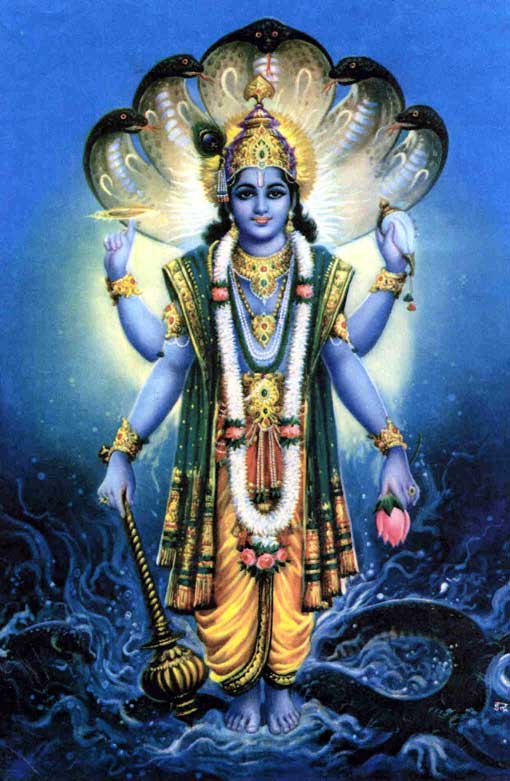
Here is an old story from Indian lore. It takes for granted the spiritual expectation, in Vedic philosophy, that with good karma and spiritual advancement, we may gratefully escape samsara, the seemingly endless cycle of birth and death that keeps us trapped in the torment of our own karma and misery. It also takes for granted the assumption that the Brahmins—the high-caste priests—would have earned the privilege of liberation first. But watch for the twist! Here, The God of time, Narayan—another name for Lord Vishnu—offers a surprising decree. I am retelling the story as I remember it.

—   —   —   —

Once on a sunny day near the Ganges, a Brahmin priest, who had just finished his oblations, came across Narada, the messenger of the Gods. After bowing deeply in respect, the Brahmin took the liberty of asking the divine sage for a favor:

Brahmin priest: “Could you be so kind as to ask the supreme Lord, Narayan, when I’m going to be liberated from this world and joined with him in holy bliss? I know it will be soon because of my station, and all, but I would just like to know, all the same.”

Narada: “No problem, my sir. I’ll ask when I see him.”

Further along down the river, a lowly cobbler, fixing shoes by the wayside, also stopped Narada, as he was passing through, and chanced to approach the great emissary:

Cobbler: “Could I appeal to your kindness by asking you to speak to the great God on my behalf?”

Narada: “I’d be happy to.”

Cobbler: “You see, I’m growing more weary each year, and I’d just like to know how many more lifetimes I am doomed to suffer in this material world?”

Narada: “I’ll be sure to pass on your message.”

And Narada continued on, passing seamlessly through to the spiritual world. When he saw the great Lord Narayan, he bowed to his feet, as is the custom in approaching great spiritual masters. The Lord then asked if there was anything he could do for Narada, who proceeded to put forth the concerns of both the priest and the cobbler.

As Lord Narayan can see through the barriers of time, and into eternity, he thus knows all. With a brief pause, he informed Narada of the destiny of his supplicants:

Lord Narayan: “The cobbler will come to me at the end of this present lifetime. But the Brahmin will live through at least 100 more lifetimes.”

Seeing the confused look on Narada’s face, the Lord only smiled and gave these instructions:

Lord Narayan: “Next time you see the cobbler and the priest, they will ask you what I was doing when you saw me. Tell them I was threading an elephant through the eye of a needle. When you see their reactions to this, you will then understand everything.”

So, Narada went on his way. The first man he saw was the Brahmin, who was shocked and insulted by the news:

Brahmin priest: “A hundred rebirths in this hell! I don’t believe it! You probably didn’t even see the Lord! Tell me, what he doing when you saw him?”

Narada: “Threading an elephant through the eye of a needle.”

Brahmin Priest: “Threading an elephant through the eye of a needle? That’s totally absurd! You must be lying about everything!”

So, Narada excused himself and pressed on until he found the cobbler. He gave him the news that he would soon be liberated and would be joining the realm of the Lord at the end of this lifetime, at which point the peasant exclaimed in joy:

Cobbler: “Oh, what blessed and glorious news! But, alas, tell me my good sir, what was the Lord doing when you saw him?”

Narada: “He was threading an elephant through the eye of a needle.”

Cobbler: “Lovely. Absolutely lovely.”

Narada: “You mean, you believe that?”

Cobbler: “Why, sure! You see that huge old oak tree up the hill? It grew from a tiny acorn. So, if the Lord can squeeze a gigantic oak tree into a little seed like that, He can just as easily thread an elephant through the eye of a needle.”

And with that, Narada understood the difference between the priest and the cobbler, as well as why the priest was not yet ready for liberation.

Five Tricks to Get your Mojo Back

Mojo, as popularized in the Austin Powers movies, is defined in the Urban Dictionary, as The ability to bounce back from a debilitating trauma and negative attitude. This is how I think of it, as well.

One of my students recently found herself in a funk (depressed mood). She asked me if I ever find myself in this sort of situation. Of course! She then asked me if I have any tricks. Of course! And that is the only difference.

Here I share my top five:

1. Before getting out of bed in the morning, do 1-3 minutes of Breath of Fire. This is a powerful breathing technique used in the form of Yoga that I teach. Among a long list of benefits, it not only balances the nervous system, but very effectively oxygenates the system, which is vital in kick-starting your body’s natural healing mechanism. Your body responds to this boost of vitality both physically and psychologically. Doctors who recognize the interconnectedness of mind and body stress the importance of breathing in the healing process. An example is Dr. Sarno, who cites oxygen deprivation as a prime cause of what he calls mind-body disorders. Whether the roots of your funk are psychological or physical, the Yogis have known about the power of breath for thousands of years. As an aside, film buffs will remember the scene, in Harold and Maude, in which the full-of-life Maude tells Harold to “greet each dawn with a breath of fire.”

*Here’s how to do it: (Remember, do this before getting out of bed!) Begin panting like a dog. Notice how the inhales and exhales are of equal duration. Notice also, how the “pumping action” comes from the belly. These are the proper mechanics of it. Now, close your mouth and continue on through the nose. This is Breath of Fire!

(To make it even more powerful, lift your legs and head six inches off the mattress while you do breath of fire for at least one minute. This gets easier with time!)

2. Super Food! 38.00 for magic-in-a-bottle. I’m lucky to live five minutes from Dr. Schulze’s famous warehouse, but they ship anywhere—and people fighting illnesses of all sorts use this product. (Note: I have no stock in this company!)

If you have a juicer, add a scoop of this green powder to freshly juiced spinach, apple and lemon. The super-trick is to make sure you drink it first thing in the morning, on an empty stomach, so that it goes straight to your bloodstream and to your cells. If you don’t have a juicer, add a scoop to a glass of water with freshly squeezed lemon, or shake it up in a bottle of apple juice or V8. Remember: on an empty stomach! Wait a half hour before eating.

3. Take a half-hour walk, first thing in the morning, before eating. The earlier, the better—preferably at the break of day when the street lamps are still lit. This rejuvenates psychologically, as well as physically. You are drawing on your own prana, or, life-force, free from the weight of digestion. Similar to the mechanism of homeopathy, this has the effect of stimulating your own inner power. On a subconscious level, you understand that you are capable of waking up your own inner vitality.

4. Switch to the heart-perspective. This has been an enormously important element in my own journey. What does this mean to you? If the funk has come about because of physical illness, how might the heart-perspective facilitate healing? This is subtle, but unspeakably powerful. It may be a simple matter of letting go of the inner fight against your physical body. And letting go of the fight allows healing. The inner acceptance of the time needed to heal, allows healing. In the case of mental disturbances, for example, an exchange with an irritating person, it may mean reminding yourself of how trivial the situation is, in comparison to worldly issues, or reminding yourself that the offensive action was done out of ignorance and not out of intent to provoke. Both perspectives engender forgiveness, and ultimately, healing.

5. Pray. This is like supercharging the heart-perspective. It took me a long time to fully appreciate the power of prayer. Especially “nondirected prayer,” which invokes the natural healing ability of surrender, and ultimately brings about an “inner unburdening” (and gives you back your mojo!)  Here’s a little something about this from one of the teachers in my tradition, Dr. Dharma Singh Khalsa:

One of the most potent forms of the mind-power effect is the type of prayer called nondirected prayer. In nondirected prayer, there is no request for a specific outcome. Instead, the person who prays focuses on the feeling that things happen for the best, and focuses upon his or her desire to see events unfold naturally, according to the benign flow of the universe.

Hence, it doesn’t matter to whom you pray. You are attuning yourself to the higher powers that be and to your own higher consciousness, which is the ultimate perspective changer. After all, as the Yogis also say, it’s all maya! Just a dance and none of it is as serious as we make it out to be. This enables a true liberation.

And don’t get stuck on the word desire in the quote above. They’re made out to be terrible things, but it depends on what kind and how we’re able to direct them.

Perfectionism; The Link between Self-Forgiveness & Healing

You can never get rid of your fears, you can never get rid of your pain, no matter what effort you make, until you have the guts to forgive yourself. Just forgive yourself. ~Yogi Bhajan (1/29/86)

I came across this quote by our teacher. Because it spoke to me, I saved it, but I found myself wondering…why? Why do we need to forgive ourselves? That analytic hex I’ve got was at it again. In my left-brained delirium, I discovered the connection in the perfectionistic tendency. So, for others who may be similarly afflicted (by the need to know, or by perfectionism), here is my take on the link between personal evolution and self-forgiveness.

  • To forgive is most literally, to forth-give. In other words, to go forwards.
  • Because the perfectionism that many of us get caught up into, creates subconscious road blocks, which manifests as a plethora of psychological hang-ups, as well as physical issues. We perfectionist types literally make ourselves sick over the possibility of failing in some way. Forward-thinking healers in the medical profession who have embraced this phenomenon, refer to the myriad psycho-somatic conditions more euphemistically, as mind-body issues. Letting ourselves, or others, down, is so unbearable, that mind-body issues, such as pain or depression, becomes more acceptable psychologically. So, forgiveness, in this regard, is more about forgiving what we perceive to be failures, so that we can move on.
  • The secondary emotions that accompany the perfectionistic tendency result in additional unconscious baggage, such as guilt, regret or even anger, which is perhaps the the worst of all because of the internal backlash it generates. I like to refer to these emotions as “backpack emotions,” that only perpetuate our issues.

In short, when we let go of harmful emotions, we simultaneously enable ourselves to heal. Those toxic seeds worked as a scapegoat, in effect—a distraction, of sorts, that allowed for an ailment that our minds considered more acceptable than personal disappointment. Letting go enables our personal liberation.

God and Prayer

I remember my beloved grandmother teaching me how to say my bedtime prayers when I was little. I liked saying them. They made me feel secure. And for many years, I felt that something was missing and incomplete if I forgot.

Perhaps a certain spiritual longing was always there. Because I also remember relishing the opportunity to go to church with a very religious friend, during my adolescent years.

But then, as a college student — especially as a philosophy student — I encountered all of the arguments against God and later even lectured on Aquinas’ notoriously flawed five proofs for the existence of God, in my own classes. I pointed out all of the irrefutable logical fallacies in those five proofs, to my own students.

During those years, I wondered about the absurdity of it all. God, that is. And by extension, the whole idea of praying to a God. In my logically trained young mind, I wondered about the idea of a God that would proceed with his plans for annihilation and devastation, only to suddenly cancel them at the request of a petitioner. After all, I reasoned, that’s why people pray, to convince God to alter some undesirable course of events. I wondered about the idea that he might change his mind so whimsically.

But then one day, I realized how differently things can look when you flip them around. One day, I flipped around my own viewpoint about it all. Or, it was flipped around for me.

I came to see that God is within, not without.

Additionally, praying isn’t about loving a God out there, somewhere. And changing the course of events is secondary to the understanding of prayer as connection, rather than petition. It is about connecting with that which may be called, infinity, for there is no adequate way to convey the sense of going beyond the confines of what you thought of as your finite self. (Nor is there any adequate way to convey that which is beyond the confines of reason.)

And it isn’t about fear, as in the idea of fearing God, for, there’s no room for fear where divinity lives.

And about the business of changing some course of events; coming to divine consciousness – becoming conscious of our own divine nature – reveals our role in creating that very shift we seek. And that makes it nonetheless incredible, but all the more awe-inspiring and wonderful.

As Zen says, “you create your own universe.” And as Yoga says, “you control the universal consciousness.”

But alas, it isn’t really about personal pleas, petitions and procurement, at all. It is really just the personal expression of gratitude and completeness. Praying, that is. For no other purpose. Like a flower reaching up toward the light, leaning over permanently to one side with time, devotion expresses this feeling of affection and longing, but with no object of desire.

How to Turn Anger into Forgiveness (Four Tools)

Lists are cute, but…they can only take you so far. The reason is usually because they tell you the “what” at the expense of the “how,” rendering them entertaining, and perhaps inspirational, but simplistic.

For example, I saw this piece of advice, in a list, just last week:

Give up the need to always be right.


A good pointer, for sure. After all, the need to be right is not worth the price of your inner peace. But, alone, it’s a bit like that pair of shoes that looks really good, but won’t help you much when it rains. First, we need to understand where this need comes from. Yes, it’s the ego’s obsession. But for practical purposes, the need to be right arises, all too often, in the midst of conflict, and in the nub of an argument. And it comes with anger (the deeper problem), which is escorted by the inability, or unwillingness, to let go, which, in its turn, comes with the inability, or unwillingness, to forgive.

So, what do you do when your mind is spinning, your composure is slipping and your heart is raging? Here are four tools to use, either alone, or in any order you choose:

1. Affirmations. To diffuse anger.

And you thought a Zen person would only tell you to stop talking to yourself! It all depends on what you say. Talking to yourself can either be a help or a hindrance. We talk ourselves into things and out of things all the time and can skillfully talk ourselves out of being angry if we commit to the task. We can start by reminding ourselves that it is our choice to refuse anger and turmoil and instead choose peace and tranquility. It’s also a choice to be offended and if we’re not offended, there’s nothing left to “prove.”

Anger starts out as a feeling and can quickly turn into words, or even worse, violence. And as both the Yogis and the behavioral therapists say, you are not your feelings. Meaning, that bit of anger that starts out as a nudge can be nipped before escalating into a coercive shove.  It’s a kid, talking out of turn. “Thank you for sharing,” you might say, and move on.

But, what about those television shows that tell us to punch things and get it all out? Anger is not something that needs to be nurtured or “practiced.” Which is why, “venting” doesn’t work. Venting is destructive, rather than constructive. Anger is a habit, like everything else. By venting, you are nurturing the combustible mixture of blame and resentment, clinging to the short-lived illusion of relief due only to the effect of exhaustion.

So, how do we talk to ourselves effectively? A positive affirmation is a bit like a mantra, which, when used properly, results in healing and restoration of the mood and emotions. By repeating a mantra, you are enabling your mind to focus on what you want it to focus on, rather than on the continued negative self-talk that only spins the anger. An affirmation can create a powerful shift in your attitude, resulting in peace of mind. An example would be something simple, such as, “I Am Love,” or, “I Am Forgiveness,” or, “I Am Light.” Notice these are all grounded in presence, as opposed to the past or the future realms, which keep us grounded, in turn.

2. Perspectives. To diffuse anger and enable forgiveness.

The need to be right is a poorly covered power struggle, with you vying to maintain control. The palpable tension it creates is driven on by your belief that there is a price the offender must pay, for their wrongful words or actions.

Remember back, for a moment, to a time when you acted rudely to someone you loved, when you unintentionally hurt someone either because you were distracted by your own troubles or because you let your emotions take you for a ride. Sometimes we don’t even know why we do certain things. We can hardly understand, let alone control, our own moods and behaviors—how much more difficult to fathom someone else’s? It’s seldom even about us, at all. Remembering our own slips and blunders brings us quickly into a state of equanimity and calm compassion. It lets us remember that we too, have been there, done that.

3. Visualizations. To Forgive and let go. 

This is a powerful Buddhist meditation I learned many years ago from one of my teachers. It is both startling and highly effective—if done with concentration. Here is the shortened version:

Imagine the dead body of the person who angered you. Visualize their body as distant, pale and lifeless. See, in your mind’s eye, the lifeless body beginning to rot. Imagine worms crawling in and out of the eye sockets and the mouth, and all of the crevices, eating away at the putrefying flesh. Finally, see nothing left, at all, but a strewn pile of dried-up bones. 

This ancient meditation will remind you of the fleeting nature of existence. It will remind you of how silly it is to get hung up on what usually turns out to be nothing at all. It will remind you, most powerfully, of the precious, short time we have to spend with our loved ones and to cherish that time, rather than waste it on nonsense.

5. Breathe.  To diffuse anger and quickly switch gears.
Truth: Most people breathe unconsciously. Which means, too shallow and too fast. We don’t fill up our lungs, which means, we’re not getting enough oxygen and we’re not expelling carbon dioxide. Aside from the health problems that would likely be ameliorated through deep breathing, what it means for our purposes here, is that we’re irritable. The Yogis have long known that shallow breathing is associated with anger and ill temper. And to make things worse, stress uses up even more oxygen. To turn things around, take three big, long breaths—but really do it! With one hand on your belly to act as a guide, bring that breath down toward your belly, expanding your diaphragm until you look like you’re pregnant! This activates the parasympathetic nervous system and effectively kick-starts the relaxation response, immediately bringing you into a different state of mind.

“The art of deep breathing is also the art of real living.” ~Yogi Bhajan

What’s Wrong with Distractions?

Can you just sit, without the need to go shopping, have a drink, play some slots, meet some girls…or guys,  place a bet, see the game, look at magazines, call people, surf the net or have a smoke?

But what’s wrong with those things? You might ask.

In philosophers’ patter, let’s presuppose three things: (1) That the highest purpose of human existence is to awaken our consciousness (2) That by ethically wrong, we mean the deliberate causing of harm to a sentient being (3) That there is a difference between ethical wrongness and and spiritual wrongness.

With that in mind, we first have to understand what is meant by “wrong.” We can rule out the idea that anything is ethically wrong with those things mentioned (presumption #2)—because in doing them you’re not causing direct harm to yourself or others and you probably have no intention to. But, those kinds of attractions may be considered wrong in the sense that they fail to support us in our longing for true inner contentment. Moreover, they don’t serve in bringing us nearer to the most exquisite goal of spiritual awakening (presumptions #1 and #3).

We’re talking more about what an activity doesn’t do for us than what it does do. And it doesn’t mean that we shouldn’t ever engage in amusements for the sake of amusement. It just means that we shouldn’t expect them to deliver what they are incapable of delivering.

Joy and happiness never derived from the external world. It is only the ego that looks habitually and incessantly for the next new thing—attached as it is, to the illusion of fulfillment by these things, as well as to the illusion that fulfillment happens at some other time. So, we are deceiving ourselves, from the beginning, by looking for happiness from anything, amusements, novelties, fantasies, experiences, in short, from things—things external to ourselves, things whose novelty quickly wears off, whose initial thrill wears away and whose very fabric wears out. All external things have a shadow side. The addict crashes every time and every time goes looking for another fix. The shopper needs the current issue, the gamer needs the latest version.

We even look to other people as potential sources of happiness, thus converting them into possessions and approaching them in the spirit of ownership, with negative emotions, like jealousy, suspicion and resentment the inevitable result of such an arrangement.

Meanwhile, we become prey to our own never-ending search for fulfillment out there. By doing so, we are essentially giving up our power to the world. And when we disempower ourselves, we become further distanced from the ultimate goal of awakening and further entrenched in illusion.

In Zen terminology, true joy comes from waking up to this moment. In Yogic language…from the realization of your own divine, abiding Self.

Nothing is more empowering than our liberation from the chains that bind us to the mistaken belief that joy is external to us. Distractions, by definition, keep us from this realization, thus leading us astray from our spiritual goal, wasting our time and disparaging our sacred purpose as humans.

And this, we may call spiritual wrongness (presumption #3).