Tag Archives: meditation

Three Things Spiritual People Do Differently

1. They See Themselves as Part of the Cause

I remember the Dalai Lama once speaking about Saddam Hussein…how every body blamed him, alone. The reality is, he explained, that without his army, his warfare, his ready militia and unquestioned support among the populace, his capacity to do harm would have been all but nonexistent. In Buddhism, this willingness to see the interconnected causal web underneath the facade, is called deeply looking.

To bring this home, to the everyday, it would be the moment when you ask, how am I contributing to the situation? How did my action or lack of action play a role in the development of this dispute or occurrence? 

2. They See Themselves as a Witness 

I have heard it said that this one skill is the defining criterion of a spiritual life. Not unlike #1, seeing yourself as a witness develops as you begin to shift your focus from finding solutions on the outside, to finding solutions on the inside.

This is what meditation prepares us for—watching ourselves.

Every time you sit, without reacting, you strengthen your capacity to avoid “taking the bait.” Without analyzing, condemning yourself, or getting involved with the passing parade of emotions, you begin to see the whole thing for what it really is…just neurotic bursts of inner dialogue. And eventually, you find yourself able to bring space around the fear, the anger, the doubt, rather than acting on it.

3. They Take the Lesson 

My teacher, Guru Singh, uses the analogy of the postal person. While we may find ourselves resentful of some irksome situation in our lives, perhaps one involving a partner, neighbor or workmate, the energy we spend trying to make them realize how wrong they are will be totally wasted until we figure out what it is we’re supposed to learn from the whole thing. The mailman won’t go away until we’ve signed for the letter!

This too, is not unlike #1, in that the external blame only serves to keep us blinded to our own role in life’s deep interconnected relationships. We are all karmically linked, which is only to say that we affect one another in myriad countable and uncountable ways. The awareness that develops out of a spiritual practice brings us more in touch with this causal dependency.

Why Meditation Works

morning meditateWhen I was growing up, it seemed everyone was impressed with those who could fix computers or who were technologically savvy in some way. They’re so intelligent, they’d say. And then there was always that family superstar who could answer the questions on Jeopardy before the contestants. Everyone would ooh and ahh, admiringly.

But, from the point of view of our soul, we are not here to fix computers or recite historical data.

Philosophy was impressive, too. While I wasn’t the one you’d call for a hard drive on the fritz, nor the one yelling out the answers to civil war trivia, I could talk about free will or argue about the existence of God. Of course, I didn’t choose this line of study in order to impress people, but as a girl in my twenties, I could already count on the type of reaction I’d get when asked what I’m majoring in.

That is…until I went to a real Zen monastery.

When I was in my 20s, I was already drawn to the eastern traditions—I knew about Zen and emptiness. I had read Alan Watts and even knew about koans. And for the first time, no one cared.

The bald man in robes, who they referred to as “Roshi” spoke that day. He said we were all there because we were “neurotic.” No words were ever truer! None of the brilliant papers I’d written seemed to matter at that moment. I still had my hang ups, just like everyone else. Because I still had that head of mine. All the studying in the world doesn’t seem to do much when it comes to true transformation.

That was when it dawned on me: Even the geniuses are screwed up! It’s like this passage:

Have you seen all these people who drink, who search for a partner, and who look for drugs? They start the search in earnest, or have the urge to do it, after 4 p.m. Why do they need drink? Why do people feel they need to take drugs?  They do all that out of an instinct to seek stimulation. At those times their biorhythm has gone down, and they feel irritated. They cannot exist like that and have to have a change…The root cause is that your basic biorhythm of energy, your mental projection and strategy are not reflected in a unisonness of character. Those zones are natural times that shift your energy level, your mental projection, and your performance. That is the time you must direct the mind, refine it, and create a consolidated unisonness of character and projection. ~Yogi Bhajan

The point is, what we are really here to do is guide the mind rather than let it be guided. Guided by what? By our own emotions, by other people’s expectations, by traffic, by disappointments, by the media…by endless, daily provocations (the worst of these being our own thoughts). Neither techie skills, nor historical data, nor a big bank roll can do this for us.

To me, it all boils down to this question: Are you a sanctuary for yourself?

Can you be still in your own solitude? We become a refuge for ourselves only when our mind is at peace. And only then is it remotely possible to be a source of peace for others — because our mind is the wellspring of every word we speak, every decision we make and every action we take.

How do we become our own sanctuary? When we discover our neutral center—the crowned sovereign over all the noise, the judgments, the neurotic outbursts and the incessant tug of war between positive and negative. The neutral channel is the balm that quells the drama that turns people’s lives upside down.

That neutral eye sees right though the drama. Thus, this quality creates vastness of character. This is true greatness. And this is what we’re here for.

If you have not established some vastness in your attitude, then your habits and facets, your fears and pettiness will betray you. ~Yogi Bhajan 

What is meant by “vastness?” No matter what spiritual tradition we’re speaking of, it all comes down to union, or, said the opposite way, letting go of the illusion of separateness. Where is that illusion kept? In the mind. Zen calls it the small self. Yoga calls it the finite self. No matter what we call it, this ego-based identity is what drives the pettiness in our lives, which in turn, makes spiritual union impossible. This is why governing the mind is the first task in any spiritual practice.

How do we refine the mind, in this way? It’s too bad you can’t just take a 6-week course, or a workshop, or an intensive. The old masters weren’t lying when they said you have to sit. There’s no way around it. It’s not as easy, of course, as taking a course and sticking some degree on your wall, but that’s also why there are so few truly enlightened beings in the world.

So how does it work?

Consider this car analogy: Before driving off to work in the morning, you warm up your car for a few minutes. As the engine warms up, a distinct alteration takes place within the engine that affects the oil pressure and viscosity, which prevents wear and tear on your car and gives you a smoother drive. In a similar way, it is through meditation, that we “warm up” our systems by better preparing our minds to handle the stress of daily living, to make the choices that need to be made and to navigate our way through our own doubts and anxieties. Through the refinement process that only meditation affords, we give ourselves a smoother drive.

Not only is there an alchemical process taking place, via the glandular system and the nervous system, but by coming to stillness, we develop a capacity to stay present even when things seem unpleasant. This translates into less reactivity and more patience in the “real world,” as we interface with difficult people and everyday dilemmas.

Through meditation, instead of simply reacting at once, we create space around every stimulus, whether pleasant or unpleasant and whether internal or external.  Our minds challenge us at every turn, like a toddler pulling at our pants for an ice cream, but as we persist, we become solid. We become a witness to the ways of our own minds, which is what Buddha meant when he urged us to study the Self.

To be sure, being a witness does not mean being passive. Nor does it mean being narcissistic. Not passive because we retain our intention to cultivate our awareness even when we get up off the cushion. Not narcissistic because as spiritual warriors, we know all too well the effect of one mind on the world at large.

We know that even a few minutes of warming up our engine daily, will shape every decision we make, in every area of our lives, from relationships to work. This is why it is the highest form of self betterment—because we are getting to the root of our being.

Day 1 – Meditation Journal

It’s that time again—I’m grading end-of-semester projects and as is always the case, I was struck many times, by moments of  gratitude and delight. It’s the gratitude of being able to introduce stressed-out students to meditation and the delight of witnessing what is sometimes nothing short of a personal transformation. Taking up a personal meditation (sadhana) for a week, as this student chose to do, is one of their project options. As I’ve done before, with the student’s enthusiastic permission, I’m sharing a portion of the one that brought the biggest smile.*

*Note: Following the entry, I have added the instructions to the meditation she did, along with a link to the recorded mantra she used.

Meditation Journal: Day One

It was Day One of my new sadhana commitment. I was woken up by a Rihanna song blasting out of my Iphone, and a few minutes after that, by my ten-year-old brother urging me to get ready and take him to school. After the hustle bustle of my early routine, I arrived at SMC and tried to fit my car into a parking space that would need a plier to get out of. I sat through class after class, took notes, stared at the clock, and made about thirty lists of things I had to do.

After the long day had progressed and I was finally in bed, I found myself nervous, as usual, and lost in my monkey mind of excess thoughts. I have quite a neurotic habit before I sleep, where I replay all the little, unimportant negative moments of my day that stuck out to me, like when my history professor poked fun at my question, or when a friend said something that hurt my feelings. Before I know it, I am usually so involved in the replaying of these scenes and distracted by other thoughts that remind me of other negative scenes, that I am up all night, with only a couple hours of sleep to spare.

But on this night, before I started this tedious process, I remembered it was day one of my new sadhana and I was committed to practicing the Sa Ta Na Ma meditation every day for the next week. I put on the mantra recording I had downloaded from amazon and sat calmly with my eyes closed. I breathed deeply a few times and then started whispering SA TA NA MA, then singing it, then singing it in my head. I chose this sadhana because I love singing and I loved the element of music and chanting that this sadhana had. As I sang the words, I alternated connecting my thumb fingers with each of my other fingers.

I started to feel more relaxed as I felt the anxieties of my day being sung away. My mind felt more focused and at the same time, more clear. I felt like I had created a peaceful sanctuary in my quiet room. I felt connected with my body and felt it get lighter as I let go some of the worries I was bottling up all day. As the meditation came to an end, I found that my mind was lighter than usual, and to my surprise, I laid my head on my pillow and fell asleep.  

—–

Sa Ta Na Ma Meditation

  1. Sit with a straight spine, either on the floor or in a chair. Rest the backs of the hands on the knees.
  2. Eye Focus is at the Third Eye (look up toward forehead).
  3. Inhale deeply and begin to chant aloud the mantra: Sa ta na ma.
  4. On the syllable sa, touch the index finger of each hand to the thumb; on ta, touch the middle finger to the thumb; on na, touch the ring finger to the thumb; on ma, touch the pinkie to the thumb. Continue with these finger movements, with a firm pressure.
  5. First chant the mantra aloud, imagining that the sounds come in through the crown and exit through the third eye in an L shape. Then, chant in a whisper. Finally, chant silently (mentally), before reversing the order (Follow the recording).
  6. To finish, take a deep breath and reach your arms overhead. Exhale, and draw your hands to your chest in prayer position.

This meditation is one of the core Kriyas in our tradition of Kundalini Yoga and has been duly researched and lauded for its measurable benefits to those suffering from Alzheimer’s disease and related brain disorders.

Here is one of my favorite short recordings of it, on amazon: Sa Ta Na Ma.

The Power of Positive Thoughts

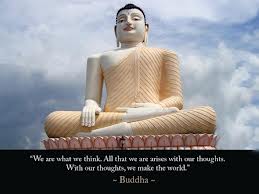
Buddha ThoughtsIn the Dhammapada, Buddha speaks of the power of thoughts when he says, “all that we are is the result of what we have thought.” Yet, Zen master Suzuki seems to dismiss that power, when he likens those same thoughts to passing waves, urging us to learn to let them go, for, they are not who we are.

It seems contradictory. But we can look upon this delightful little enigma as an invitation to reconcile both aspects of the polarity. It’s kind of like light…now it’s a particle, now it’s a wave.

Where thoughts are concerned, the catch is that they can and do pass…when we let them. As weary travelers pass continuously through the revolving doors of the grand hotel, so our thoughts go flooding through our minds. As Yogi Bhajan says, thoughts erupt at the astounding rate of 1000 per blink of the eye. At this rate, it’s hard to imagine we could catch any of them, but this is exactly where it gets tricky.

The problem happens when we get stuck on a thought. Like gum stuck to our shoe, we then begin to wear it, exude it, transmit it. And then, it wears us.

What are we to do?

Through the simple practice of mindful meditation, we practice letting thoughts come and then letting them go. We practice non-attachment to those thoughts. Like anything worthwhile, it takes a lot of practice (which is why the monks and Yogis have traditionally retired to their caves for a life of seclusion and long hours on the cushion)…because let’s face it—most thoughts only get us into trouble!

But as we become more comfortable with this process, we learn how to work with our thoughts in more skillful ways. MRI screening now confirms what Patanjali told us 2000 years ago in the Yoga Sutras, namely, that through focus and conscious intention, we can convert pesky thoughts into more uplifting ones. Cultivate counteractive thoughts, he said.

What it all boils down to, is living a more fulfilling life because when our thoughts have got us by the nose (to use an expression my Zen teacher once used with me), we become too engrossed in our internal battles to truly enjoy life.

This is where positive affirmations come in. By learning how to actively work with our thoughts in a more purposeful way, we can affect our physical, mental and emotional well-being, as well as usher in the kinds of positive changes in our lives that may have once seemed out of reach. In other words, by learning to work with affirmations, we may even open doors to the realms of the miraculous.

The Paramedic Has a Lifeline, Too

Every once in a while, a student sends me something that is not only heartwarming, but serves as a reminder of why I do what I do. Here is a story of a modern day medic and an ancient Yogic technique. I hope you are just as touched by my student’s story, as I was.

My Sadhana (Daily Practice)

As a young man living in the 21st century my brain is constantly being rushed with all sorts of stimuli. It is quite difficult going about my day with out being affected by social media, subliminal messages, and other avenues of gaining my attention. Due to all of this my mind is essentially never present or clear. I am always thinking about what to do next and move ahead. However, about two weeks into this class, I was introduced to a breathing technique that quickly brought me back into the present.

This technique is called alternate nostril breathing. The first time I tried this in Professor Quesada’s class, I did not fully feel the effects. My brain was not used to being in the present moment, so I started to feel a little restless. At first, I had no faith in this technique because I did not see results immediately. Again, my brain was used to getting things done fast and seeing results quickly. Later that day I went home and looked up the benefits of this ancient breathing technique; everything that was listed was what I needed.

I have had a problem with anxiety for many years. I can now say that alternate nostril breathing has significantly helped me with that.

alternate nostril breathing
About a month or so ago when I started alternate nostril breathing, I started doing it for 15 minutes every morning to get me ready for the day. Those first few days were pretty challenging – it was difficult to stay focused because after sitting for 5 minutes my mind started wandering. Eventually my brain was able to stay focused for longer periods of time. I eventually figured out that this technique could be used any time I feel stressed or anxious. I currently practice alternate nostril breathing multiple times throughout the day in addition to the 15 minutes I do every morning.

I work as an Emergency Medical Technician for a private ambulance company where I deal with life and death constantly. There is a very high level of stress everyday and I take on a huge responsibility while the patient is under my care. Prior to learning this breathing technique, I would get butterflies every time I was dispatched and they would last the whole ride to the scene. The lights and sirens just made me more tense and even though the adrenaline rush was too much at times, I thought I had no choice but to force my body adapt to the stress and disregard it.

However after becoming comfortable with alternate nostril breathing I now use it when responding to calls. My performance and mental clarity has drastically changed.

For example, a few weeks ago my partner and I responded to a call for a traffic collision. When we arrived on scene I found an 11 year old child in the back seat trapped, with no pulse and no respiration. The patient had suffered a traumatic full arrest and it was the first time I had ever witnessed this. The family was crying and pressuring me. I felt a little dizzy, and just extremely overwhelmed. As my partner pulled out the patient and started compressions I ran over to the ambulance to pick up the defibrillator. On the way to the ambulance I forced my brain to focus on my breath and I quickly slowed down my respiratory rate which almost instantly calmed me down. My whole sprint to and from the ambulance was maybe 30 seconds but in those few moments I was able to stay calm and regain my focus just from focusing on my breath. The patient came back after 2 rounds of CPR and 3 shocks.

In school I have also used alternate nostril breathing before exams. By using this technique prior to exams I feel a sense of calmness and a major reduction in angst. It has also taken away tension throughout my body. Overall it has been useful to me in my work, school, and personal life. It has also made me more aware of living in the present. Thank you so much Professor Quesada for teaching me this breathing practice.

The Morning, the Mosque and the Glandular System

What do the early morning, the pituitary gland and the mosque have in common?

I had done my early morning meditation the other day before taking my dogs out for their walk. I live on the street with the beautiful Mosque, so I always see activity there during the pre-Dawn hours. On this occasion, I saw my mechanic, who is a Muslim. The sun, not yet reflecting off the minaret, was just beginning to lighten the sky as I waved hello and turned the corner.

If I were to walk a little further, I’d see the Orthodox Jews making their way to temple for their early morning prayers. And in the many Buddhist temples across town, the monks are chanting their first sutras while the smoky aroma of sandalwood incense fills the dimly lit room.

The pre-Dawn hours have always been the favored time to engage in spiritual practices, among all traditions, since the time before those practices were subsumed and consumed by religion as we know it today…since the time when all who practiced were Yogis—since, true to the spirit of the word, they were merely seeking divine union. They were mystics, seeking nothing but the experience of God.

Although the façades have changed, the inner motivations are varied and the reasons why are largely unknown, the custom of rising early remains.

In Sikh scriptures, it is known as the Amrit Vela—that special and tranquil time we may call the ambrosial hours. The ancients may not have known that this is the time when our glandular system undergoes a natural shift, but they knew there was something very magical about it. They may not have known about the pituitary gland, whose proper function regulates all other endocrine functions and brings us into that state Yogis called Shuniya, but they experienced this state of neutrality and they knew that this was the gateway to higher consciousness…to that realm that transcends time-space boundaries.

These are the hours when the world sits still. It is when the earth’s magnetic field and its angle in relation to the sun make it the perfect time to sit still with it. It is when we are given refuge from the tug-of-war between those forces known in the Bhagavad Gita as Rajasic and Tamasic. Between fire and sloth. But between them, there is balance. It is therefore, the most Sattvic time to enter into that divine stillness that lies within. It is when ego’s protective wrapping is most easily peeled away, along with those habits that go along with it.

It is as such that in these ambrosial hours, the pituitary gland—master at the helm—secretes optimally and when all those who pull themselves out of bed to practice, can melt into the stillness that was there all along.

Gratitude (It Goes Both Ways)

It was an ordinary Tuesday morning on campus. On the heels of an especially hot September, it was already stuffy inside the classroom. Amid the pre-class clamor, I sat, perusing the instructions for a meditation that was originally given by my teacher some 30 years ago. I thought twice about it. It seemed too detailed and too complex for a classroom setting. But I went ahead with it, anyway.

We were a couple minutes into it, when I passed my eye over my 80 students, from left to right, across the oddly shaped, wide room. Through the darkness, I saw only fingers pressing together at the heart center, closed eyes and heaving chests pumping air in segments.

After class that day, I saw two of my students hanging out by the field—with exaggerated puffing, one was instructing the other in the correct way to do the meditation. The next day at my home studio, a student, who is also in my college course, was practicing this meditation as I entered.

Truth be told, I was feeling a bit off my game lately. Like I didn’t have my usual spark. So, what happened two days after this meditation, was especially meaningful.

One of my students caught up to me as I was walking to my car after class. She is a young woman who as I learned, is in the middle of a painful divorce. They were high school sweethearts, she told me. The separation process has been so painful she nearly dropped my class before the semester even started because she didn’t think she would be able to handle the extra demands and pressure.

Through tears, she continued to share her story. Then she told me what had happened the day before—how the meditation had helped her pull herself out of another panic attack, just after a particularly difficult phone conversation with her ex. She said it was the first time she had felt empowered rather than crushed.

She wanted me to know that her tears were now the tears of hope and gratitude and that for the first time in months, she was able to experience the taste of renewed joy—even in the midst of crisis. She is looking upon this internal shift—this newfound sense of optimism and inner strength as a rebirth. My own heart melted when she told me she was holding in her mind the image of me giving instructions for the meditation in class, to ensure that she was doing it right.

Her intention was the most important ingredient of all, I reassured her. And that can only come from her. She had decided it was time to heal.

With a long hug we parted. The gratitude goes goes ways. Here’s why it’s so important to share these kinds of things:

1. The other person may need to hear it, as I did in this instance. Positive feedback of this sort is a source of upliftment and inspires the recipient to continue doing what they’re doing. Moreover, it lets them know they’re making a difference.

2. It enables connection and that’s what we live for.

3. We spend too much time criticizing—both ourselves and others. But as my teacher, Yogi Bhajan, has said: It takes the same energy to complain as it does to compliment. When there is a short circuit there is a complaint and when the energy is flowing there is a compliment. Thus, taking a moment to scatter flowers, rather than count the weeds, makes the world feel beautiful.

How to Turn Anger into Forgiveness (Four Tools)

Lists are cute, but…they can only take you so far. The reason is usually because they tell you the “what” at the expense of the “how,” rendering them entertaining, and perhaps inspirational, but simplistic.

For example, I saw this piece of advice, in a list, just last week:

Give up the need to always be right.


A good pointer, for sure. After all, the need to be right is not worth the price of your inner peace. But, alone, it’s a bit like that pair of shoes that looks really good, but won’t help you much when it rains. First, we need to understand where this need comes from. Yes, it’s the ego’s obsession. But for practical purposes, the need to be right arises, all too often, in the midst of conflict, and in the nub of an argument. And it comes with anger (the deeper problem), which is escorted by the inability, or unwillingness, to let go, which, in its turn, comes with the inability, or unwillingness, to forgive.

So, what do you do when your mind is spinning, your composure is slipping and your heart is raging? Here are four tools to use, either alone, or in any order you choose:

1. Affirmations. To diffuse anger.

And you thought a Zen person would only tell you to stop talking to yourself! It all depends on what you say. Talking to yourself can either be a help or a hindrance. We talk ourselves into things and out of things all the time and can skillfully talk ourselves out of being angry if we commit to the task. We can start by reminding ourselves that it is our choice to refuse anger and turmoil and instead choose peace and tranquility. It’s also a choice to be offended and if we’re not offended, there’s nothing left to “prove.”

Anger starts out as a feeling and can quickly turn into words, or even worse, violence. And as both the Yogis and the behavioral therapists say, you are not your feelings. Meaning, that bit of anger that starts out as a nudge can be nipped before escalating into a coercive shove.  It’s a kid, talking out of turn. “Thank you for sharing,” you might say, and move on.

But, what about those television shows that tell us to punch things and get it all out? Anger is not something that needs to be nurtured or “practiced.” Which is why, “venting” doesn’t work. Venting is destructive, rather than constructive. Anger is a habit, like everything else. By venting, you are nurturing the combustible mixture of blame and resentment, clinging to the short-lived illusion of relief due only to the effect of exhaustion.

So, how do we talk to ourselves effectively? A positive affirmation is a bit like a mantra, which, when used properly, results in healing and restoration of the mood and emotions. By repeating a mantra, you are enabling your mind to focus on what you want it to focus on, rather than on the continued negative self-talk that only spins the anger. An affirmation can create a powerful shift in your attitude, resulting in peace of mind. An example would be something simple, such as, “I Am Love,” or, “I Am Forgiveness,” or, “I Am Light.” Notice these are all grounded in presence, as opposed to the past or the future realms, which keep us grounded, in turn.

2. Perspectives. To diffuse anger and enable forgiveness.

The need to be right is a poorly covered power struggle, with you vying to maintain control. The palpable tension it creates is driven on by your belief that there is a price the offender must pay, for their wrongful words or actions.

Remember back, for a moment, to a time when you acted rudely to someone you loved, when you unintentionally hurt someone either because you were distracted by your own troubles or because you let your emotions take you for a ride. Sometimes we don’t even know why we do certain things. We can hardly understand, let alone control, our own moods and behaviors—how much more difficult to fathom someone else’s? It’s seldom even about us, at all. Remembering our own slips and blunders brings us quickly into a state of equanimity and calm compassion. It lets us remember that we too, have been there, done that.

3. Visualizations. To Forgive and let go. 

This is a powerful Buddhist meditation I learned many years ago from one of my teachers. It is both startling and highly effective—if done with concentration. Here is the shortened version:

Imagine the dead body of the person who angered you. Visualize their body as distant, pale and lifeless. See, in your mind’s eye, the lifeless body beginning to rot. Imagine worms crawling in and out of the eye sockets and the mouth, and all of the crevices, eating away at the putrefying flesh. Finally, see nothing left, at all, but a strewn pile of dried-up bones. 

This ancient meditation will remind you of the fleeting nature of existence. It will remind you of how silly it is to get hung up on what usually turns out to be nothing at all. It will remind you, most powerfully, of the precious, short time we have to spend with our loved ones and to cherish that time, rather than waste it on nonsense.

5. Breathe.  To diffuse anger and quickly switch gears.
Truth: Most people breathe unconsciously. Which means, too shallow and too fast. We don’t fill up our lungs, which means, we’re not getting enough oxygen and we’re not expelling carbon dioxide. Aside from the health problems that would likely be ameliorated through deep breathing, what it means for our purposes here, is that we’re irritable. The Yogis have long known that shallow breathing is associated with anger and ill temper. And to make things worse, stress uses up even more oxygen. To turn things around, take three big, long breaths—but really do it! With one hand on your belly to act as a guide, bring that breath down toward your belly, expanding your diaphragm until you look like you’re pregnant! This activates the parasympathetic nervous system and effectively kick-starts the relaxation response, immediately bringing you into a different state of mind.

“The art of deep breathing is also the art of real living.” ~Yogi Bhajan

Yes, Yoga Is Wise!

I recently had lunch with a few old friends. While sharing our current goings-on, the fact that I teach Yoga was met with general interest: I would love to take Yoga…It seems so wise, one woman said.

Well, that’s an understatement, I thought! It is wise—but how? What does it mean to be wise? Something that is described as wise, conveys the suggestion that by practicing it, you’ll become privy to a better way of living.

Yoga is defined as a technology and set of practices that are employed to enable human beings to achieve Self-Realization. Will this Self-Realization lead one to a better way of living?

Firstly, what is Self-Realization?

It is a state in which one is profoundly aware of his/her true nature. And if that is vague it is because it has to be, for it is a state that must be experienced. According to Yogic traditions, it is a process by which one ceases to identify with the ego-self, and the sense of separateness that characterizes this ego-based, state of illusion, known to Yogis as maya.

And so, as for the first question, how this awakening may improve the quality of life, we must remember that this condition of maya is plagued by a roster of negative emotions, like fear, suspicion, envy and anger. Accordingly, a practice meant to bring us back to a realization of wholeness, and away from this false sense of separateness, would restore a feeling of inner peace, while removing the adverse emotions. If we can speak in terms of goals, we might say the ultimate goal is increasing the joy in our lives.

Of course, like any noble and worthy goal, true practice takes work, but as my dear teacher Gurudhan is wont to say, life without Yoga takes even more work.

This worthy goal involves the pacification of our thoughts, emotions and habituated reactions—nothing short of the management of the mind—that unruly, rebellious thing, that does not want to be managed. Yoga offers us various tools to help us do that. And the many diverse Yogic traditions emphasize different tools. Like trails that lead to the summit, all will lead you there. In my own practice of Kundalini Yoga, we make copious use of kriya, mudra, eye-focus, powerful breath work and mantra meditation, all of which are often enhanced by sound modalities.

In the language of Yoga, the process of awakening is just that—a process, meaning that on a subtle level, you start to approach life in a different way, relate to people through new perspectives, see through open eyes, perceive with a clearer, less reactive mind. Problems may not be interpreted as problems any longer, and when they are, you have the clarity and presence with which to approach them more skillfully. All of this results in a higher quality of life.

Yes, Yoga is wise!

Please, Call Them “Yoga-Inspired Exercises”


This morning, on my usual walking route with my dog, I noticed a new sign on the neighborhood gym that said “Yoga.” The word “Yoga” is everywhere, especially here in L.A., where, according to recent statistics, there are more people doing it than in its native India. The problem is, the activity that is actually being practiced is not exactly Yoga. More often than not, it is a simulation of the ancient spiritual technology, at best, thereby rendering the statistics irrelevant.

As Stated Elsewhere

Like many arts and sciences that are profound, beautiful, and powerful, yoga has suffered from the spiritual poverty of the modern world–it has been trivialized, watered down, or reduced to cliches. The deep and eternal essence of yoga has been misrepresented and packaged for personal profit by clever people. At the hands of some, yoga has been reduced to the status of just another exercise program available on videotape. In other contexts, yoga has been presented as a cult religion, aimed at attracting “devotees.” Such a haze of confusion has been created around the clear and pure concept of yoga that it is now necessary to redefine yoga and clarify its meaning and purpose.
~ Bhole Prabhu

While there are many holistic classes to be found, too often, all you’ll find in “Yoga classes,” are the postures, which are merely a preparatory part of the discipline as a whole. But this is the part that is most eagerly consumed here, due to our emphasis, or rather, obsession, on the body.

My Proposition

For the sake of maintaining the integrity of this ancient, and unbelievably rich tradition, here’s what I’d like to see hanging on the doors of these kinds of classes: a sign that says, “Yoga-inspired Exercises” in place of the sign that says, “Yoga.” After all, as Swami Bharati says, “we would not call a brick a ‘house’ even though it is part of the construction. Yet, this is what is often done with Yoga.” The postures are but a small part of the complete eight-part system known as Raj Yoga. So, the change would be done for the sake of clarity, dignity and truthfulness.

So, What Is Yoga?

It is not within the scope of this article to explain those eight rungs of Raj Yoga, nor the other ancient Yogic paths, such as Bhakti Yoga and Karma Yoga, since this information can so easily be found elsewhere (including via my own Youtube lectures). But, here is an overview of the inherent point and purpose of all the Yogas.

Yoga is about union. You could say that the goal of Yoga is…Yoga, since  that’s what the word means. It is the union of the self and the True Self, of the ego identity and the Supreme consciousness. It is a process of awakening to the divine reality that we were never separate from in the first place. It is the evaporation of maya, or, the delusion of separateness. It is the direct experience of the preexisting union between Atman and Brahman, or if you will, Shiva and Shakti. It is, as Paramahansa Yogananda describes it, Self-Realization. It is the awakened consciousness. It is God-consciousness. It is, as Sivananda has described it, Supreme Harmony. It is Samadhi—the final limb and crown of Patanjali’s eight rungs of classical Raj Yoga.

The many therapeutic effects of Yoga have been touted so frequently, that many people now realize that the purpose of Yoga is not to workout. But to think of Yoga as a form of relaxation is to still miss the point. It is to replace one misunderstanding with another!

Yoga Is Spiritual

On their website, YogaDayUSA.org listed the “Top 10 Reasons to Try Yoga” as, stress relief, pain relief, better breathing, flexibility, increased strength, weight management, improved circulation, cardiovascular conditioning, better body alignment, and focus on the present for health reasons. The authentic reasons for Yoga seem to be not even worthy of mention in their Top 10 Reasons for Yoga.

Yoga Alliance, the sponsor of Yoga Day, described itself as “the leader in setting educational standards for yoga schools and teachers.” However, while they claim this authority, they did not see fit to acknowledge or include in their Yoga Day promotions the fact that the roots of Yoga come from the ancient tradition of Sanatana Dharma, out of which has grown Hinduism, Buddhism, Jainism, Sikhism and other traditions.
Swamij 

The therapeutic effects of Yoga are many, but they are not the central intention of any of Yoga’s many paths, which are like the many rivers that all find their way to the sea. The different paths, or Yogas, intersect one another and often run in parallel. They accommodate the various inclinations and karmic propensities of the individual student who would find himself on a spiritual journey. Yet they all have the same goal of Self-Realization.

* In this article, as elsewhere, I have followed the tradition, as pioneered by the renown authority on Yoga, Georg Feuerstein, of capitalizing the word Yoga, just as we would capitalize Zen, or, Christianity.