Tag Archives: philosophy

The Hindu Notion of God… What is Brahman? Pt I

What is Brahman?: To be absolutely direct… everything… meaning, EVERYTHING that exists, is an expression or manifestation of Brahman. This means that all the Gods that are associated with Hinduism, are Brahman. Shiva, Krishna, Parvati, Durga, Lakshmi… all of them, are manifestations of Brahman. Humans are Brahman. The trees, rivers, and all the animals of the seas and forests are Brahman. Energy is Brahman.

Again, like the actors on a stage, Brahman just appears differently in different contexts.

Brahman is the universe and everything in it. Since Brahman is everything in the universe, the concept of the universe, and the universe itself… and since Brahman is divine, it is self-evident to simply say that the universe is not separate from the divine.

Pantheism

This is the pantheistic aspect of Hinduism… Everything is divine. God is everywhere and in all things. Pantheism just means that nature is inseparable from God. God is everywhere and in all things.

When you look into a creature’s eyes, you are looking at God. When you wrap your arms around a tree, you are embracing God. When the beauty of a sunset renders you speechless, you are experiencing God.

In a pantheistic universe, all of nature is sacred. In a pantheistic mindset, we feel a natural sense of unity and kinship with all beings, since all beings are Brahman. All beings are sacred.

Hinduism is often mistakenly described as “polytheistic” because of the appearance of so many deities. But they are all aspects of Brahman! So, then why have all the Gods? Because Brahman can seem too abstract to conceive of, and we need a tangible manifestation of source energy to relate to… and to embrace. The many manifestations present in the Hindu pantheon of Gods represent the many ways that God appears.

Like us, God isn’t just one thing. He is a she sometimes, and an it at other times. He is loving sometimes and harsh at other times. She is peaceful and then downright angry. This is very different that the western point of view, in which God is generally thought of only in the masculine form and described as all good all the time. Here, God is not so different from us… we have many aspects to our personality, rather than just one.

But, of course it’s no different than us… we are IT!

The metaphor used in the early Hindu scriptures, to emphasize the oneness of all, is the ocean. We feel so unique. We feel separate. But that’s just our ego. We are just waves on the surface of the ocean… for a while, our ego tells us we’re a big beautiful wave… and everyone, everywhere, would love to just lay their eyes on us… photographers would love to capture our perfect barrel, and surfers would travel near and far to take us on!

But alas, we will crash back into the same ocean from whence we came. Moreover, we were never any different!

Buddha’s Four Noble Truths: Part II… The Eightfold Path

The Noble Eightfold Path is the fourth part of Buddha’s Four Noble Truths. It is usually stated as Marga, which just means “Path.” Think of it as one path, that consists of eight interconnected practices, which work together to help us liberate ourselves from our own self-created suffering. 

As you’ll recall from the first part of this presentation, on The Four Noble Truths, the kind of suffering we’re talking about here, is the mental variety.

The intent of these eight steps is to habituate the wild-horse that is our mind, into a calm state of awareness. 

It is worth noting that in Buddha’s brilliance, he articulated these steps so as to apply to both the actual practice of Zazen, or seated meditation, as well as to our lifestyle, as a whole. This comes through in their organization: The first two steps capture the basic wisdom of Buddhist teachings, the next three steps all concern our conduct in the world, while the last two focus in on meditation. 

Finally, a note about the context… The Buddha, authentic child of India that he was, responded to the prevailing Vedic notion at the time, that if you practice asceticism—that is to say, give up everything—you could put an end to your suffering. Buddha felt that this was not the way because the “picking and choosing mind,” forever full of preferences will always dominate, so a better practice is to learn how to lean into those attachments, so to speak, rather than make the attachments go away. 

We might look at the eightfold path as the practice of leaning into our attachments, so as to neutralize them and remove their power.

1. Right Understanding (Wisdom). This first step is a reminder that all experience is part of an impermanent and conditioned cycle, driven by the law of cause and effect. 

That is to say, we are all connected and we all need each other to exist. 

Said differently… everything needs everything else to exist. 

Differently still… Everything is totally dependent on everything else. And everything really does mean EVERYTHING… the birds and the trees, the water and the clouds… everything.

This is known as Emptiness in Buddhism, which said in the simplest way possible, just means that every single thing is “empty” of self-sustained capacity (We need other things besides ourselves to exist). And if everything outside of us is just as vital as everything inside of us, then everything is “I.” Or, nothing is “I.” 

I am everything and I am also nothing.

The idea is that, until we see into the nature of reality clearly, we suffer trying to hold onto things (and situations), when nothing is ours to hold onto.

2. Right Intention (Wisdom). This step spotlights the importance of keeping our thoughts in a place of acceptance… because there’s nothing to hold on to! 

On a deeper level, it is also a reminder to check ourselves when we become too focused on our selves, at the expense of compassion for all… because if we’re always focusing only on our own gain, our mind will never be at rest. We’ll always be mentally calculating and clutching. Also, to focus only on ourselves is to forget how we all affect one another. 

The idea is to eliminate the seeds of what Buddha called the “Three Poisons:” Greed, Anger and Ignorance. Greed and anger need no explanation. Ignorance in this context, is to disregard our inter-connectedness. 

3. Right Speech (Conduct). This is the first of the three steps that deal explicitly with our actions in the world and how those actions affect others. The idea is to align our behavior with the quality of compassion. 

Whenever we speak unkindly, we tend to spin it around in our heads long afterward, and this impedes the overall intention of our practice, which is to be peaceful on the inside. We ruminate on all the “shouldas” and “couldas”… “I shoulda said this”… etc. If we become better habituated to speaking simply and truthfully, there’s never a need to second guess ourselves. 

But this requires presence and a keener sense of being conscious… conscious of ourselves, of what comes out of our mouths, and of how people are responding to us. 

How we talk to ourselves counts, as well! Be kind and encouraging with yourself, too.

4. Right Action (Conduct). This is where Buddha’s Five Precepts come in. But I like the way Thich Nhat Hanh refers to them better, as “Five Mindfulness Trainings.” 

Very simply, these are: 

Reverence For Life: Usually stated as “Don’t kill,” this precept is a reminder to be compassionate toward all life. Compassion entails that we regard the lives of all sentient beings, and the plant life that sustains us all, as precious. This is a reminder to align myself with actions and habits that support and protect life, rather than with actions that cause harm. This applies to our eating habits, shopping habits, and overall consumption.

As a side-note, sometimes people like to say that we will never eliminate our footprint here on earth. To this, I say that it’s true… none of us will ever be perfect… but we’re not going for perfection. We’re trying to do better. Honesty, compassion, along with genuine effort will guide us. 

True Happiness: Commonly listed as “Don’t steal,” this precept reminds us that the happiness and suffering of others are not separate from our own, so stealing something that belongs to others is an affront to our collective well-being.

True Love: This precept is commonly translated as “Don’t be promiscuous.” I much prefer Thich Nhat Hanh’s “True Love,” as it reminds us of the beauty and integrity of loving relationships, in which mutual respect is valued. It simply goes to follow that relationships that are not enriched by love and respect are more likely to be motivated by selfishness and to result in abusive or toxic relationships.

Loving Speech and Deep Listening: This precept is a reminder of the harmfulness of lying and gaslighting. The idea is to keep in mind the importance of not causing harm when we communicate. 

Nourishment and Healing: I really appreciate these words, in place of the usual “Don’t intoxicate.” To heal brings to mind the spirit of this precept, which is to remember the power of consumption on all fronts… we consume food, drink, movies, internet material, AI generated material, social media, video games, commercials, and on and on. When we consume in any of these areas, we should be guided by mindfulness, and always consider the impact all of this stuff has on our peace of mind and overall state of being. 

5. Right Livelihood (Conduct). This one is very clearcut, and serves as a reminder to align our work and livelihood with our commitment to reduce harm and suffering to all beings. Very simply put, try to find work that doesn’t involve killing or slavery. Don’t work in a slaughterhouse.

6. Right Effort (Meditation). Now we focus in on meditation. Right effort alludes to the steady commitment to practicing… which is no small thing. At any given moment, there’s always something easier or more “entertaining” to do than sit and face the wall. It takes dedication, to be sure, to get yourself onto the cushion. 

But that’s not the end of it… once you’re on the cushion, it takes constant effort to rein in those wild horses of the mind! Before you know it, they’re off and running, into the past, and into the future, and around in circles, spinning the same thoughts over and over again.

Right effort in meditation means we’re trying, but not trying too hard… which in the Buddhist sense, means we’re pulling ourselves back to the present moment again and again, but with softness and compassion. The result is relaxed awareness.

7. Right Mindfulness (Meditation). Mindfulness is a word that has been adopted into the modern day lexicon and has been used in different contexts to the point that its original meaning has been diluted. To be mindful is to watch. In meditative practice, often a “device” is adopted to help us focus our watchful awareness. Examples are the breath, mandalas for the visually oriented, bells or other sounds for the sonically inclined, or visualization, for those with highly creative minds. 

Sitting, with the sole purpose of watching, expands our capacity for awareness. We begin to see things that evaded us before… because we were distracted by a hundred things, or we were just in our heads

We begin to see the roots of our moods… the one thought that started the whole chain reaction of other thoughts, which made us angry. We see the kernel of discomfort… the restlessness, the desire to go lie down, or the impulse to check our e-mail for the tenth time. 

We come to see that with every observation, there is a choice. Whereas before, we never thought we had a choice. We were just operating out of unchecked compulsion and habit.

8. Right Concentration (Meditation). This is Samadhi… What in Zen, we call non-distracted awareness. If the previous step was still doing, this final step is being. Pure being. In Samadhi, our magical insights come spontaneously, the bliss that can only come from deep presence, sparkles forth. The trick is, not to grasp at it or try too hard to maintain it. Like sand, the harder you clench, the faster it slides away.  

*This article was originally posted on Awaken.com.

Buddha’s Four Noble Truths: Part I

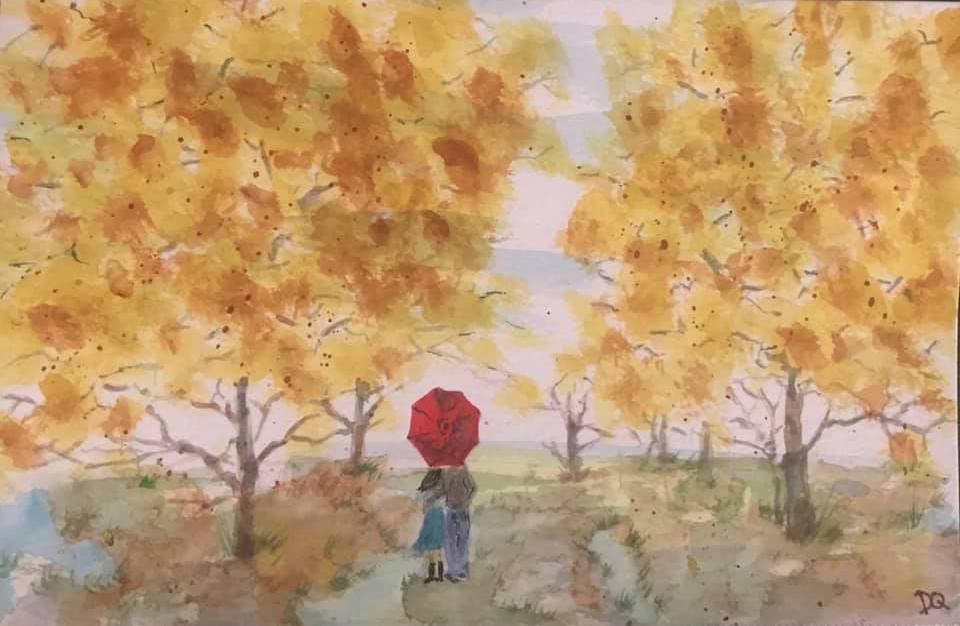
Watercolor by me… Donna Quesada

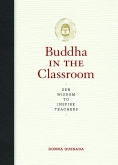
Throughout the course of teaching Buddhism for 30 years, and authoring the book Buddha in the Classroom, I have thought a lot about how to present the basic tenets of the Four Noble Truths in not only the most concise and understandable way, but in the most relatable way. My first attempt to do that was in the “The 12 Houses of Suffering.” The mini stories presented there show every day situations where Buddha’s teachings apply.

Here is a summarized presentation of the Four Noble Truths…

1.Duhkha. Traditionally stated as “Life is suffering,” this basic declaration is more subtle than that, since what Buddha meant was more mental than physical. He was referring to a kind of chronic dissatisfaction that lies just below the surface most of the time, as we go about our lives.

It manifests as a perpetual restlessness, where we are trying to get something else, or get somewhere else, so that we can feel complete. But of course, it doesn’t work, and we continue reaching.

2.Trishna. This is the cause of the restlessness, which is usually stated as desire, or attachment. Said simply, it is the reason why we suffer… We are restless and we suffer because we are attached to something.

But, a better way to think about this second truth is in terms of lack of acceptance. We are not in full acceptance of what this moment is…

In the Zen tradition of Buddhism, there is an expression… “the picking and choosing mind.” The mind reacts habitually to everything with its preferences and aversions. We like this and we don’t like that. We want this but we don’t want that.

To preempt the natural objection here… which is to say, but what about when a situation really is intolerable? Of course, the capacity for discernment is a valuable one, and sometimes real change is needed.

To this, I will emphasize what my own Zen teacher used to say… “When it’s time to eat, you eat, when it’s time to sleep, you sleep, and… when it’s time to march, you march!”

And then you come back to the beauty that is all around you, in real time.

3.Nirvana. There is a way out of our predicament. Nirvana literally means to extinguish, and in this context, Buddha was emphasizing the importance of blowing out or letting go of the constant craving for something new. There is a beautiful logic to this; If our clinging is the problem, then it naturally follows that letting go would be the solution.

4.Marga. This is the path, or the way to do it. Letting go isn’t as simple as letting go of a hot potato, so we don’t burn ourselves. You see, we’re interesting creatures… even though we see that our constant craving for more and better, keeps us trapped, and thus, keeps the fire of dissatisfaction burning, we continue the pattern because habits die hard.

This is where “The Noble Eightfold Path” comes in. It is the detailed way to reshape our habits, by confronting the mind directly.

Because this fourth Noble Truth is laid out in eight parts, I will summarize it, in all its parts, in a separate article which will follow next…

*This article was originally posted on Awaken.com.

On Over-Explaining

The Realization—

It had been a long and exhaustive weekend. We went deep into many areas of personal betterment in a weekend training seminar. Sometimes the simplest-seeming things are the most memorable. One of those moments came when my favorite female teacher answered one of my questions with nothing more than this: “you don’t need to over explain.” I’m not sure I even remember the question anymore… I do remember that it had to do with the problem of explaining difficult concepts. What really struck me was the simplicity of her response. But also the thud of the obvious… such as when you’re hemming and hawing about asking someone to the dance… wondering how to do it, how to approach him/her, and what to say… when your best friend casually suggests, “why don’t you just ask him/her?”

But it sometimes takes years… I mean… decades to learn a new trick. Skip ahead 10 years to a lovely dinner party.

Example—

Host: Oh, you teach Taoism… what’s that about?

What I could’ve and should’ve said: An ancient Chinese philosophy that embraces nature and finding peace within the natural rhythms of life.

What I did say:

Me: ”If I was cornered and forced to explain, in a word, (Hah!… “a word”) what Taoism is, I’d say it all comes down, as all wisdom teachings do, to non-resistance.” (Ohh… but wait there’s more!) “It’s all about letting go,” I continued, “…letting go of our attachments, which conflict with what Lao Tzu calls the way of nature.” (Oh, but yes… I did!)

Another Example

A relative ran an invitation by me…

Relative: We’d love if you could join us on a group vacation to Puerto Vallarta, by cruise ship.

What I was thinking: Hmm… that sounds like a nightmare… I’m not a group travel kind of gal. I have sleep issues, and I like to make my own schedule, and I’m an introvert, and I get seasick.

Which came out like this…

Me: “Well, I’ll have to check my teaching schedule… Things’ve been hectic this last year, with the pandemic and all, and I’m grateful to have work.. so, I gotta accept whatever course-load they offer, since colleges have really taken a hit… so I’ll check in with you sometime in the next few weeks…”

But, this would’ve been enough: “Thank you for thinking of me, but I don’t do well with cruises… Let’s get together when you’re back, though!”

Why Do We Over-Explain?

Why do we feel we have to prove and convince?

Why do we feel that a simple word or two isn’t enough? Is it insecurity? Is it distrust of the other person’s ability to understand? Or, perhaps we seek approval… and so we continue our presentation, looking for that satisfying nod of approval. Is it the overachiever’s complex?… wanting to “be the best student” and do good, thorough work? Especially in my case… having gotten my degree in philosophy, a discipline which requires you to “argue your points with sufficient supporting evidence.” I remember being told that it’s not enough to know philosophy; one must be able to DO philosophy, which captures that spirit of argumentation. That’s why philosophers make good attorneys. This is certainly part of my own answer and the rest is probably a combination of all of the above.

With regard to the overachiever’s complex… life isn’t a classroom. And most people don’t need or want a lecture. And a thorough explanation simply isn’t needed. Most people just want a token word to satisfy a passing lackadaisical curiosity. Especially at a social gathering. And if there’s a genuine interest and a need to go deeper, you’ll know it. All those extra words serve about as much purpose as the extra clothes in our suitcase that never get worn on trips. But we bring them anyway, ‘cause… Better make sure!

Insecurity

But, the more interesting reason has to do with insecurity. Needing the other’s approval.

The Irony: While thinking that saying more will solidify our point, it actually does the opposite. While thinking that having the complete answer will boost our own sense of potency, it actually diminishes it, by making us appear unsure of ourselves. In another stroke of irony, while we think that a lengthy explanation will tighten the fortress against any possible objections, it actually leaves us more susceptible, since the insecurity will be felt. On the other hand, one strong statement communicates solidity, with no aggression, no sarcasm, and no over-explaining. It simply says, this is what it is. period.

Accept Your Power

My own teacher, Guru Singh, speaks often about self-authorization. This is another way of saying accept your power!It means breaking through the self-imposed blocks that we place on ourselves, due to the old fear-based, restrictive stories that we have been imbibing for years… stories that come from every corner… family, culture, educational systems, peers and social media.

With this freedom there are no blockages; you have the probability of every possibility; ideas and solutions for each moment are inside of each moment…you’re virtually unstoppable.” Of course, with this incredible freedom, you must now deal with the ‘equal and opposite’ — it’s the law of nature. The equal and opposite of total freedom is the daunting sensation that you have no right, you have no authority to be so free. This is life’s natural reaction; the only way around this is for you to be ‘self-authorized’ — give yourself the authority — no one can do this for you. It’s called Raj Yoga for a reason — the universal authority of royalty. ~Guru Singh

As part of our own awakening process, which includes the granting of our self-authorization, it’s crucial to reflect on our beliefs, which are built on the foundation of all those stories. If they are disempowering and limiting, then they will continue to compromise our ability to trust our own voice, our own convictions, as well our own personal truths. And we will lack the confidence to speak directly and simply. Funny, it goes back to the most oft-repeated refrain in all of western philosophy… Know Thyself.

*note: I originally wrote this article for Awaken.com

Simplest Relationship Advice, Ever

If you’re happy and satisfied within yourself, you’ll find any reason to be happy while in the company of anyone else. Your perspective will be shaped by your state of mind, and thus, you’ll see only the good in them and all around you.

But, if you aren’t happy and satisfied within yourself, you’ll find any excuse to be disappointed by what the other does or does not do. You’ll notice the offenses readily and will be quick to spot the deficiencies everywhere.

The latter sets up a kind of neediness, in which, you’ll look constantly to the other person to do certain things or stop doing certain things, so as to fulfill the fantasies in your mind and your idealized vision of how things should go.

This is what Esther Hicks refers to as “looking for love in all the wrong places.” It is why self-care and your relationship with yourself is at the core of all other relationships. Like a healthy heart, it keeps everything else around it healthy and happy.

I know it is tricky because… “what about when the other really does display intolerable tendencies and inappropriate patterns?”

In response to this all too realistic objection, I am thinking of Alain de Boton, a fellow philosopher, and his successful Ted Talk called Why You Will Marry the Wrong Person. In a humorous way, he suggests that we are all… well… a bit crazy. We’ve all got surprises and hidden neuroses that make us all challenging to be around. And to expect to find someone who doesn’t require some tolerance and patience and forgiveness is fanciful. Even foolish.

It’s not to say that there is never a time when walking away is the right thing to do, but when it is, you’ll know so surely and confidently, that you won’t need an article or a Ted Talk to tell you. You’ll feel the answer in your bones.

Internal Conflict (not desires) Causes Suffering

It is not desires that are the root of misery, angst and suffering. It is conflict of desires.

On Desires—
Firstly, many desires may be seen as intrinsically noble, such as the desire to be enlightened, or, the desire to serve the world through one’s unique skill set. Secondly, many desires are simply natural, such as the desire for the next breath. Thirdly, many desires may be classified as “neutral,” such as the desire to learn to play the violin. With all of them, problems and frustrations arise only when we don’t know how to manifest them, or when there is a conflict with another desire. It is this latter point that I will focus mostly on, below.

Of these many varieties  of desires, there is only one sub-species that I would call inherently “bad,” namely those that include causing harm to others as a motive. The others are not inherently bad, in and of themselves.

Internal Conflict—
The real problems start when we are torn and divided. This is what I’ll call internal conflict and it is at the root of all disharmony, frustration and all havoc, from benign to catastrophic. From the everyday nuisances, like wanting to eat the whole bag of cookies to the huge life-changing situations, such as divorce.

There is always conflict underneath. In the first example, there is a conflict of more than one desire, since on the one hand, you may want to eat the cookies, but on the other, you don’t want to consume all that sugar, or gain weight (so, the other desire would be to maintain your weight). And, in the second example, you may want a long-term marriage, but you also want an honest marriage. If you’re in a situation where this isn’t possible, it will likely blow up in some way, such as in a divorce.

Another example may be: you want to go to Europe for a month, but you don’t want to miss work (so, the other desire would be to continue being productive at work). Again, the internal conflict will likely blow up. Not in such a cataclysmic way, as in divorce, but in a subtler way, such as in the everyday vexations that we all experience in life.

Lurking underneath what Buddha called dukkha, or suffering, you will find that there is an unacknowledged secondary desire. It is just a matter of digging a little deeper in your contemplation.

As a final example, imagine you were a homeowner who wanted very much to get going on the construction of your house. It is taking too long, and if you had it your way, you’d simply call a contractor and tell him to “make it happen.” But real life is more complex. You have to wait for your spouse, who is too busy with work priorities to share in the planning and expenses. So, you have to wait. In this case, we can say that underneath the desire to continue with construction is the pre-existing desire to keep peace in the household.

If it were as simple as wanting to build a room, with nothing standing in your way, you’d simply manifest the desire and move on. The desire, alone, would not be the problem. When something is standing in your way, such as lack of funds, or bad-timing, as in the play-out above, the obstructed desire transmutes into an unhealthy attachment.

As such, it is the internal conflict, caused by discordant desires, that causes suffering.

Manifestation (Three Ingredients)

Through my own personal experience of bringing into my life the situations that reflect my heart’s true longing and my soul’s sense of purpose, I have discovered three essential ingredients in manifestation.

1.Intention.
Articulating your intention, whether mentally or out-loud, is part of the act of creation. It is a heartfelt message to your conscious self, to all the layers of your psyche and to the universe, as a whole, in all its hidden workings. It’s as I tell my college students, when I ask them to articulate a response out loud; once you say it to yourself, you have connected the dots, you have turned something vague into something usable, retrievable…something real.

Intention, after all, is what is responsible for the astounding wonder of placebos, which have brought about the same results as the real thing, time and time again; the power of prayer, which continues to mystify the non-believer; and the success of great athletes, whose mental run-throughs of the big event, have proven to be just as effective as the actual physical activity—even down to the neural level. When we direct our focused intention on a specific result, it activates its fruition. Energetic flow follows your attention.

2.Feeling
It is not new to speak of ourselves as vibrational entities. Anything written about the Law of Attraction will remind us of the inevitability of bringing into our lives that which is vibrating at a similar frequency. In this sense, we are a bit like a two-way transmitter, which sends and receives subtle signals via vibrational energy that is constantly moving through the universe. This energy is like a web that contains us and wholly engulfs us because we’re indistinguishable and inseparate from it. Think of this energy nexus like a spider web—when touched on one end, the corresponding vibration will reverberate all the way through to the other end. Everything affects everything. And it starts with our very thoughts.

The question is, how do we consciously direct this signaling? How do we program the wave motion?

Other writers have said that it is this signaling that determines what we project and bring into our lives, rather than our feelings, thoughts and desires. But this is to beg the question (in the true philosophical sense). For, we may ask, what shapes the signal?

What we feel!

What we feel defines our energetic flow, our state of being and the vibrations we signal out to the universe and to everyone we interface with.

Choosing what we feel is much more advantageous than letting our feelings choose us. This is what Yoga is all about—stilling the mind, so as to bring it into union with all that is.

This is also what free will really means.

The more conscious we are, the more control we have over what we choose to do in life. Or, put differently, the more conscious we are, the less enslaved we are by our mind’s whims and emotions, all of which are shaped by the incessant thoughts that buzz through our mind, like a swarm of bees, at any given moment.

So, consciously pausing to ask, what do I want to feel, is an important part of getting hold of the runaway train and purposely bringing ourselves into alignment with our heart’s true longing. It’s a bit like wagging the dog, in that we’re going from the outside in; starting with feeling, rather than thought.

For example, in the proclamation, I am joy…what does joy feel like?

My teacher, Guru Singh, sometimes reminds us of what may seem inevitable: To “experience the experience.” To really experience this moment, is to be completely present in this moment. It is also to be completely present in our body and mind. What does this moment feel like? To embody the moment is to literally get into our bodies, our whole selves. Normally, we become very closed in, as if blanketed under the fog of those thoughts and worries. We become myopic and unavailable, when we’re not present and fully embodied in this moment. So, to feel it is to make it real.

It’s like saying, “I’ll believe it when I feel it.”

3.The Present Tense
Notice the proclamation above: I am joy. It is stated in the present tense. Wayne Dyer talks about this aspect of manifestation in his book, Wishes Fulfilled. Saying, I will be joy, is much different than saying, I am joy. The first says simultaneously, that, I’m not yet joy, but I hope to be, in the future. That’s not good enough! And this goes way back in Yogic philosophy. Consider the most essential mantra: I Am That. Or, I Am That I Am. It doesn’t say, I Will Be That! Try it with any statement: I am prosperous (which just means, to do well), or, I am healthy. Time is just an illusion, anyway. It’s just a matter of the event unfolding into the perceived now.

But, What if the New (fill in the blank) Makes Me Happy?

buddhaMy students and I were talking about the aging cover model in the story, how she was willing to go into debt just to get her neck done. In her warped sense of reality, maintaining the appearance of youth and the false promise of hope that she might have a second spin in this harsh industry, it made perfect sense. This story is part of a grouping of short anecdotes, called The 10 Houses of Suffering, that I wrote to give a better idea of what Buddha really meant by Dukha—the root of human suffering.

Then one student asked a reasonable question about our right to spend money on whatever makes us happy:

Student: Isn’t it our right, as mature individuals, to buy things as we like? I mean, what if the new BMW…or the new iPhone…or the new Kobe shoes, makes me happy?

Me: In a practical sense, yes.

But don’t miss the subtle implications of what you’re being asked to consider. If, as the Four Noble Truths go on to explain, our deep-rooted discontent and enduring lack of fulfillment is caused by incessant desires, then those desires must either be inherently wrong or else misguided. And our equally ingrained tendency to cling to stuff, must derive from some confusion on our part, about what it is we’re looking for. Whether it’s the new techie gadget, hairdo, nose job, your college admission letter, or something more intangible, like your idea of what life will be like once you get to UCLA, desires crop up like weeds, with a new one popping up to replace the old one, just as quickly as it’s satisfied.

So we fasten our grip, time after time, around some new fantasy that we think will fix everything. So the pickle we find ourselves in, is about more than the consuming. It’s about the wanting. It’s about what we’re looking for and the ways we go about finding it.

The drug addict (one of the 10 Houses) has the right to dope himself up one more time, for that quick fix, the instantaneous thrill and quick-lived sensation of gratification. But from the outside looking in, we see that he’s sedating himself into a half-dead stupor, an action that he’ll repeat until his death. Unless he wakes up.

This is the shadow-side of all attempts, in fact, to find happiness through external means. They are interminable and our desire for them is insatiable.

The more profound question is whether we are akin to this fellow.

For millions of people, turning on the TV is automatic. But consider the message that is relayed, the minute it lights up: if we wear Chanel No. 5, you’ll find ecstasy; if you lose 10 pounds before the holidays, life will be perfect; if you’re a bald man and you suddenly grow hair, five bikini-clad 20-year-olds will come and sit on your lap; if you win the lottery, you’ll live happily ever after; if you party in Las Vegas for the weekend, and lie to your partner about your whereabouts, your problems will disappear, and it will be your secret.

I would like to clarify a common misperception about spiritual disciplines and desires. We’re not talking about just any desires, but rather, the desires for things that we think will make us happy.

And that’s the crux of it…those things then become conditions of our happiness.

Reconciling Free Will with Destiny (and how about fate?)

free-willIt’s hard to imagine Pavarotti or Maria Callas not ending up as singers. It’s as if they came to uplift, inspire, heal and delight the world with their voices. Each soul is incarnated to fulfill its destiny, according to Yogic philosophy, and when we awaken to that purpose, we are living according to our destiny.

A poetic expression of this idea is found in this passage:

Your mission is to vibrate higher in your vessel so you awaken completely to your sacred purpose. ~Dror B. Ashuah

This awakening is the key to our sense of fulfillment. But it is a huge challenge in a society, which would tempt us, left and right, to seek fulfillment from external sources and all things pinned to appearance—from the allure of a sexy body to the amusement of a new gadget, to the promises of the perfect dream vacation. Profit is made by keeping us trapped in a cycle of codependency and separateness. The tragedy is that we are kept from our own inner power. The result is a never-ending cycle of unrecognized addictions of every sort, in which, fueled by a vague neediness, we go on supporting this infrastructure—a mega-system that thrives on our insecurities.

How can we wake up from this codependency and align ourselves with our destiny? This wisdom, this sense of knowing is already within. It is the little spark of light that shines forth from within. But because the fog of our emotions and obsessions is so thick, we often miss it. But when we pause for a moment to let the fog settle, we find it. And we delight in its warmth. And sometimes we summon the courage to trust that light and let it guide us along our path.

Where does free will fit into this?

The minute we come to center, we find ourselves nourished. Like drinking from the nectar of our own internal fountain of bliss, we feel full. Those things on the outside seem to lose their appeal. We realize that what we tend to call free will, is but a confused mix of desires shaped by others and meant to mask insecurities. We have taken the reins of our life. But this requires the choice to wake up from those things that have held us hostage for too long—the things on the inside, like unhealthy emotions and insecurities, as well as the things that keep us wobbling around on the outside. As soon as we stop believing that there’s a quick fix “out there” in the world of pills and thrills, we begin to take steps on our true path. And we begin to resist those things that take us off our path. This is the beginning of waking up.

So, what is fate?

Fate, according to Yogic wisdom, is the black hole of other people’s opinions and ideas. It is the nowhere land, in which we get lost in the web of expectations and pressures set by others, be it society, parents, or personal delusion. These pressures drown out the voice of the spirit and over-ride our own sense of self-authority and purpose.

Every time we come to center, we have made a choice. We have honored our commitment to align with our sense of purpose. This is free will.

Walking our path, guided by our ever-brightening inner light, we encounter our karma (which doesn’t mean punishment). Think of karma as the residue of our actions, either in the here and now or in the here to fore. It is everything we have inherited, assumed, absorbed and adopted—from our DNA, to our zodiac sign, to our first kiss, to our first break up. It’s the record of all the patterns and habits that are embedded in our mental, physical and psychological selves, right down to our very cells. Why bother about it? Because that which would transform has first to be exposed.

And this process of transformation is strengthened by our moment-to-moment commitment and through the tools of practice—which we may call “spiritual,” since the desire to come back to center and to wholeness is a spiritual one. These tools include, but are not limited to, the uplifting presence of community, meditation, movement, and especially, intention.

Waxing philosophical.

Am I, as the western philosophers would say, pre-supposing the existence of free will? To that, I extend a brief summary of Sartre’s position, that as conscious beings, we are innately free. Where I differ (and where I differ from my earlier position, as expressed in my book, Buddha in the Classroom), is on how this relates to destiny. Diehard existentialists, like Sartre, reject any suggestion of a deterministic universe, one which would open up a world of easy excuses that render us helpless, like puppets on the strings of our inherited tendencies. Typical of the western tendency to polarize beyond repair (and even more typical of an existentialist like Sartre, who was allergic to any species of God-talk), destiny and free will are seen as irreconcilable.

But, what if we instead, look upon destiny as a flexible journey, in which my will and God’s will (or universal will…or divine will) are one and in sync?

To be clear, free will, as it is typically defined, is the ability to choose from among genuine alternatives. In the world of eastern mysticism, we go further here, too; while existential freedom describes our conscious choosing, the Yogis were more interested in our state of consciousness, itself.

The difference is subtle but immense, since it is our state of consciousness that structures what we see as choices, in the first place. What most people think of as freely choosing is nothing more than habit patterns and uncontrollable desires for things that aren’t necessarily good for us. The more conscious we are, the more inclined we will be to investigate those ingrained tendencies (what the Yogis call samskaras), and the more adept we will be to change what we can and reconcile ourselves lovingly with those we can’t. This happens through those Yogic tools and through all meditative practices, which temper our reactive mind while taming the twin dragons; fear and anger.

Ultimately, the more conscious we are, the more freedom we have.

Judge Not Lest You Be Judged (Here’s Why)

This teaching is part of the common thread that runs through all wisdom teachings. Here, I explore the reasons why.

1. Because we don’t have access to the Akashic records. The universal perspective is not always revealed or in accordance with our clock, our limited perspective or our expectations. Life and its workings are too vast.

Case Study. Consider the old story of the Taoist farmer whose horse runs away. His neighbor is quick to come and appraise the situation: “What bad luck!” he declares. The farmer just shrugs his shoulders. When the horse comes back with another horse, the neighbor comes again: “What good luck!” The farmer just shrugs. When the farmer’s son tries to saddle the newly acquired, wild horse and breaks his leg in the process, the neighbor comes again: “what bad luck.” The farmer shrugs. Finally, when the army comes, ready to haul the kid off to a bloody war, they take one look at his broken leg and decide to leave him behind. “What good luck! Your son sure picked a good time to break his leg!” the neighbor proclaims.

A broken leg is generally not seen as a “good” thing, but in this case, it saved the kid’s life.

The farmer was too wise to get involved with these assessments. He knows he doesn’t know what’s good or bad in the big picture. He is able to let it unfold and is willing to honor the process. This takes wisdom, humility and courage. Wisdom to know we don’t know. Humility to yield to the unknown and courage to be fine with it, regardless of the outcome.

It’s a willingness to live in trust, rather than in fear.

2. Because everyone has lessons to extract from each and every event that appears in their lives. And as my teacher often puts it, the messenger will keep coming back until the message has been delivered. Everyone has their karma (which doesn’t mean punishment).

3. Because, by judging, you now take the karma. (Doubly: for interfering and because you have demonstrated need for the lesson and compassion for that perspective.)

4. Because the judging is more a statement about you, than the object of your criticism. Our reality is shaped and limited by our thoughts and experiences, meaning, our perceptions provide us with a very limited viewpoint. This means, further, that it’s guaranteed we don’t have the whole story. Only at the end of time can we make over-all assessments. Who will be here? This is why the wise know better than to speak.

Those who say don’t know and those who know don’t say ~Tao Te Ching

But in the guise of “being concerned,” we speculate, condemn and as Zen author Karen Maezen Miller is wont to say, we run commentary. The base assumption is that the other—even when (especially when) the other is a family member—needs our concern. That energy could be better directed inwardly, toward our own needed improvements, for we are all a work in progress.

If you have reached a state of human perfection and have no need for continued work and improvements…Congratulations! Your work here on earth is complete.

Here is an example that both highlights the absurdity of making judgements about others and at the same time, illustrates the workings of truly turning the pointer to the inside, rather than toward others:

Case Study. Your aunt tells you your wife needs to dress differently because her way of dressing, she feels, will influence her daughter to dress in a way that solicits male attention and fosters promiscuity.

But, in your reflections, you note that when it comes to alcoholic beverages, your aunt tends to serve herself generously, sometimes to the point of excess. If we look from a wider lens, and follow her own logic to the end, we see that this, too, might be setting an undesirable example—it may foster alcoholism, or at the very least, irresponsible drinking in her children. Of course, the whole thing is absurd and endless, for, everybody has “stuff.”

I have a dear friend who now avoids a member of her own family for habitually starting sentences with “You need to…” As we become more conscious, we also become more aware of how often our words express this kind of judgmental attitude toward others.

Here’s what it boils down to:

❖ Everybody is a mixed bag, with aspects that we might label as “good” and others as “bad.” And everybody has a history, complete with skeletons and dregs of many varieties. Acceptance of people as evolving entities, like ourselves, fosters better relations.

❖ We are shaped by countless influences, from our Zodiac sign, to our favorite TV show growing up, to our first kiss, our first best friend, our first broken heart, to more obvious, genetic and social factors. Meaning, we are a confluence of infinite influence.

❖ We don’t know how others will perceive us (The young girl in my example will probably only see the good in her aunt. As in The Little Prince, only adults discriminate. Children see through, to the heart of a person.)

ACCEPTANCE; Life in the balance – accept it all. Nothing is good or bad but thinking makes it so. It is the nature of the universe to establish balance; thus, trying to prevent perceived bad will also block desired good. Instead, welcome challenge and difficulty, enjoying the indicated activity, and growing in each situation.” ~Guru Rattana