Tag Archives: religion

The Hindu Notion of God… How To Know Brahman Pt II

Experiencing or realizing Brahman isn’t about believing in an idea—it’s about directly knowing the ultimate reality through the transformation of consciousness. It’s the kind of knowing that can only come from experience.

How do we gain those experiences? Through the Yogas. Although the word “Yoga” is often associated with physical poses here in the west, its roots come from the Sanskrit “Yuj” and means “to yoke,” or rather, to connect to the divine that is within and without.

As I explained in Part 1 of this series on Brahman, in Hindu spiritual teachings, the divine is everywhere… there is nothing that is not divine. The Four Main Yogas highlighted below, explain the pathways to Self-Realization… to realizing that divinity within.

Note that I will interchangeably use expressions like “liberation,” and “Self-Realization,” to convey what can never be described adequately with words… the direct experience of Brahman.

Said more simply, these Yogas are the paths to God…

1.Jnana Yoga (Path of Knowledge)

This is the path of the intellect. It focuses on the philosophical ideas and meditative disciplines taught in the Upanishads and in the Advaita Vedānta.

An example would be Ramana Maharshi’s approach, which emphasizes self-inquiry to realize the Atman, or the little spark of Brahman that lies within. The central practice involves asking the question “Who am I?” to trace the sense of self back to its source and to prompt the realization that the sense of “I” is not a separate entity, but rather, just a stream of thoughts.

This method helps to dissolve the ego and to see the Self as the underlying, unchanging reality. Zen Buddhism is in many ways, a continuation of this path, with the Kensho experience of sudden enlightenment, being not unlike the realization experience of Jnana Yoga. The differences emerge in the context of Buddha’s skepticism of the permanence of the soul.

The idea is that when all identification with the body and mind falls away, the seeker awakens to Brahman — the infinite, formless consciousness — and to the unmistakeable knowing that it is none other than “I.” It was within all along. You are it and I am it and there is nothing that is not it.

2.Bhakti Yoga (Path of Devotion)

This is the pathway of the heart. It is the devotional path, which is emphasized in the Bhagavad Gita.

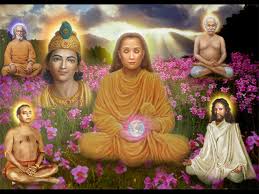
Here, Brahman is experienced as the personal God — whether we are referring to Krishna, Shiva, Devi, or any beloved form, including Jesus and Mary and all the saints. For the truly devotional, there is no distinction between traditions! They are all Bhakti traditions, and serve as portals to the divine.

I like to say that if Jesus and Buddha met at a gathering, they would find in each other, an instant kinship and would break bread together while talking and laughing into the wee hours of the night. It is we ignorant mortals that like to put a partition between the spiritual traditions.

In Bhakti practices, such as prayer, chanting, and silent devotion, the devotee surrenders his/her ego and experiences the feeling of oneness within.

Eventually, the sense of the separate “I” dissolves, and only divine presence remains, which is another way of realizing Brahman.

3.Raja Yoga (Path of Meditation)

This is the Yogic path described by Patanjali in the Yoga Sutras, and focuses in large degree on stilling the mind. To this end, Patanjali outlines the Eight Limbs of Yoga, which form a cohesive system that begins with lifestyle, then addresses the energies of the body, and ultimately tames the wild horses of the mind, so as to achieve Self-Realization.

In summary form, here are The Eight Limbs of Raja Yoga:

  • Yamas (ethical restraints): My teacher called these the “what not to dos” because they include instructions to avoid harming other beings, and to avoid greed. The idea is not so much to moralize, but rather, to stay away from behaviors that tend to reinforce the ego and the idea of the separate self.
  • Niyamas (observances): While my teacher called the Yamas (above) the “what not to dos,” he called these the “what to dos” because they include things like commitment and surrender, which all contribute to a calm, simple and disciplined life, and make liberation more likely.
  • Asana (physical postures): These are the postures that most people in the west identify as “Yoga” (although the postures are but one step, in a multifaceted approach to Self-Realization!). Patanjali’s inclusion of postures recognizes the body as a more approachable vehicle toward the ultimate goal of taming the mind. The body is more tangible and allows us to break through our physical resistance to stillness as we get better at focusing our attention inward.
  • Pranayama (breath control): One of my teachers would always remind us that “there is only one thing the mind will follow, and that is the breath.” Working with our breath is the most viable way to calm the nervous system and in turn, the busy mind.
  • Pratyahara (withdrawal of the senses): I like to think of Pratyahara as the discipline of managing our external distractions. It’s an application of what any elementary classroom teacher meant when he/she would tell us to mind our own business and stop worrying about what others are doing. We are cultivating the discipline to go inward.
  • Dharana (concentration): If Pratyahara (above) is the discipline of managing our external distractions, then Dharana is the discipline of managing our internal distractionsThe ability to concentrate is not always automatic. Our thoughts take us hither, thither and yon, and harnessing the frenzied energy of the mind takes practice.
  • Dhyana (meditation): This is the real objective. This is the ability to sit in meditative stillness. This is what it has all been leading toward. The word “Dhyana” eventually became “Chan” as Indian teachings made their way into China, “Seon” in Korea, and “Zen” as those teachings continued on their journey to Japan. Hence, Zen focuses on seated meditation as a vehicle to enlightenment.
  • Samadhi (absorption): Samadhi is the experience of being absorbed in the divine. In Zen, it is called “non-distracted awareness.” In this state, the individual mind merges with cosmic consciousness.
  1. Karma Yoga (Path of Selfless Action)

Taught in the Bhagavad Gita, this path transforms daily life into spiritual practice. The seeker acts without attachment to results, dedicating all actions to the Divine. The idea is that selfless service (seva) purifies the heart and dissolves the ego — allowing a gradual experience of God realization.

When a man sees, hears, touches, smells, and tastes what is real, and realizes that the Self is Brahman, he becomes free from sorrow.” ~Upanishads

The Hindu Notion of God… What is Brahman? Pt I

What is Brahman?: To be absolutely direct… everything… meaning, EVERYTHING that exists, is an expression or manifestation of Brahman. This means that all the Gods that are associated with Hinduism, are Brahman. Shiva, Krishna, Parvati, Durga, Lakshmi… all of them, are manifestations of Brahman. Humans are Brahman. The trees, rivers, and all the animals of the seas and forests are Brahman. Energy is Brahman.

Again, like the actors on a stage, Brahman just appears differently in different contexts.

Brahman is the universe and everything in it. Since Brahman is everything in the universe, the concept of the universe, and the universe itself… and since Brahman is divine, it is self-evident to simply say that the universe is not separate from the divine.

Pantheism

This is the pantheistic aspect of Hinduism… Everything is divine. God is everywhere and in all things. Pantheism just means that nature is inseparable from God. God is everywhere and in all things.

When you look into a creature’s eyes, you are looking at God. When you wrap your arms around a tree, you are embracing God. When the beauty of a sunset renders you speechless, you are experiencing God.

In a pantheistic universe, all of nature is sacred. In a pantheistic mindset, we feel a natural sense of unity and kinship with all beings, since all beings are Brahman. All beings are sacred.

Hinduism is often mistakenly described as “polytheistic” because of the appearance of so many deities. But they are all aspects of Brahman! So, then why have all the Gods? Because Brahman can seem too abstract to conceive of, and we need a tangible manifestation of source energy to relate to… and to embrace. The many manifestations present in the Hindu pantheon of Gods represent the many ways that God appears.

Like us, God isn’t just one thing. He is a she sometimes, and an it at other times. He is loving sometimes and harsh at other times. She is peaceful and then downright angry. This is very different that the western point of view, in which God is generally thought of only in the masculine form and described as all good all the time. Here, God is not so different from us… we have many aspects to our personality, rather than just one.

But, of course it’s no different than us… we are IT!

The metaphor used in the early Hindu scriptures, to emphasize the oneness of all, is the ocean. We feel so unique. We feel separate. But that’s just our ego. We are just waves on the surface of the ocean… for a while, our ego tells us we’re a big beautiful wave… and everyone, everywhere, would love to just lay their eyes on us… photographers would love to capture our perfect barrel, and surfers would travel near and far to take us on!

But alas, we will crash back into the same ocean from whence we came. Moreover, we were never any different!

Buddha’s Four Noble Truths: Part I

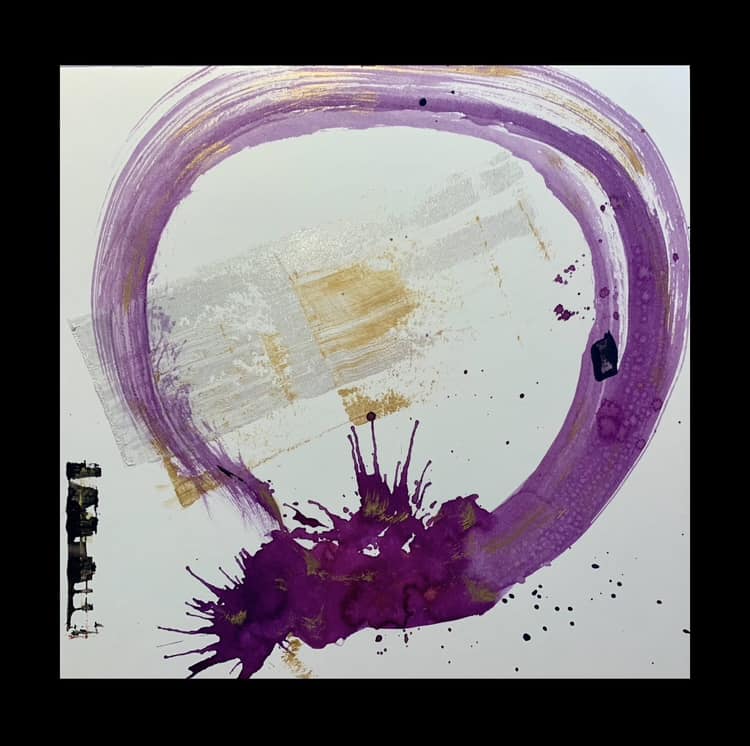
Watercolor by me… Donna Quesada

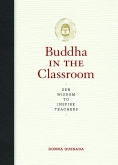
Throughout the course of teaching Buddhism for 30 years, and authoring the book Buddha in the Classroom, I have thought a lot about how to present the basic tenets of the Four Noble Truths in not only the most concise and understandable way, but in the most relatable way. My first attempt to do that was in the “The 12 Houses of Suffering.” The mini stories presented there show every day situations where Buddha’s teachings apply.

Here is a summarized presentation of the Four Noble Truths…

1.Duhkha. Traditionally stated as “Life is suffering,” this basic declaration is more subtle than that, since what Buddha meant was more mental than physical. He was referring to a kind of chronic dissatisfaction that lies just below the surface most of the time, as we go about our lives.

It manifests as a perpetual restlessness, where we are trying to get something else, or get somewhere else, so that we can feel complete. But of course, it doesn’t work, and we continue reaching.

2.Trishna. This is the cause of the restlessness, which is usually stated as desire, or attachment. Said simply, it is the reason why we suffer… We are restless and we suffer because we are attached to something.

But, a better way to think about this second truth is in terms of lack of acceptance. We are not in full acceptance of what this moment is…

In the Zen tradition of Buddhism, there is an expression… “the picking and choosing mind.” The mind reacts habitually to everything with its preferences and aversions. We like this and we don’t like that. We want this but we don’t want that.

To preempt the natural objection here… which is to say, but what about when a situation really is intolerable? Of course, the capacity for discernment is a valuable one, and sometimes real change is needed.

To this, I will emphasize what my own Zen teacher used to say… “When it’s time to eat, you eat, when it’s time to sleep, you sleep, and… when it’s time to march, you march!”

And then you come back to the beauty that is all around you, in real time.

3.Nirvana. There is a way out of our predicament. Nirvana literally means to extinguish, and in this context, Buddha was emphasizing the importance of blowing out or letting go of the constant craving for something new. There is a beautiful logic to this; If our clinging is the problem, then it naturally follows that letting go would be the solution.

4.Marga. This is the path, or the way to do it. Letting go isn’t as simple as letting go of a hot potato, so we don’t burn ourselves. You see, we’re interesting creatures… even though we see that our constant craving for more and better, keeps us trapped, and thus, keeps the fire of dissatisfaction burning, we continue the pattern because habits die hard.

This is where “The Noble Eightfold Path” comes in. It is the detailed way to reshape our habits, by confronting the mind directly.

Because this fourth Noble Truth is laid out in eight parts, I will summarize it, in all its parts, in a separate article which will follow next…

*This article was originally posted on Awaken.com.

The Crazy Element that Makes Art… Art

What Does Art Have?—

Aesthetics has always asked, What does all good art have in common? Is there some common denominator? What is art, anyway? What is beauty? There may be more than one answer to those questions. Sometimes art does different things and serves different purposes. Andy Warhol’s Brillo Boxes stood as art (and not Brillo Boxes) because of what they were “saying” about consumer culture. I spoke of that here.

Lessons Unit: Brillo: Is It Art? – The Andy Warhol Museum

As Immanuel Kant said, art invokes within us, a sense of awe and deep pleasure. Like nature, it takes us where words cannot.

This helps us understand what art does, but still feels inconclusive, as far as what art has. Or is.

Yet, after taking great interest in aesthetics as a philosophy student, through my 20s, I still couldn’t answer, at least to my own satisfaction, the question: What does all good art have in common? Even if there are multiple answers, or none at all. (Maybe it’s like asking what religion is… there is no common denominator. Only what scholars have termed “family resemblances.”)

Nonetheless, it is only now, through direct experience, after 30 years of painting in watercolor, and writing poetry… and writing in general, have I started to get a glimpse of what I feel to be a truthful response.

But first, indulge a memory with me… I promise, it’ll bring us back to the question of art!

The Storm Rolling In—

I remember running to the classroom window, pushing aside those heavy beige, vinyl drapes, to see the sky turning dark, and the sudden burst of light that illuminated the asphalt outside. Then the rumble. And the anticipation it brought on… how loud will it get? How close will it come?

It wasn’t merely because we rarely get ferocious storms in Southern California. My excitement, which I still feel when storms approach, reveals more than that. Alluding to Kant again, who recognized that nature most powerfully elicits that sense of awe, that all art is but a kind of exemplar of the sublimity we find in nature, we find our clue as to what makes both art and nature riveting in the same way. And, the storms outside of LA were all the more so.

It was in the Midwest somewhere… we heard it coming. Like a high speed train roaring. Getting closer. As we ran to open the door, the wind pushed it against the wall. Yet, we couldn’t resist and so we charged into the flurry and out into the middle of the street and it felt like the world was coming to an end. We stood and watched with wild hair and our arms outstretched against the electric jet stream of warm air. We were buzzing. Suddenly turned the heavens poured out a river and in 20 minutes, it was gone.

Jason Bonham’s Led Zeppelin Experience—

I felt that frenzied excitement when I saw John Bonham’s son and his Led Zeppelin Experience last year. My own reaction was totally unexpected. But that’s the whole point, as I’ll explain below. A genuine reaction to art is, and has to be, totally uncontrived. And to do that, the art will possess some element that is wild, like the storms above. More on that in a moment. When those first notes of Immigrant Song exploded, I was, at that moment, like a teenager. I remember jumping up out of my seat, straining on my tiptoes to see… at any cost and discomfort… perhaps managing to blurt out Oh My God a few times because I couldn’t say anything else. Because I couldn’t believe what I was seeing or hearing. Because teenagers do crazy things. Because teenagers have energy (except for when they can’t get out of bed).

Presence (The location of Beginner’s Mind)—

More to the point, a youngster’s sense of physical presence exceeds their mental ruminations. And since thinking is draining, the result is vitality… and there has always been an inverse relationship between presence and the degree to which you are in your head. Meaning, the more you are in your head, in the world of thoughts, the less present you are. It starts when we become adults. When we become rational. Teenagers haven’t gotten there yet. So, they are still free.

That’s why we adults have so much fun at events like that, we don’t just act like teenagers for that moment in time. We become as kids again. Because we are in our bodies… not in our heads. The music (and all art… and nature) is a conduit for feeling. We are feeling the music, and leaving the world of thought behind for that moment. And thus, we have no sense of “should be’s.” We act naturally, in all our exuberance. In Zen, this is what it means to have a “Beginner’s Mind.” To be blissfully ignorant of the world’s ideas and judgments. And so, free to express oneself authentically.

Crazy… It’s The Same Criterion for Both The Artist and The “Feeler”—

It’s not holding back. When a singer moves us it’s because she’s not holding back. She’s willing to sing at the edge, right at the place where her voice might crack. But she’s not concerned with that. She’s not playing it safe. She’s not tightened or constricted or self conscious. It’s what good writers do. It’s what good actors do. She’s doing, in her art form, what we wish we could do in life. She’s purging emotions as we wish we could. And thus, there is a purification process in the art exchange, for both artist and viewer, through the feeling of release.

And so, we’ve come around to what I feel answers the question… What does all good art have in common?

It could be said this way: It’s the element of crazy. Something wild and crazy has to happen in that painting, in the dance, in the routine, in the song, in the performance.

Why? Because art unleashes something that has been laid to rest in the depths of our soul… Ultimately, it’s fear. At the very least, it reveals what we wouldn’t do in “real life.” In that sense, it is therapeutic. It is revelatory. It reveals the capacity to let go and to abandon ourselves. It reveals possibilities we thought weren’t for us… to be whimsical, carefree and unguarded. To be fearless.

Which ultimately means… To be FREE.

When asked, “what does freedom mean to you?“ the iconic singer Nina Simone simply said, “to be fearless.”

But we don’t dare, in our everyday lives. We were taught to be rational. We’re careful. We’re measured. We’re prudent. We’re tight. We don’t dare take a chance!

The Wild Stuff Makes it Special—

It’s the big, bold tree stroke in the foreground of a painting. The stroke that makes you think, as an artist, or someone watching from behind, as you’re about to do it, “Oh no!… You’re going to ruin it!“ because the background was done so carefully. Reason will dictate… Leave well enough alone.

That’s where art steps in. Art messes it all up, like crazy hair. Like that sky that turned black before it opened up and flooded the streets for those 20 minutes.

Art is where convention is, ipso facto, irrelevant, since creativity is by its very definition, the birthing, or the configuration of something new. And this process often looks weird or wild or simply… crazy. To be clear, this doesn’t and shouldn’t mean harmful. Nor necessarily loud. But it does mean bold… in myriad ways. Think John Cage in his silent symphony. Think Marina Abromovic, in her meditative, interactive art. Think Cindy Sherman in her performance pieces, which feature herself as objet d’art, in different guises. All pushed boundaries and convention in their own weird and wonderful way. Keep in mind, to sit still is bold. To be quiet is bold.

In a more prosaic example, I remember seeing footage of Joe Cocker singing at Woodstock, as a girl… I asked my mom what was wrong with him… why was he shaking? Yet I couldn’t take my eyes off of him.

Nothing new? The row over Marina Abramović's next show | Apollo ...

Beginner’s Mind—

It’s that element of crazy, again. It feels like freedom—the most basic human requirement. It’s the quality of being uncontrived. The Zen masters call naturalness. And it springs forth from the “Beginners Mind,” which is a mind that is free of concepts. In plain terms, it is a mind that is free of the “should be’s”. Free from fear of failure. Free from the corruption of other people’s judgments and opinions. Free from the rules of convention that we spoke of. Totally spontaneous and totally yourself. Joe Cocker let the spirit move through him (and the drugs). Cindy Sherman had to disappear, in a sense, in order to become the characters she became.

A Strange and Perfect Pairing of Chutzpah and Selflessness—

It’s chutzpah. It’s bold. It’s brave. It breaks the rules. It can’t be tamed. It’s why every new genre has to break from the past. It’s rock and roll. And by rock and roll, I don’t only mean rock and roll as we think of it today. Using it loosely at this moment, I mean that which possesses that quality of boldness that I have been speaking of… Vivaldi, by this standard, was as rock and roll as it gets, with his reputed flamboyance and innovative spirit. He just couldn’t “plug in.” He was wild, like all rockers, who do whatever the hell they want to do. They scream and yell and kick and move their hips, like Elvis. They growl like Gregg Allman and Leon Russell… just growl on tune!

But, in some measure of paradox, the artist has to lose himself, through the boldness. Or, said differently, the boldness must not come from ego, lest it be contrived, which is the antithesis of beginner’s mind. And the same is true for the viewer. And together, the journey is taken into abandon. And this is freedom.

It’s what good acting does… The actor loses himself. He lets go of control, for that moment. He becomes the character, as effort gives way to effortlessness. It’s why Joshua Bell, the violinist, once said that at the moment of performance, all practicing is let go of. He has to trust at that moment that it’s in his bones.

The Enzo Brings it Back Around—

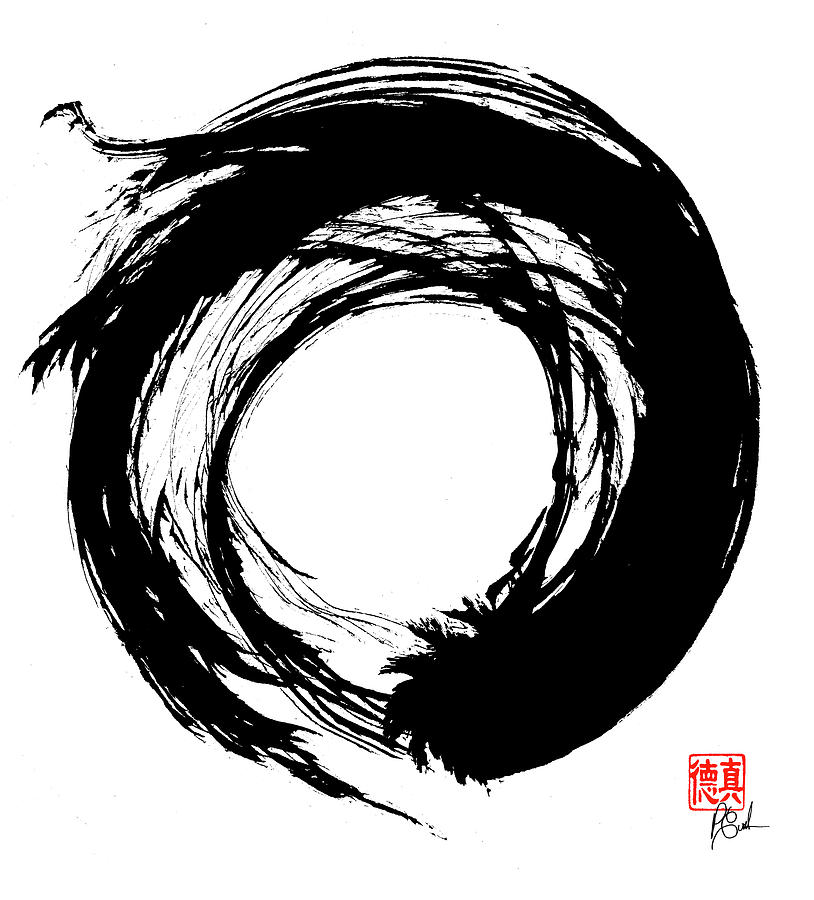
enso-zen-circle

The Japanese Enzo displays this element of naturalness and spontaneity. Which is wild and irrational in its appearance of not-caring. And… free. Like all good calligraphy, you would never “go back over it.” Because perfection has nothing to do with it. Because perfection is in the head! The question is rather, is it “felt?” Not, “did you think it through?” Were you inspired at that moment? Was it free? Was it confident (and thus, bold)? Was it authentic?

Like me, at that concert… when we act naturally, out of beginner’s mind, there is no limiting or constraining sense of “should be”… there’s no sense of embarrassment. There’s no sense of “not good enough.” Like the wild storm, you just pummel through and do what you came to do… with no inhibition.

For a plant or a stone to be natural is no problem. But for us there is some problem, indeed a big problem… The true practice of zazen is to sit as if drinking water when you are thirsty. Then you have naturalness. ~Zen Mind, Beginner’s Mind (Shunryo Suzuki)

In this way, art conveys what we wish we could be in “real life.” We long for that spirit of abandon. It’s why we love road trips; it’s why we love falling in love (“we are not in our right mind”… it’s been called a kind of temporary insanity, but we love it). That’s why we miss being children.

I Don’t Have to Figure It All Out Right Now

A very simple question:

What’s the big deal about Now?

I remember one of the advanced monks asking this question to Roshi, at a Zen meditation retreat, many years ago. From Ram Dass’ 1971 classic, Be Here Now, to Eckhart Tolle’s contemporary bestseller, The Power of Now, and the ubiquitous self-help emphasis on mindfulness, it warrants the asking. It has become standard among mental health practitioners to champion this most basic of meditation practices, for its proven benefits for those suffering from depression, to PTSD to the more benign, but inescapable varieties of generalized anxiety, all as common as daily bread. And surgeons recommend it for pre-treatment nerves, as well as post-op recovery. Mindfulness is, at its most simple rendering, the ongoing act of bringing your attention to this present moment… here and now.

Sooo…..

What’s the big deal about Now?

First, let’s answer that question with another question…

Because… What if this moment, here and now, is full of pain and misery? (Why would we want to be present with it?)

The answer to this last question, is that this present moment is not full of anything, at all. It is only our heads that are full of commentary, or as my Zen teacher used to say, ruminations. He loved that word. It comes from the Latin word for chewing. Makes sense. We like to chew on stuff. And chew some more. Then, chew some more. Even when — and there usually isn’t, unless you’re solving some mathematical equation — there’s no nutritive value left in whatever it is you’re chewing on.

Why do we do this?

It’s a compulsion. And we all do it. We are all obsessive compulsive. We’re problem solvers. We want to figure out that which can’t be figured out. We want to solve… even when it’s unsolvable. And know the unknowable. We want to have all the answers, ironically… right now. We’re not so good with the idea that there’s more to come, just around the bend… and relaxing with that. It makes us feel nervous and insecure not to be sure… not to be certain about things. Although, as denoted in the Alan Watts book that started it all for me, The Wisdom of Insecurity, there is an unmistakable prudence in simply letting life dance its dance. We don’t obsess about getting to the end of the dance, or rush to get there.

When we can summon up enough faith to do that, we will have enabled within ourselves a different relationship with this moment.

And that is the answer to the first question… it’s not the now, that has so much importance, it’s our relationship to the now. When we’re living easily with what is happening now, then we will be resistance free. And being resistance free is what every spiritual tradition, everywhere, from the beginning of time, has extolled.

And how do we do that?

After 30 years of practice, I still wouldn’t call myself an expert at it. At all. But, that’s why they call it a practice. It’s never really, fully and finally, accomplished. But, I do like the Abraham-Hicks access code:

I don’t have to figure it all out, right now.

This is like a golden key. A doorway into the state of nonresistance… into a more peaceful relationship with whatever this moment holds. Use it like a mantra. Say it to yourself when panic taps its familiar tap. It works because it’s general. If it were more detailed, and applied to some specific problem, the mind would find some argument, and the ruminations would continue. But in generalized form, it dislodges the ruminations.

~~~~

Follow My Other Blog, Too!…

https://fiftyyearsafter.wordpress.com/


Yes…Jesus Was a Yogi

Jesus is Universal—

The great Yogi, Paramahansa Yogananda, once asked, “Many are the powerful churches founded in Jesus’ name, but where is the communion that he stressed…where is the actual contact with God?”

When Jesus spoke, he was imparting deep truths, which he himself, received through direct experience and genuine communion with the divine. We may refer to this state of consciousness by many names, such as Christ Consciousness, or God Realization, in which the oneness that exists among all revelations, regardless of name, sect, or geographical location, is perceived. Truth is Truth is Truth is Truth, no matter its name and irrespective of what costume or scripture we wrap it in. This means that The New Testament is no more Christian, than The Bhagavad Gita is Hindu. They are written records of enlightened revelations available to any seeker by any name for the purpose of upliftment.

images-2

Not Through Rituals, but through Yoga—

Thus, Christ Consciousness is beyond category, and can only be known through experience, not by dint of ritual, costume or temple. Not even by the arrival of Jesus himself. As Paramahansa-ji put it, “A thousand Christs sent to earth would not redeem its people unless they themselves become Christlike by purifying and expanding their individual consciousness.”

Through the technology of Yoga—a word meaning, Union with Divine—a seeker can expand his/her consciousness to the frequency of the divine. Or, said differently, he/she can unite his/her finite awareness with the infinite awareness, often called God. The technology of Yoga was first revealed in written form, in Patanjali’s Yoga Sutras, about 500 years before Jesus. In these sutras, it is said that through various daily disciplines, culminating with meditation, the omniscience of cosmic awareness may become known.

The Soul of Yoga has been Lost—

These practices, known by sages and Yogis…and by Jesus himself, have been held in secrecy and passed down with discretion, from teacher to disciple, for millennia, long before they were ever written. Unfortunately, through the commercialization of mainstream Yoga, through its importation to the west, this technology, as well as the original intent of Yoga—has been lost in the morass of poses, products and popularity.

The Hidden Truth in Jesus’ Parables—

And the disciples came, and said unto him, “Why speakest thou unto them in parables?” He answered and said unto them, “Because it is given unto you to know the mysteries of the kingdom of heaven, but to them it is not given….Therefore speak I to them in parables: because they seeing see not; and hearing they hear not, neither do they understand.” 

Like the Yogis of old, who carefully guarded this technology of enlightenment, Jesus, too, selectively revealed the higher and more advanced teachings for those that were able to receive them, which is why he taught in parables.

When asked by his disciples, why he often taught through parables, Jesus said, “Because it is so ordained that you who are my real disciples, living a spiritualized life and disciplining your actions according to my teachings, deserve, by virtue of your inner awakening in your meditations to understand the truth of the arcane mysteries of heaven and how to attain the kingdom of God, Cosmic Consciousness hidden behind the vibratory creation of cosmic delusion. But ordinary people, unprepared in their receptivity, are not able either to comprehend or to practice the deeper wisdom-truths. From parables, they glean according to their understanding, simpler truths…”

Esoteric Practices—

As is taught in all practices, the ultimate truths of heaven, that Jesus spoke of, can not be grasped by the senses, nor the rational mind, but can only be known through intuitive awareness. In other words, only through direct experience, can we ever really know the reality that lies behind the trappings of logic and beyond the illusions of the senses.

Through direct personal practice in the myriad techniques of Yoga and meditation, transcendental consciousness may be achieved. For example, through the awakening of the energy centers in the spine, we open the gateways into what Jesus called “The Kingdom of God.”

When man is settled in that inner kingdom of divine consciousness, the awakened intuitive perception of the soul pierces the veils of matter, life energy, and consciousness and uncovers the God-essence in the heart of all things…. ~Paramahansa Yogananda

Resurrection—

An example of Jesus’ mastery over the materialistic laws of earthly life are seen in the act of resurrection, something that has been understood by accomplished yogis of India for thousands of years. These Yogis consider Jesus to be a realized yogi: one who knew and had mastered the spiritual science of life and death, God-communion and God-union.


Jesus Misinterpreted—

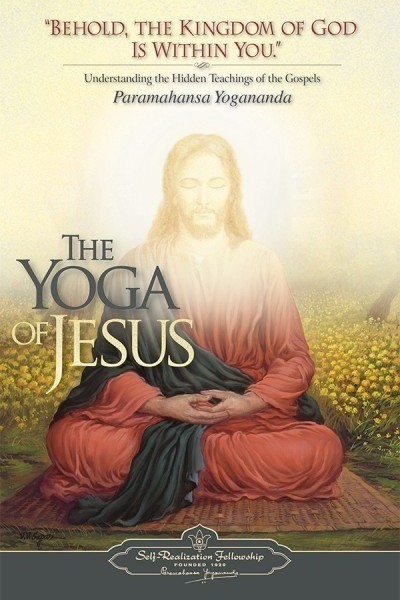
In his book, The Yoga of Jesus, Paramahansa-ji, points out that even the most basic principles of Jesus’ teachings have been distorted, while “genocidal wars have been fought, people have been burned as witches and heretics, on the presumed authority of man-made doctrines of Christianity.”

1730-e1419898127912

~Donna Quesada


Free Will & Faith (Say Yes)

We, the descendants of the Age of Reason, have been nurtured to raise a suspicious eyebrow at suggestions like have faith, or, trust the universe, or worse, let go & let God, because it insults our conviction in the power of our own free will…our capacity to be self-determined, autonomous individuals…masters of our own destiny…captains of our ship.

Then, by means of direct experience with the tumultuous and liberating changes that occurred throughout the sixties, or else by dint of our good fortune in happening upon a teacher, some of us became “spiritual.”

Part of being spiritual is the realization of our inter-connection with the world, and by extension, our influence on it; through every action, every word, and even every thought, we affect everything in known and unknown ways. Coming out of a God-fearing era, in which one didn’t dare assert one’s power over the mysterious workings of the divine, this was huge. By reclaiming our power, we assumed our role as creator, or at least co-creator. And we liked it. We took to the idea of manifestation like a cat takes to a newly-emptied box. It pleased our sense of doing and gratified our need for control. After all, if we can simply choose our thoughts and direct our intention, then we can shape the world we want to live in.

We can’t stop our thoughts, the reasoning went, so we might as well learn to master them and so we willfully embraced our role as co-creator of our destiny. The idea of activating our ability to manifest tangible things, like cars and money, as well as the more elusive intangibles, like health and well-being, made us feel powerful.

I eagerly stepped onto the bandwagon.

But, then I asked, what if this, too, were but a stepping stone, a bridge, to a more exalted plateau, still? What if, all of life amounted to this one question:

Can you release even that—the need to make choices at all… can you release the need to co-create?

In other words, can you say yes to life on its own terms?

But, rather than seeing it as a denial of free will, why not look upon this gesture of renunciation, as “the ultimate act of free will?”…as the most courageous choice there is, which is to melt away, that you may move about, like two feathers on a bird, where no difference exists between your will and divine will.

Yogis have always been renunciates. And by Yogis, I mean all seekers, who have abandoned material comforts, mundane temptations and distractions in their passion to find God. So intrinsically a part of spiritual life, renunciation is considered to be the final stage of life in India’s religious traditions.

I propose that the truest gesture of renunciation is internal, rather than external, which is to say, unseen. It is implied in our courage to let go of even the pretense of control. And to the extent of our willingness and ability to do this—to truly surrender—we are Yogis without necessarily looking like Yogis…Yogis as householders…as ordinary people in ordinary surroundings, wearing ordinary clothes, doing ordinary things.

The only thing extraordinary (but doesn’t have to be extraordinary) is the degree of presence one brings to one’s life, since presence is proportional to the extent of surrender, as every wily attempt by the mind, to grasp at anything, is a step out of this moment.

I am reminded of an old Zen Koan about the man who encountered a tiger.

A man was traveling by foot, when all of a sudden, a tiger came running after him. When he reached a precipice, and could run no more, he caught hold of a wild vine and swung himself down over the edge. The tiger sniffed at him from above. Trembling, he looked down to where, far below, another tiger was waiting to eat him. As if things couldn’t get worse, he then noticed two mice, gnawing away the vine; the only thing that sustained him. It was at that very moment, that the man noticed a luscious strawberry within reach, so he ate it. How sweet it tasted!

Can we laugh at the ultimate paradox of life? The exquisite beauty that exists within and alongside the ephemeral. The moment we try to possess it, it vanishes.

Like the man hanging off the cliff, we all have the ability to “transcend” our situations and dramas, but that transcendence is discovered through the relinquishment of our perceived identities in this life, especially our role as the “doer.” More profoundly, it is expressed through our willingness to offer up thanks and laugh with the beauty and apparent absurdity of it all. But really what we’re doing is giving the whole thing over to a higher power.

And, “giving it over” isn’t to “give up,” in the ordinary sense, it’s rather, to begin to relate to a larger field of creation. Giving up, in the ordinary sense is the ego’s way of saying, in a passive-aggressive voice, “I can’t have my own way,” so I’ll act like I never wanted it, anyway.” There’s a lurking resentment there. Whereas, in the truest form of surrender, it is of the soul, rather than the ego. It is not only to identify with a larger—so large so as to be infinite—perspective, but to come into a genuine state of allowing. It’s as if the you, that you thought you knew, disappears into this infinite self. So that you are nothing, but at the same time, everything.

And this expansion occurs to the point where, even your need to figure things out, e.g., the hows & the whys, begins to fade. You just trust. It’s not that you trust any being in particular…you just trust. It’s a state of being.

And this brings us back to the ultimate act of free will; it’s a choice to trust. To trust that everything is going to be OK…that everything is already OK…that everything is unfolding just as it should….that even this tempest you’re in the middle of right now, is part of it all…and it’s perfect. It’s to know that the workings of the divine, and your purpose within it all, is beyond what the mind can comprehend.

So, you just live. And, like the man on the precipice, rather than trying to figure it out or outsmart the process, or improve God’s timing, you surrender to this moment and eat the strawberry. And everything is delicious. And perfect…as it is.

Misunderstanding Religion; What Is its Purpose?

One thing students realize when they begin their readings for my class, is the lack of anything resembling unified agreement, among academics, on what religion is.

Firstly, if you’re looking for agreement among academics, you’re looking in the wrong place.

But in a more analytical vein, every attempt at a common denominator is defeated by a counter example. Even the belief in God, which isn’t embraced in the context of Buddhism, is frustrated. In short, we are hard-pressed to find one feature common to all religions of the world. So, rather than one solitary feature, scholars have taken to describing a collection of characteristics – things like community, beliefs and stories –
that are inevitably found, in some combination or another, in the world’s many religions.

One student expressed concern over the problem of interpreting those stories that are part and parcel of the world’s religions. In a disdainful tone, he alluded to the violence that is easily justified by a relativistic interpretation of religious writings.

A common and seemingly justifiable concern, considering the state of the world today.

Nonetheless, I find it lamentable because it stems from a massive misunderstanding of what the whole point of religion is and has always been. Arguing about scripture reduces it to nothing but philosophy—a discipline which is deep, difficult and meaningless, all at the same time. Joking aside, it’s not exactly meaningless, if we understand that its value lies, not in finding answers, but in the very act of asking questions. That is, meaning emerges when we stop misunderstanding its purpose.

Likewise, in the domain of religion, we get hopelessly caught up in the supposed contradictory nature of certain passages, especially where violence is implied. This is common in the context of the Jewish and Christian bibles, and in that of the Koran. But what if we were to consider the very purpose of these holy books differently? What if we were to assume its purpose lay in encouraging us to look upon our own violent ways?

Thus, rather than assume a breach between our virtues and those in the holy stories, we might consider the purpose of those stories. And more pertinently, we might let go of the assumption that these stories contain explicit instructions. In that way, the bible may become purposeful.

But perhaps the most profound problem lies in a different kind of chasm. There is an immense difference between the spiritual state of the reader and the nature of the divine. A holy book is of a different nature than a science book or a philosophy book or a car manual. Dare I say bluntly that its arcane nature will be missed by an unenlightened mind? Its higher truths will not be revealed to eyes that don’t yet see, to a mind that is not ready.

Or even more to the point, to a mind that pushes an agenda.

Anyone can misuse anything when guided by greed, selfishness, lust for power, and vengeance. A person whose mind is clouded by odiousness has eyes that are blind. He will misinterpret, misconstrue and misuse. He’ll abuse the land, other people, scripture, and everything he touches. Put that person in a position of power and watch the world crumble.

Which brings me around to the closure of the circle and to my final point, that of looking to the academics for a definition of something that does not lend itself to definition.

Just as looking for answers misses the point of philosophy—which values itself on the questions it asks, looking for definitions misses the point of religion—which treasures only experience as a means to truth.

No matter the religion, its purpose is to bring the practitioner to an experience of his or her own wholeness. When this underlying essence and purpose goes missing, it quickly and inevitably dissolves into empty rituals. How could it be anything else in the absence of an awakened consciousness? Even the meaning of the word religion betrays its supreme spiritual purpose—to remember your spiritual identity. But without clarity all we have is confusion, without heartfelt practice all we have is mechanized ceremony and without open eyes all that is left is the blind leading the blind.