

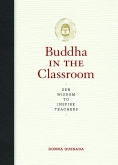
Throughout the course of teaching Buddhism for 30 years, and authoring the book Buddha in the Classroom, I have thought a lot about how to present the basic tenets of the Four Noble Truths in not only the most concise and understandable way, but in the most relatable way. My first attempt to do that was in the “The 12 Houses of Suffering.” The mini stories presented there show every day situations where Buddha’s teachings apply.
Here is a summarized presentation of the Four Noble Truths…
1.Duhkha. Traditionally stated as “Life is suffering,” this basic declaration is more subtle than that, since what Buddha meant was more mental than physical. He was referring to a kind of chronic dissatisfaction that lies just below the surface most of the time, as we go about our lives.
It manifests as a perpetual restlessness, where we are trying to get something else, or get somewhere else, so that we can feel complete. But of course, it doesn’t work, and we continue reaching.
2.Trishna. This is the cause of the restlessness, which is usually stated as desire, or attachment. Said simply, it is the reason why we suffer… We are restless and we suffer because we are attached to something.
But, a better way to think about this second truth is in terms of lack of acceptance. We are not in full acceptance of what this moment is…
In the Zen tradition of Buddhism, there is an expression… “the picking and choosing mind.” The mind reacts habitually to everything with its preferences and aversions. We like this and we don’t like that. We want this but we don’t want that.
To preempt the natural objection here… which is to say, but what about when a situation really is intolerable? Of course, the capacity for discernment is a valuable one, and sometimes real change is needed.
To this, I will emphasize what my own Zen teacher used to say… “When it’s time to eat, you eat, when it’s time to sleep, you sleep, and… when it’s time to march, you march!”
And then you come back to the beauty that is all around you, in real time.
3.Nirvana. There is a way out of our predicament. Nirvana literally means to extinguish, and in this context, Buddha was emphasizing the importance of blowing out or letting go of the constant craving for something new. There is a beautiful logic to this; If our clinging is the problem, then it naturally follows that letting go would be the solution.
4.Marga. This is the path, or the way to do it. Letting go isn’t as simple as letting go of a hot potato, so we don’t burn ourselves. You see, we’re interesting creatures… even though we see that our constant craving for more and better, keeps us trapped, and thus, keeps the fire of dissatisfaction burning, we continue the pattern because habits die hard.
This is where “The Noble Eightfold Path” comes in. It is the detailed way to reshape our habits, by confronting the mind directly.
Because this fourth Noble Truth is laid out in eight parts, I will summarize it, in all its parts, in a separate article which will follow next…
*This article was originally posted on Awaken.com.














 Donna Quesada Schollhammer