Tag Archives: meditation

An Insightful & Honest 10-Day Meditation Journal

One of my students turned in a 10-day journal, chronicling her first sustained attempt at meditation. It was one of their options for a 50-point feature project. This particular journal was penned by a Japanese girl of about 18 years old. She presents such an amusing, accurate and insightful account—with all her struggles and modest rewards delightfully narrated—that I am reproducing it here without edit, as some of the awkwardly translated phrases only add to its overall charm.

First Day.
Sitting still for ten minutes was the toughest thing in meditation. After five minutes, my legs started to feel numb and my concentration faded away. Breathing is what humans do without even realizing, but I could not breathe well when I tried to focus on my breathing. Moreover, I felt difficulty to even hear the sound of my breath. Another thing I realized was that something that never bothers me could really bother me during the meditation. Sounds of people talking, noise of my neighbors, things in nature really tick me off during the meditation. The more I tried to focus, the more I became distracted. During the ten minutes of meditation, my hatred towards meditation grew and I even started to blame the existence of meditation itself. After the meditation, it made me realize how immature I am.

Second Day.
As I expected, today’s meditation was as tough as yesterday’s. During the meditation, I was wondering how I can improve my concentration during the meditation. I know that meditation helps to purify my foul mind, but only disturbing thoughts came up during the meditation. I just remembered what professor said, that people are rushing and rushing. I think this is a necessary practice in the life. To shorten the time makes more time that I can do other things. Therefore meditation gives me more relax and steady.

Third Day.
Still meditation is not enjoyable for me but I believed that I could find something through it. Today I meditated while listening to music from Youtube for meditation. I could relax and hold steady mind. I used to understand what meditation is, but it was so irritating to my existence on the first day. I read the text book to feel Buddha’s spirit more deeply. It said bodies and minds are strongly related. I feel like I understand the meaning of this. For example, we say “pain is from the mind,” in Japan. For example, if someone trod on my foot and the person was who I like, probably I would not mind and the pain would go away soon, but in the case of someone who I hate, I would feel pain longer than in the previous case and with hatred. Moreover, I might give the same back to the person. I felt that I have to practice meditation in order to control my devil spirit.

Fourth Day.
I don’t feel pain with sitting anymore, although sometimes I started thinking and can not focus on being empty and my mind moves around. 10 minutes passes more quickly than before. It may just be my imagination, but I feel I’m able to be kinder to others than I was. Because I can rethink how I am after meditation.

Fifth Day.
On the fifth day, my attitude towards meditation finally became positive from negative. I was willing to start to meditate to find out what kind of outcome I will be getting out of this session. Once I started to meditate, I realized how clear my mind was. To be honest, I was not thinking about anything during the meditation. I was not enjoying the moment nor hating the moment. I was neutral. When I opened up my eyes and checked how long I had been meditating, I found out that I was meditating for 20 minutes without any thoughts. My mind was so clear that I felt like my brains were washed out. My breathing was so natural and smooth that I could not even tell if I was really breathing. I was so happy with the effects of meditation that I finally started to look forward to the next mediation session.

Sixth Day.
I had a bad day at school and I felt like I didn’t want to do anything. I was chilling on the bed all day after school because fortunately I didn’t have any homework for tomorrow. Still, since I continue to meditate, I did so before I go to sleep. Then I came to realize that meditation gives me opportunities to face myself when I become deflated or have an anxiety. At times like that, I tend to escape from the matter and try to get them away from my mind; though I have learned the importance of facing my problems, not turning away from them. My feeling has become great, even though I was depressed before meditation.

Seventh Day.
Period of wax and wane of the moon.
Cycle of period.
Period of revolution of the moon.
Period of rotation of the sun.
28 days.
28th is cycle of the time of the universe. After I meditated, I was just muddling about the universe, and I came up with these. If we live the life according to the rhythm of nature, physical and mental would be healthy more and more. Live along with universal providence. It is beautiful.

Eighth Day.
I did meditate on the eighth day. I felt great and refreshed. By listening to the sound and wind of nature, I realized I was part of the universe. Human beings are not the center of the universe. If everyone can realize that, confusion and worry would be diminished in the world because all human beings are connected by a big bond.

Ninth Day.
I assumed happiness was always felt when we achieve some difficult goal, though actually, it was not. Truthfully, happiness is always nearby; in addition, it costs nothing and is fuss-free. I was meditating for 30 minutes today. Meditation makes me comfortable, and I can see myself from the third person. If I can keep this sense, I would be able to act with making transgressions because I believe people make transgressions only when they can not see themselves. There is really a lot to learn about meditation.

Tenth Day.
Today is the final day for meditating for this assignment. Before I started the final session, I was thinking how far I’d come already. I could not even stand the idea of meditation on the first day, but I was already addicted to the idea of meditation on the tenth day. I was surprised at how clear my mind was before the last session started and how good I felt about my achievement. Finally, I started my last meditation. Everything was going well until I realized the strange noise my neighbor was making. At first, I tried to shut it off and concentrate again. Funny, I could not. After I failed to concentrate, I started to get mad at the noise because it is ruining my precious last meditation session. I was surprised at the fact that I got ticked off so easy again, just like the first day. I was satisfied with my mental growth just before this session started, but here I am acting like myself as I was on the first day. After I finished meditating, I was embarrassed and decided to be more humble. Another lesson taught by meditating. I have to be humble. A lesson is something we are taught by others. It is amazing how meditation can create a lesson out of myself. The lesson is coming from the deep part of my mind. I really think that is beautiful. I am fascinated with meditation now and I will practice meditation more and more in my life.
Teaching Kundalini Yoga

I have been grading papers this week. Earlier I came upon a passage written by a student who has also taken my Yoga class. My heart swelled with gladness as I read the description of this girl’s first experience in a Kundalini Yoga class. It touched my heart to know that the class had so touched hers. Here is a portion of the endearing note:

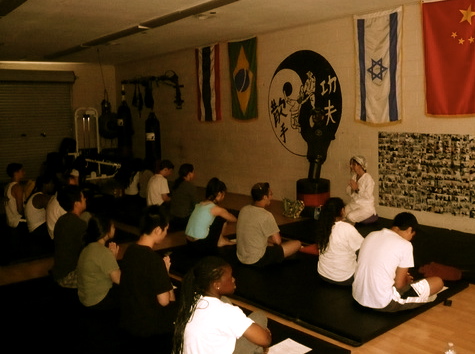
On July 8th, I attended Professor Quesada’s Yoga class at Machatz Self Defense Studio. I am not a morning person, especially when it is not a school day. Thus, I entered the studio rather grumpy. However, the lights were out, so that was a plus. I sat on the mat and we were told to sit with our legs crossed, a diamond-like pose. The tuning-in mantra was “Ong Namo Guru Dev Namo,” meaning, I call on divine consciousness. It calmed me down…We began some deep breathing and gradually sped up the pace…we flexed our bodies…I couldn’t have begun my day better…Professor Quesada had us lie on our backs while she played the gong. This was my first time having this experience. It felt as if my heart was beating along with the sound. As I closed my eyes I felt as if I was in a whole different world, a world of emptiness, a world free of strain and frustration. To conclude the Yoga, we all began to sing Long Time Sun, which I found on Youtube that night and played on my laptop. It just puts a smile on my face, and the fact that we all sang along made it so much more beautiful…

Mindfulness vs Distraction

Mindfulness vs Distraction

Seventh on Buddha’s eightfold path, Zen buzzword, and greatest hit of Buddhism in general, is mindfulness–which is simply the practice of being here. It at least sounds simple, and it is, but simple is not always easy. Which is why it takes practice. With slightly more elaboration, it is the deliberate, but nonjudgmental, attention we place on the present moment.

A student asked me one day about it, and why it was preferable to distraction, especially in the face of something unpleasant. For example, if you have a headache, what’s wrong with watching TV just to zone out? In brief, distraction immediately separates us from the situation, which might sound desirable, but the problem is, the discomfort remains, and worse, we rob ourselves of the opportunity to surrender, and worse still, of the opportunity to recondition ourselves out of old patterns. And as life is full of discomfort, we’ll simply continue to suffer as a result, as we try in vain to run, time after time, and find, time after time, that wherever we go, there we are.

The question is a bit like the one I was considering the other day.

Presence vs The Big Picture

During the first few days following my book’s release, I found myself checking sales statistics obsessively, looking for sales info and any other sign of excitement that would signify, what was to me, an important event. But, this kind of narrow focus only sets us up for disappointment. I reminded myself how fortunate I was just to be published and how wonderful it is that my book is finally available. Moreover, I reminded myself of the real purpose, which is to inspire other teachers. I marveled at how strange it is that being published—every author’s dream—suddenly wasn’t enough. We are funny creatures that way, endlessly grasping for the next thing while missing everything. This reminder to myself, of what is essentially at the heart of Buddha’s Noble Truths, engendered a swelling of gratitude that left no more room for frustrations.

Funny enough, the very next day, one of my Yoga masters told a story about pain. He described a midwife he knew, who had the habit of telling her screaming clients, while in the grips of agony, to remember that they are having a baby! It might sound like a silly reminder of the obvious, but it indicates importance of putting the pain into perspective.

But, isn’t this a departure from presence? You might ask. After all, the pain is as present as it gets!

But in neither case—my obsessive checking nor the laboring woman—does the reminder to see the big picture negate the importance, or, if I may, the presence of presence. It’s not obvious at first, but the fact is that seeing bigger means seeing more, and seeing more means nothing other than more presence!

You’re looking at everything, you’re in tune with all that is, rather than merely your own hang-up. And by getting in tune, you’re dropping your resistance to the current situation, and since resistance is what magnifies all discomfort and suffering, by dropping the resistance, you’re lessening, at once, your suffering.

As the Taoists would say, don’t push the river.

By coming back into reality, as it is, you’re losing the AVERSION to the discomfort, you’re with what is, rather than fighting what is…and you’re in peace.

Thoughts; Do They Define Us or Not?

We are what we think, The Dhammapada begins. All that we are arises with our thoughts.

Yet, at the same time, a thought is nothing other than a passing wave of the mind, Suzuki Roshi says, in the classic, Zen Mind, Beginner’s Mind. I remember another Zen master likening thoughts to bodily secretions. He was reminding us not to take them seriously. A thought is nothing other than an inconsequential emission, like sweat, which evaporates on its own, or a burp, which is gone as quickly as it arises, without a single trace. It is why, in Zen meditation, we don’t try and stop our thoughts. Like a revolving door, they will come and they will go, of their own accord. Those incessant emissions don’t define us any more than the steam from a boiling cup of tea defines the quality of the tea leaf.

Or do they?

Perhaps thoughts are more like the emissions from an old Chevy…black and heavy, betraying our old, outdated, carburetor engine, and the total lack of smog control. The smoke and soot sullies up everything, and we breathe in all the black pollution. As The Dhammapada suggests, our thoughts give us away, and we can hide our identity no more than a ’57 Chevy can hide its smoke. We think ugly thoughts and we wear them.

The Resolution:

Thoughts are passing waves, but there’s a catch…if we let them pass. They come and they go…if we avoid getting attached to them. And this is where mindfulness starts. With this realization, we can avoid the karma that clings to us, like gum getting stuck to our shoes, every time we fixate on those thoughts.

So both ideas are true. They can live together, side by side, without conflict. Like a light wave, there’s no necessary contradiction with regard the different viewpoints: it’s a wave or a particle, depending on which way you look at it. Our thoughts are only secretions when we recognize them as such and then let them go—a useful trick, when it comes to what Buddhists would call unskillful thoughts, and what the Yogis would refer to as negative thoughts. The problem surfaces when we habituate. Then we get stuck; then we get in our own way; we prevent ourselves from moving along;  we wear it on our faces; we exude it in our demeanor, and it affects every aspect of our relationships, our lives and our worlds.

Seen in this way, our thoughts have tremendous power and define us, if we let them. So we can let them, in a skillful way, or in an unskillful way. That’s where spiritual training comes in. As one of my favorite yogis, Swami Sivananda reminds us, in Thought Power, by raising only thoughts of mercy, love and kindness, we bring happiness upon ourselves and others. Conversely, when we are stewing in hatred, pain is sure to follow. In this way, we use thoughts conscientiously, with deliberate aim.

Similarly, in Kundalini Yoga, we are taught to convert negative thought forms and tendencies, rather than fight against them or wait for them to go away on their own; we use them skillfully to good purpose. For example, we may put the tendency toward anger to good use, by directing that anger toward ourselves for not being more patient, or we may turn our greed into the noble desire to become enlightened.

So, it seems we have two choices, we can let negative thoughts settle on their own, without the validation of judging them, or even naming them. Or, we can convert them. In both cases, we are willfully using our mind rather than the other way around. We are the master and are working with our thoughts in a decisive way.

Whatever you give attention to, thrives—especially habit patterns. Water the grass and it grows. Water the weeds and they grow. Water the thoughts and we become those thoughts.

Close Your Books! Teaching Meditation in a Community College Classroom

I’m thrilled to be a part of elephant journal!

Following is an excerpt from my article, Close Your Books and Forget the Thinking: Teaching Meditation in a Community College Lecture Hall:

In the East, knowledge is all tangled up with the religious and so it is that the western categories of philosophy and religion don’t quite fit. Knowledge comes via direct experience, rather than cogent arguments. Truth is found in the stillness of the quiet mind, rather than on the pages of competing theories and the very pursuit is to drop the pursuit. We rediscover, rather, what we already know, uncover what was already there—what Zen calls your original face, what Hinduism calls your true self. But we have to get real still, so that we can see without looking and hear without listening.

I explained all of this. Then, I dimmed the lights.

“With your attention only on your breath, jot down, in your project books, each thought you become aware of. But don’t write me a composition! And, as strange as it sounds, don’t try to write stuff—because that means you’re following your thoughts. Just scratch out any key word and come back.”

I tiptoed around and stole glances over their shoulders. Some had no more than five words, even though five minutes had passed, even though we’ve got thousands of thoughts streaming by in the blink of an eye.

I interrupted the silence with two hits of my handheld meditation bell.

“Anybody care to share?” I asked. “Was there some thought you kept coming back to?”

“Yeah, that I can’t wait to eat, after class!” one said.

“Me too–I couldn’t get lunch out of my head,” a girl in the back added.

“Sounds like what we used to call ‘sick dreams’, as kids,” I laughed.

“So, we’ve got burritos on the brain. What kind of thought is that?” I asked.

“A future thought,” offered one quick student in the front.

“Exactly!” I said.

“So, here’s part two of our experiment: Next to each word, write a ‘P’ next to the past thoughts and an ‘F,’ next to the future ones.”

Read the whole article here!

Reincarnation and Presence: A Contradiction?

We talked in class, about the importance of presence, and the role of meditation in bringing us back to the only moment that has ever, and that will ever, exist—Now. And then a student asked a question:

“But Hindus believe in reincarnation—isn’t that a future-worry?”

At the heart of meditation, in Hinduism, and in all the Dharmic traditions, including Buddha Dharma and Sikh Dharma, is the importance placed on nurturing our power of focused awareness. It strengthens the mind’s ability to consciously choose, in anew in each moment, where to focus its attention. As it happens, the best thing to focus on is now, and although there are countless reasons why, these are the three most important ones:

  1. Now is the most incredible and momentous event of our lives.
  2. Now is the only time and place joy lives
  3. Now is the only time and place we can discover how the mind really works, and thus, get it to work better.

Now starts with the simple sensation of our own breath flowing in through our noses, and down into our lungs. Watching this is where presence begins and where true meditation begins.

I can appreciate my student’s concern about reincarnation, and the idea that if it happens at a future time, then thinking about it would seem to constitute future thinking—a direct contradiction to the enterprise of staying present.

However—and this is at the heart of my response—Just because you know the rest of the staircase is there, doesn’t mean you ever walk more than one step at a time!

The subtler nuances of my response concern the idea of reincarnation itself, which may be conceived of in myriad ways.

Ask a Zen Buddhist what she thinks of reincarnation and get one answer. Ask 10 others and get 10 more. Ask a Hindu, get another one still. Life and death happens every moment. It happens because you change every moment. In each and every moment, the forces of creation, preservation and destruction happen within you and without you, on every level of your physical, spiritual and mental existence. On the cellular level there is a war going on, and in the world of our minds, as meditation clearly shows us, we are forever duking it out.

But we only notice the aftermath and inevitable changes that follow, when something moves us and shakes us to such a degree that we’re thrown into shock—when we’re sure nothing will ever be the same again. We must remember though, that at any moment, we may proclaim with absolute certainty, that nothing will ever be the same again. We always notice only later, when, seen through the bittersweet palette of our mind’s eye, we gaze nostalgically back upon the events of our lives.

Reincarnation, conceived of in the most brute sense, as the soul taking up residence in a new physical vessel, after the complete physical death of the prior, is still just an extension of the way life is already—you know there’s a tomorrow, but you don’t live there. You know you’ll die, but you choose to live, while you’re alive.

In this unrefined interpretation of reincarnation, the soul’s rebirth is determined by the karmic balance left after our physical existence is done. But in the meantime, and in realtime, through meditation, we can redeem our innumerable debts. When we say we choose to live, we can really do it, by waking up now. The Hindus call it Moksha. We can all call it liberation.

As written for Spirit Voyage.

10 Reasons to Chant

In yogic parlance sound is related to the dimension of space. So when we use sound in specific ways, we positively affect our internal space, our most subtle element. We trigger transformation from within.

I am particularly happy with my latest blog-post for Spirit Voyage, on sound and mantra in yogic meditation–not only because mantra meditation is such a beloved part of my own practice, but because, well, simply put, I worked hard on putting together intricate material in a readable format. The reward is that it has already reached over 350 shares! Here is an excerpt:

#1

The Benefit:

Reduces Anxiety and Depression

The Technology:

By combining sound, breath and rhythm, mantra meditation channels the flow of energy through the mind-body circuit, adjusting the chemical composition of our internal states and regulating brain-hemisphere imbalances, contributing to a natural abatement of fear and despair–emotions that underlie both of these common afflictions. By balancing the nervous system, chanting regulates the chronic stress and tension that is the norm for many people in today’s hyper-stimulated lifestyle. And by balancing the endocrine system, chanting normalizes hormone production, which balances our moods and overall sense of well-being.

#2

The Benefit:

Releases Neuroses

The Technology:

Chanting delivers us from the excessive preoccupation with our bodies and with material concerns. It delivers us from fear of old age and death. We begin to identify with the timelessness of the soul and consequently begin to shed neurotic habits that no longer serve and that no longer seem relevant. By returning us to what is essential, it clears away subconscious habit patterns. Embraced by the steady rhythm and by the vibration that connects us all, our thoughts combine wholly with the sound current. As the captain sets the canvas to the wind, thus pulling the boat out of trouble, it is through mantra that we steer ourselves out of our own stormy seas and into clear waters.

#3

The Benefit:

It is Soothing

The Technology:

The power of mantra is betrayed in the roots of the sanskrit word, man, meaning mind, and, tra, meaning deliverance, or, projection. Thus, chanting the sacred sound of the mantra delivers us from our sense dependency, from our unrelenting habit of looking toward the senses for gratification; pleasures that are and that will always be, fleeting and limited–how much can you eat? Or drink? Or buy? Sense gratification never really gratifies. We are always left either unfulfilled and guilty–wishing we had never started, or else, wanting more and lamenting the loss.

Chanting is a pleasure that transcends the senses, it takes us beyond the bounds of time and space (which is why we don’t have to understand the mantra). Thus it soothes in a most profound way. It soothes on a cellular level. It merges our finite identity with the infinite, and so dissolves us. It relieves us from the sights and sounds and stimulation of the material world and delivers us into a spiritual space, where the sound is God. The material needs are reduced to nothing but mind chatter, and like smoke pumped into the sky, will be scattered into the expanse. Through the sweetness of devotional surrender, mantra turns the negative into positive. I once heard it said: “as music has charms to soothe a savage beast, so the spiritual sound of mantra soothes the restless mind.”

Hop on over to Spirit Voyage to continue!

Oneness

This lovely question landed in my youtube inbox the other day. I think it is the kind of question others probably wonder about, too–it is the same kind of question I wondered a lot about, so I would like to share it.

Sent to: profquesada

Hi, I’ve been watching your videos, and have been reading Alan Watts and I have a question that keeps coming up whenever the concept of no self is talked about. I understand very well the fact that other things should be considered vital and important to us such as the air, the trees, ect., because without oxygen our lungs would be useless. But where I start to lose understanding is why this vitalness of other things is linked with the concept that we are the same as them? Yes everything is interdependent, but the difference between an earthworm and I is that all of my cells have a certain DNA structure or code that is different from the earthworms’, and even different from other peoples’. This is a question I thought a lot about that I don’t ever see discussed. Thanks for your videos they were very interesting to watch — Ellie

Hi Ellie,
I’m happy to know you enjoyed my talks. I’ll respond to your question very simply. You’re quite right, on the material plane, I am very different than an earthworm! However–and this is the whole point of meditation, really–the idea is to transcend this material identification. It is the same tendency that is at the root of our body identity, and all the suffering we bring upon ourselves because of it. Our physical identities are like masks we wear for a limited time, then, as a snake sheds its skin, we shed that persona. What’s left? That’s where different traditions come in, but that doesn’t matter for now. The practices nudge us out of our illusion, our delusion of separateness and dissolve us into this, whatever-it-is. Call it suchness, call it Brahman, call it God, call it energy. Everyday, we can simply call it beauty!
~DQ

The Yamas–What Yoga is Really All About


Patanjali–Composer of The Eight Limbs of Raj Yog

Here I offer a study on the foundation of Patanjali’s path, with additional insights from the perspective of Kundalini Yoga.

Although Patanjali’s eight limbs of Yoga were penned some 2000 years ago, they are more relevant today than ever, not least of all because of the horribly mistaken, but popular belief that yoga is but a system of exercises, but because the function of those eight interconnected branches is better thought of as the route to a balanced mind–a most dire need, now as always.

The first of those eight limbs, the yamas, are themselves, divided into five parts, and serve as ethical restraints on our behavior. Patanjali saw it as imperative that we get our act together, morally, before we can ascend our spiritual paths.

Ahimsa, or, non-violence–the first of the five yamas–brings our attention to the the violence we direct toward others, as well as toward ourselves. The idea of violence conjures up all kinds of dramatic images, but it is really about the ill-will that starts in our hearts and that shapes our attitudes. It is reflected in everything we do–in what we eat and in what we consume. And it cultivates powerful habits. Even the judgments we fling out so freely toward others is a form of violence, which ironically, only keeps us trapped at the level of the behavior we are criticizing. In Kundalini Yoga, this tendency toward fault-finding and pointless grumbling is simply the nonsense of the negative mind, and it is specifically these restraints that call it to a halt. The yamas help us help ourselves.

Consider now, the second mark of the yamas, satya, or, truthfulness. Again, looking deeply, we don’t think of ourselves as liars, but every time we gossip, we take part in tarnishing someone by spreading what we don’t know to be true. Every time we make a false promise, or indulge in exaggerations, we participate in a form of lying. Even saying that nothing is wrong when something is clearly wrong, is a form of mis-communication, that will likely explode in the wrong way later. But worse, trust breaks down, relationships break down, and on a larger scale, social balance breaks down. We end up causing suffering and feeling alienated by the karmic effects of unskillful speech.

The third instruction within the five yamas is asteya, non-stealing. Again, no one wants to think of themselves as a thief, but we steal in the most subtle ways, all the time. Taking credit where it’s undue–seeking fulfillment in superficial acclaim. Every time we’re late, we steal someone’s time. Every time we take more than we need of anything, we magnify our role in the earth’s depletion and simultaneously draw it away from those who need it more–making us participants in the mass gluttony of consumerism. But, we are driven on by the hope that temporal things might deliver lasting joy.

Next is brahmacarya, the most misunderstood of all. Normally interpreted as total renunciation of sexual activity, the householder’s practice of Kundalini Yoga holds it as a reminder of the pitfalls of abusing sexual energy. It means we don’t engage in activities that involve taking advantage of others or that degrade ourselves–behavior that lies outside the confines of a balanced relationship. Not only do such situations leave us depleted, but they prevent growth into higher realms of yogic practice, such as pratyahar, or, commanding the senses. How can we harness the whimsical diversions of the fickle five senses, if we’re drunk with desire? And dharana, or, concentration. How can we hone our powers of concentration if we’re following every fancy?

The last yama, aparigraha, means fulfilling our needs rather than our interminable parade of wants, lest we live out another existence without having known the subtleties of a heightened awareness. In our commercialized world today, it means seeing through the seduction of the dazzling array of things we’re told at every turn, we must have–the biggest screen, the fastest phone, the greenest car, the greatest package, or the latest version.

The yamas strengthen our will so that we may master our impulses and master our selves. The idea of spiritual progress otherwise would be like the smoker trying to meditate while fighting the nagging thought of his next cigarette. But with compassion, consider that we are all like that smoker, every time we jump up to check our e-mail for the fifth time that hour, every time we lose our tempers and every time we overdo whatever we weren’t supposed to do in the first place.

In Kundalini terminology, it is the negative mind giving vent to its usual nonsense. But through the yamas, we train that trouble-maker, so that we may meld freely into the clear space of balance and neutrality; where the judgments, frustrations, doubts and insecurities subside; where we connect to our infinite, boundless, divine selves, and where that radiance that lies within, may shine freely on the whole world without.

It’s true, the yamas serve as an external check, but it works like a loop, since behavior tends to reinforce itself. We’re setting up conditions for new ways to act. And when we act differently, we begin to feel differently, until finally, we begin to be differently. We experience life in new shoes, so to speak, and the new gear reshapes us. New behavior takes the place of the old, and new responses follow. Through it all, we experience life differently while engaged in habits that serve. As we experience, we become.

Is Sparring the Same as Fighting?


We were talking about breathing again, in class. And again, we started by taking a deep breath together. But this time, I told them to rest a hand on their bellies and  see if they could direct the breath to that magical region called the “tan-tien,” by the Kung-Fu masters, the “hara,” by the Zen masters, and the “solar plexus” by the yogis. We are increasing the oxygen delivery to the brain, and thereby balancing our nervous systems, as well as our state of mind.

One student shared his experience with Judo and the instructions given by his teacher to breathe from the belly in order to combat nerves and conserve strength.

If the martial artist reflects steadiness and calmness, why do they fight? Isn’t that violent? another student asked.

Excellent question.

The point of sparring isn’t to fight, as you might suspect, I said. It is to train.

It is in the face of challenge that you put your tools to use. In the martial arts, you don’t confront, you don’t go against, you don’t use brute force. You learn that you don’t have to reside in a constant state of opposition to what lies within nor to what lies without–impatience, anger, discomfort, provocation from others. You learn that you have power over the impulse to react to all of it.

Thus, there, on the training mat, the martial artist learns patience. He learns to become intimate with his calm center, the source of his power, balance and composure. The source of his stillness–the stillness that gives way to heightened perception and intuition.

The Dojo is the training ground for what would be better thought of as a game of skill, like chess, or a dance, rather than as a fight. The student of any martial art is taught to always avoid confrontation. The point is about personal development, rather than public display.

On this point, here is an anecdote written, in 1979, by Joe Hyams, who took direct study with Bruce Lee:

Some time later I watched a “crossing of hands,” or match, between two martial arts masters. I had gone expecting to see a magnificent display of flashing acrobats and whirling limbs. Instead I saw two men in fighting stance study each other warily for several minutes. Unlike boxing, there were no feints, no tentative jabs. For the most part, the masters were still as statues. Suddenly, one of them burst into movement so quickly that I was unable to grasp what had happened, although I did see his opponent hurtle backward. The match was over and the two masters bowed to each other.

Equally poignant was the comment Hyams’ teacher made afterward:

Now you have seen the power of controlled patience on the mat. The same thing applies to problems in life.

And I would also point out the power of humility, as displayed so elegantly through the tradition of the bow. If only that were a value held dear in life today.