Tag Archives: spirituality

Misunderstanding Religion; What Is its Purpose?

One thing students realize when they begin their readings for my class, is the lack of anything resembling unified agreement, among academics, on what religion is.

Firstly, if you’re looking for agreement among academics, you’re looking in the wrong place.

But in a more analytical vein, every attempt at a common denominator is defeated by a counter example. Even the belief in God, which isn’t embraced in the context of Buddhism, is frustrated. In short, we are hard-pressed to find one feature common to all religions of the world. So, rather than one solitary feature, scholars have taken to describing a collection of characteristics – things like community, beliefs and stories –
that are inevitably found, in some combination or another, in the world’s many religions.

One student expressed concern over the problem of interpreting those stories that are part and parcel of the world’s religions. In a disdainful tone, he alluded to the violence that is easily justified by a relativistic interpretation of religious writings.

A common and seemingly justifiable concern, considering the state of the world today.

Nonetheless, I find it lamentable because it stems from a massive misunderstanding of what the whole point of religion is and has always been. Arguing about scripture reduces it to nothing but philosophy—a discipline which is deep, difficult and meaningless, all at the same time. Joking aside, it’s not exactly meaningless, if we understand that its value lies, not in finding answers, but in the very act of asking questions. That is, meaning emerges when we stop misunderstanding its purpose.

Likewise, in the domain of religion, we get hopelessly caught up in the supposed contradictory nature of certain passages, especially where violence is implied. This is common in the context of the Jewish and Christian bibles, and in that of the Koran. But what if we were to consider the very purpose of these holy books differently? What if we were to assume its purpose lay in encouraging us to look upon our own violent ways?

Thus, rather than assume a breach between our virtues and those in the holy stories, we might consider the purpose of those stories. And more pertinently, we might let go of the assumption that these stories contain explicit instructions. In that way, the bible may become purposeful.

But perhaps the most profound problem lies in a different kind of chasm. There is an immense difference between the spiritual state of the reader and the nature of the divine. A holy book is of a different nature than a science book or a philosophy book or a car manual. Dare I say bluntly that its arcane nature will be missed by an unenlightened mind? Its higher truths will not be revealed to eyes that don’t yet see, to a mind that is not ready.

Or even more to the point, to a mind that pushes an agenda.

Anyone can misuse anything when guided by greed, selfishness, lust for power, and vengeance. A person whose mind is clouded by odiousness has eyes that are blind. He will misinterpret, misconstrue and misuse. He’ll abuse the land, other people, scripture, and everything he touches. Put that person in a position of power and watch the world crumble.

Which brings me around to the closure of the circle and to my final point, that of looking to the academics for a definition of something that does not lend itself to definition.

Just as looking for answers misses the point of philosophy—which values itself on the questions it asks, looking for definitions misses the point of religion—which treasures only experience as a means to truth.

No matter the religion, its purpose is to bring the practitioner to an experience of his or her own wholeness. When this underlying essence and purpose goes missing, it quickly and inevitably dissolves into empty rituals. How could it be anything else in the absence of an awakened consciousness? Even the meaning of the word religion betrays its supreme spiritual purpose—to remember your spiritual identity. But without clarity all we have is confusion, without heartfelt practice all we have is mechanized ceremony and without open eyes all that is left is the blind leading the blind.

What is Spiritual Surrender?

One of my Kundalini Yoga teachers, Gurudhan, often plays a song during our deep relaxation, called “Never Surrender.” Some of the main lyrics resound in my mind:

Don’t lose faith and don’t lose heart.
Don’t lose faith and never surrender. 
Don’t lose faith and don’t lose heart.
Don’t lose faith and never surrender. 

Never surrender to your tears,
though you’ve been crying them for years.
You know the pain is just a part
of what is opening your heart.

The message is to never surrender. Yet, ironically, the importance of being able to surrender is at the heart of all the great spiritual teachings. In Taoism, it is taught that you will live with greater ease through the art of surrendering to the rhythms and natural cycles of the universe—The Tao. In Buddhism, you lessen the suffering of yourself and everyone around you by applying the wisdom to accept life’s inevitable changes, regardless of whether or not they correspond to your preferences.

And in Kundalini Yoga, surrender has its place, as well. It is the way to personal evolution and ultimately, joy. It means, surrendering to the lessons presented to us, in order to benefit from the perspective they permit and thus, to grow from them. It is the courage to use those stumbling blocks as springboards to our own higher consciousness.

To add a few layers on, surrendering, in this case, is to let go of the stories we tell ourselves—the stories we use as defense mechanisms. Defense mechanisms keep us stuck. And so, to get unstuck and to live in grace, means accepting, with all our heart, our own purpose in this life, while rising above that we think will consume us. And that is both empowering and fulfilling. But more, it is knowing that we have the capacity for this fulfillment and that state of knowing leaves no room for despair.

We only need courage and commitment. And so, “to surrender” is, in this context, to fully accept that commitment to live in grace. But, as the song reminds us, and as Buddha’s example of resisting the temptations of Mara, reminds us, we must not give in to the demons and destructive patterns that only hold us back.

Sensitivity; The Good Kind and the Bad Kind.

We all know someone who’s too easily hurt. It’s the kind of person who’s oversensitive and easily offended. Paramahansa Yogananda described this kind of person as “touchy.” When feeling offended, he or she tends to either bite back or sulk. Although the tendency stems from an inferiority complex, it ultimately lay rooted in an uncontrolled ego. Oversensitive people make themselves and everyone around them suffer needlessly.

So, then, why do Yogis constantly tell us we need to become “more sensitive?”

Because, you might say, there’s the good kind and the bad kind.

The bad kind, as found in the problem of touchiness, comes in the cargo bag of an untamed ego. Anything untamed is naturally lacking many refinements. In this case, sensitivity presents itself as an egoic perception. And perception is just that: perception. In this case, it is perception that is entirely lacking in the wisdom to see other people’s pain, as well as the many possible reasons behind their seemingly offensive behavior or words.

The good kind has to do with with what we refer to in Yoga as intuition. It is associated with the sixth energy center, appropriately called “the third eye,” since when open, it engenders a more pervasive view into the subtler aspects of existence. Downgraded in the Age of Enlightenment, through its dualistic opposition with reason—that most prized of human attributes—it was relegated to the sidelines and has been little understood in the west.

But, symbolized by the tilak markings and the bindi dots on the foreheads of the wandering holy seekers in India, it is looked upon there, as the seat of heightened awareness. Associated with the pituitary gland, it is the master control tower of the brain itself.  Rather than sitting in dualistic opposition to left-brained, rational function, it supersedes duality altogether. In its containment of all, it is the awakening of this eye that awakens the ability to see the unseen. It is what all the spiritual teachers mean when they assure you that you’ll know what to do. You can call it intuition, but you can also call it the “good kind of sensitive.”

One Year Ago: The First Teacher-Training Diary

It was this time last year that I made the decision to deepen my practice as a Yoga teacher. It was a long time coming–I heeded the calling of my heart to study directly under my beloved masters of Kundalini Yoga at Yogi Bhajan’s first and only studio, Yoga West.

It had taken six years, and at least two weeks of waffling, to finally commit. I remember the night I called to say Yes; I took my walk as usual, only the pink-stained evening sky was pinker than usual, the drooping golden sun was twice as gold as usual, and the crisp autumn breeze that chilled my just-washed face was the most delightful breeze there ever was.

I knew I would want to chronicle this life-changing journey, and I did. Here is the first of several teacher-training diaries I wrote, that were originally published on Spirit Voyage.

I walked briskly down the street in the rain, carrying an open plate of assorted curries and rice. Zigzagging around two Jewish families, out for Saturday services, I sought a moment of refuge in my car, to absorb the somewhat magical events that had transpired that day.

Still flush from the long group chant, I watched as the raindrops coalesced on my windshield. My voice had melted away into the warm sea of long “Ek Ong Kars.” I had lost the sense of where my own voice ended and the others began. The vibrational frequencies of 58 voices fused into a lush whole and time itself evaporated like dew. It was as if we all dissolved into some invisible swell that had gently washed over us. I took a bite of the creamy raita on the side of my plate and watched one single raindrop trickle down the window, leaving behind a long, clear squiggle for peeking through to the glassy, rain soaked street.

As all the genuine spiritual traditions remind us, it is through the dignity of letting go that wisdom is attained. In subtle paradox, it is by losing that we gain. In chanting, it was not merely our voices that we offered up to the infinite, but our very sense of self. In exalting the sacred mantra through chant, the tangible and the intangible disappeared into unison. At another moment, a white head wrap and an outstretched leg extended in front of my own, while mine lay, in turn, behind another. Together, we all carried on, and for the duration of the kriya, our bellies pumped air as one rhythmic body, like some multifaceted breathing apparatus. We were a woven cloth. For a time, personal space melted away, along with the intangible sense of separateness that keeps us from our own divinity.

In the shadowy world of separateness and duality, bad habits loom. Fear looms. The hum of adversity is often dispatched from the depths of the psyche, still on automatic, like a broken old alarm that sounds for no reason. There was a moment when mine hollered out – victim to the old triggers. But one of the Yogis inspirited my heart and knocked all sense out of me. I thanked him. And with a gentle word he sent me off to sharpen my tools. We are empowering ourselves to glide above those old patterns, to fly, wholly powered by spirit.

We have been gifted with invaluable tools of Kundalini Yoga, and we are learning how to use them. Through the timeless wisdom and functionality of these kriyas, we are learning how to scrap the unconscious negative reflexes and oust the heavy blocks that prevent the wholeness of mind and radiance we seek. Yogi Bhajan was forthright about the efficacy of what he called “the Yoga of awareness,” revealing that by practicing its techniques correctly, “we fry this subconscious mind; we make toast out of it and eat it.” Seeing us falter during a particularly intense kriya, Gurudhan reminded us to “become the nervous system.” “Keep going,” the yogi called out, as we disappeared into the kriya, as we became the kriya. We were mastering our energy rather than the other way around.

In some ways, this process reminds me a bit like getting thrown into the washing machine and then spat out again. And I’m hopeful it’ll be a cleaner, softer, more appealing me than what originally went in. I knew the intense, nine month period wasn’t an arbitrary figure. It’s as Guru Singh explained that first night: Like a birthing, after nine months, we’ll come out of the birth canal pure and new. “First you’re like eager babes,” he mused, as he surveyed the room full of the novice’s enthusiasm. “Then, as you begin to feel comfortable and more at home, you’ll start to relax and you’ll be draping your bodies all over, like you own the place.” But he continued on, explaining that by the end of the training period, we will have come full circle, only not exactly in the same starting place. When we get ready to emerge, as Aquarian teachers of 2011, we will be like eager young babes again. But in a different way.

I still have the teacher training pamphlet from 2005 in my Yoga files. Although it was because of Guru Singh, that I took that flyer five years ago, and because of him, that I finally committed this year, the boon is that through this intense training program, I will also have the benefit of learning from other masters, that I am quickly growing to love. Soon I will look upon them all as my teachers. And I will officially count myself among the third-generation disciples of Yogi Bhajan, himself.

It is a blessing for which I am eternally grateful, but also a tremendous responsibility, for these timeless teachings will be reflected in my own conduct and in the way I bring them forth to others as a teacher. But, it was a calling of the heart. And this is a brave heart that can only become more brave through practice.

A Three-Step Portrayal of the Spiritual Journey

This entry presents Father Keating’s three-step portrayal of the spiritual journey.

The beginning of the spiritual journey is the realization —not just the information, but the interior conviction—that there really is a higher power, or, God. Or, to make it as easy as possible for everybody, that there is an Other.

Second step: To try and become the Other.

And finally, the realization that there is no Other. You and the Other are One. Always have been, always will be.

~Father Thomas Keating

An Insightful & Honest 10-Day Meditation Journal

One of my students turned in a 10-day journal, chronicling her first sustained attempt at meditation. It was one of their options for a 50-point feature project. This particular journal was penned by a Japanese girl of about 18 years old. She presents such an amusing, accurate and insightful account—with all her struggles and modest rewards delightfully narrated—that I am reproducing it here without edit, as some of the awkwardly translated phrases only add to its overall charm.

First Day.
Sitting still for ten minutes was the toughest thing in meditation. After five minutes, my legs started to feel numb and my concentration faded away. Breathing is what humans do without even realizing, but I could not breathe well when I tried to focus on my breathing. Moreover, I felt difficulty to even hear the sound of my breath. Another thing I realized was that something that never bothers me could really bother me during the meditation. Sounds of people talking, noise of my neighbors, things in nature really tick me off during the meditation. The more I tried to focus, the more I became distracted. During the ten minutes of meditation, my hatred towards meditation grew and I even started to blame the existence of meditation itself. After the meditation, it made me realize how immature I am.

Second Day.
As I expected, today’s meditation was as tough as yesterday’s. During the meditation, I was wondering how I can improve my concentration during the meditation. I know that meditation helps to purify my foul mind, but only disturbing thoughts came up during the meditation. I just remembered what professor said, that people are rushing and rushing. I think this is a necessary practice in the life. To shorten the time makes more time that I can do other things. Therefore meditation gives me more relax and steady.

Third Day.
Still meditation is not enjoyable for me but I believed that I could find something through it. Today I meditated while listening to music from Youtube for meditation. I could relax and hold steady mind. I used to understand what meditation is, but it was so irritating to my existence on the first day. I read the text book to feel Buddha’s spirit more deeply. It said bodies and minds are strongly related. I feel like I understand the meaning of this. For example, we say “pain is from the mind,” in Japan. For example, if someone trod on my foot and the person was who I like, probably I would not mind and the pain would go away soon, but in the case of someone who I hate, I would feel pain longer than in the previous case and with hatred. Moreover, I might give the same back to the person. I felt that I have to practice meditation in order to control my devil spirit.

Fourth Day.
I don’t feel pain with sitting anymore, although sometimes I started thinking and can not focus on being empty and my mind moves around. 10 minutes passes more quickly than before. It may just be my imagination, but I feel I’m able to be kinder to others than I was. Because I can rethink how I am after meditation.

Fifth Day.
On the fifth day, my attitude towards meditation finally became positive from negative. I was willing to start to meditate to find out what kind of outcome I will be getting out of this session. Once I started to meditate, I realized how clear my mind was. To be honest, I was not thinking about anything during the meditation. I was not enjoying the moment nor hating the moment. I was neutral. When I opened up my eyes and checked how long I had been meditating, I found out that I was meditating for 20 minutes without any thoughts. My mind was so clear that I felt like my brains were washed out. My breathing was so natural and smooth that I could not even tell if I was really breathing. I was so happy with the effects of meditation that I finally started to look forward to the next mediation session.

Sixth Day.
I had a bad day at school and I felt like I didn’t want to do anything. I was chilling on the bed all day after school because fortunately I didn’t have any homework for tomorrow. Still, since I continue to meditate, I did so before I go to sleep. Then I came to realize that meditation gives me opportunities to face myself when I become deflated or have an anxiety. At times like that, I tend to escape from the matter and try to get them away from my mind; though I have learned the importance of facing my problems, not turning away from them. My feeling has become great, even though I was depressed before meditation.

Seventh Day.
Period of wax and wane of the moon.
Cycle of period.
Period of revolution of the moon.
Period of rotation of the sun.
28 days.
28th is cycle of the time of the universe. After I meditated, I was just muddling about the universe, and I came up with these. If we live the life according to the rhythm of nature, physical and mental would be healthy more and more. Live along with universal providence. It is beautiful.

Eighth Day.
I did meditate on the eighth day. I felt great and refreshed. By listening to the sound and wind of nature, I realized I was part of the universe. Human beings are not the center of the universe. If everyone can realize that, confusion and worry would be diminished in the world because all human beings are connected by a big bond.

Ninth Day.
I assumed happiness was always felt when we achieve some difficult goal, though actually, it was not. Truthfully, happiness is always nearby; in addition, it costs nothing and is fuss-free. I was meditating for 30 minutes today. Meditation makes me comfortable, and I can see myself from the third person. If I can keep this sense, I would be able to act with making transgressions because I believe people make transgressions only when they can not see themselves. There is really a lot to learn about meditation.

Tenth Day.
Today is the final day for meditating for this assignment. Before I started the final session, I was thinking how far I’d come already. I could not even stand the idea of meditation on the first day, but I was already addicted to the idea of meditation on the tenth day. I was surprised at how clear my mind was before the last session started and how good I felt about my achievement. Finally, I started my last meditation. Everything was going well until I realized the strange noise my neighbor was making. At first, I tried to shut it off and concentrate again. Funny, I could not. After I failed to concentrate, I started to get mad at the noise because it is ruining my precious last meditation session. I was surprised at the fact that I got ticked off so easy again, just like the first day. I was satisfied with my mental growth just before this session started, but here I am acting like myself as I was on the first day. After I finished meditating, I was embarrassed and decided to be more humble. Another lesson taught by meditating. I have to be humble. A lesson is something we are taught by others. It is amazing how meditation can create a lesson out of myself. The lesson is coming from the deep part of my mind. I really think that is beautiful. I am fascinated with meditation now and I will practice meditation more and more in my life.

Teaching Kundalini Yoga

I have been grading papers this week. Earlier I came upon a passage written by a student who has also taken my Yoga class. My heart swelled with gladness as I read the description of this girl’s first experience in a Kundalini Yoga class. It touched my heart to know that the class had so touched hers. Here is a portion of the endearing note:

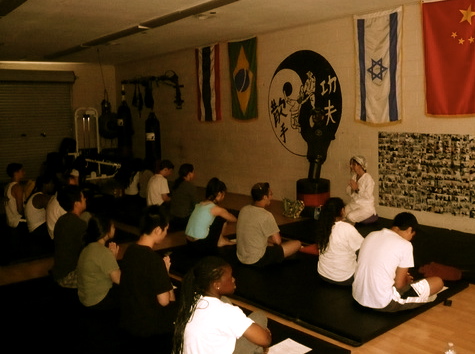
On July 8th, I attended Professor Quesada’s Yoga class at Machatz Self Defense Studio. I am not a morning person, especially when it is not a school day. Thus, I entered the studio rather grumpy. However, the lights were out, so that was a plus. I sat on the mat and we were told to sit with our legs crossed, a diamond-like pose. The tuning-in mantra was “Ong Namo Guru Dev Namo,” meaning, I call on divine consciousness. It calmed me down…We began some deep breathing and gradually sped up the pace…we flexed our bodies…I couldn’t have begun my day better…Professor Quesada had us lie on our backs while she played the gong. This was my first time having this experience. It felt as if my heart was beating along with the sound. As I closed my eyes I felt as if I was in a whole different world, a world of emptiness, a world free of strain and frustration. To conclude the Yoga, we all began to sing Long Time Sun, which I found on Youtube that night and played on my laptop. It just puts a smile on my face, and the fact that we all sang along made it so much more beautiful…

Are Zen and Kundalini Yoga Compatible?


I shared some of my favorite Kundalini mantra music with a Buddhist friend the other day. He loved it, but then gingerly asked whether I “consider it to be compatible with Buddhism.” He asked about the music, but he was really asking about the paths, in general. “Maybe I should just forget about all that and just enjoy it for what it is,” he then mused. And did I have any thoughts?

Of course, I did! And he already knew the answer—”you said it,” I told him. “You should absolutely enjoy it because only the dualistic mind sees a difference. “All paths are one and truth is truth.”

I have another Buddhist friend—a musician—who grew up with gospel. To my best knowledge, he would never consider shunning this inspirational music that he loves so much, just because it’s Christian. What an idea! So, why wouldn’t it be fine to listen to Kundalini mantra music, as a Buddhist?

One thing is certain; gospel is Americana. It’s part of our cultural heritage and we look upon it with nostalgia. On a wider note, Buddhists, like any one else, listen to a variety of music, much of which has no spiritual association at all. So, I would propose that if music with no spiritual connotation is fine, that music with some spiritual connotation would be even better—even when that tradition differs from one’s own—because uplifting vibes are, well…nice.

The question of compatibility between two spiritual traditions smacks of the guilt many people still carry around from their childhoods, when their intimidating family religions forbade even a cursory glance at some other religion’s holy book.

But, both Buddhism and the Yogas are “inclusive,” rather than “exclusive,” which means one may practice alongside any other religious practice without conflict. And many do. Consider the many Buddhist meditation teachers who still consider themselves Jews (there is even a name for them: “Jubus”)—Joseph Goldstein, Jack Kornfield and Sharon Salzberg are but a few. And everyone knows about Leonard Cohen, Steven Seagal, Robert Downy Jr., Richard Gere and Goldie Hawn. And with regard to Yoga, a better question would be: Who hasn’t tried at least some form of it?

Buddhism, and Zen in particular, is not predicated on any beliefs and if there’s no belief, there’s nothing to contradict. Thus, Zen complements any practice, spiritual or otherwise, like basketball—which is why Phil Jackson used Zen-style meditation as part of his training methods with The Lakers. Zen is, in the most basic sense, just meditation. It is the practice of waking up to the present moment; it is to “eat when we’re hungry and sleep when we’re tired.” So, it’s not surprising that training in such a discipline would improve performance in anything.

Perhaps my friend’s concern had more to do with the power of Kundalini mantra music. Known as Naad Yoga, it is spiritually potent. It is held that the human body is designed for transformation through its proper practice, but even if you don’t happen to believe that, it certainly won’t hurt you if you go ahead and chant anyway! (And less so, if you’re just listening.) It is understood, in all forms of Yoga, that we have a central energy channel, known as the sushmuna, by which prana flows. This energy is our life force, it is consciousness itself, and to awaken its flow is to awaken to our own infinite potential as humans. In Kundalini parlance, it is to awaken to the divine within. At the heart of this practice is mantra meditation, in which we vibrate that central channel as well as every cell in our body, as long as we are chanting from the heart and with the belly. It is understood that everything is vibration—even our state of mind, so we can either choose sounds that elevate, or not. Naad Yoga is the technology of doing just that.

And so, if it’s potent: all the better! 

Even though Zen is not oriented around vibrational technology, it does have another point in common with Kundalini Yoga Practice: mindful meditation. One of my teachers, Guru Singh, talks endlessly about the importance of staying in the “what is,” rather than in the “should be,” which is his way of reminding us to keep our heads out of the “picking and choosing mind.”

Sounds a lot like Zen talk to me!

Our outlook toward spiritual practice doesn’t have to be polemic. It’s not Zen versus Kundalini Yoga, any more than it’s Zen versus Judaism; they’re only separate in the divisive mind! One of the things I always liked about the Zendo was that there were Christians practicing next to Jews—at this level, none of that matters anymore. While one path is not necessarily better than another, one may be more appropriate for an individual, at a certain time, than another—that’s the idea behind the various Yogas, or spiritual paths, in India. The great sages recognized that no one path is “one size fits all.” We each have different temperaments and innumerable karmic circumstances that make up our lives. And it’s all in flux. Funny enough, if we weren’t allowed to grow and evolve, there’d be no Buddhism at all! Buddha himself, born a Hindu, wouldn’t be pigeonholed. He embraced his truth, and left the rest behind, settling himself somewhere in the middle of it all.

If acclimation and adaptation are necessary for a religion’s survival as a whole, how much more so for an individual in his own evolving, personal practice? Sometimes that means strands of different traditions get intermingled, the way Taoism and Buddhism did, in the hearts of the mystics in old China, creating the birth of Ch’an (Zen).

In this light, the whole idea of a “forever home” is questionable. But even so, only the seeker gets to choose. And with the right to proceed along the sequence that is right for her. The well-known American spiritual teachers, Ram Dass and Bhagavan Dass, both traveled along paths that were ever-expanding, each having received initiation from Buddhist and Yogic teachers—and the former started off Jewish. In Zen, as well, it’s not uncommon to venture into different forms of meditation, as found in the various schools of Zen, as well as in other Buddhist traditions, such as vipassana.

As a fun and hopefully useful analogy, look upon Zen as a wonderful broth—the foundation of every soup that ever was. Like broth, Zen is simple (which doesn’t mean easy) and unembellished. But, when you add potatoes, celery, spices and salt, you’ve got something different. Some will dig it, some won’t. To play with analogies further, Zen may be seen as an essential strand in the fabric of a rich spiritual life, as a concomitant part of a whole. And further still, think of it as a no-frills wooden boat, which, like any other boat, will carry you just fine to the other shore. Some boats are fancy, some are not, some go fast, some don’t and some rock more than others. How wonderful the differences are!

Through these analogies and commentary on my friend’s innocent question, I hope to have shown the beauty of each tradition, but most of all, that there’s no conflict between them—or with any other path.

On the Notion of a Perfect Teacher

   I watched a documentary about the American spiritual teacher, Ram Dass. His Be Here Now, has long been one of the staples on my book shelf. Now 80 years old, he talks candidly about the struggles he’s faced after his stroke. He confessed the moment when, on the verge of death, he failed to orient himself toward God. That’s the ultimate test, he explained, and according to him, he flunked it. “I still have a lot of work to do,” he says.

His honesty touched me. It is often assumed that those on a spiritual path don’t slip and fall. But as my Zen teacher has said, it’s not whether you fall or not, it’s how quickly you can get back up. In Yoga, we look at growth as it manifests in degrees and stages, the real measurement of which is entirely internal, and rarely consistent. Progress in anything, including life itself, is never a straight line. But what we do have, as seekers, is an ever keener insight into the difference between what our minds have concocted and reality itself; the tools needed to snap out of our delusion; a willingness to laugh about our own folly, and with time, perhaps, the courage to make things right.

As teachers, we can be hard on ourselves when we do find ourselves splashing around in the dark waters of old habits. At our final Yoga teacher-training weekend, Joey told us he had had an altercation with someone just before arriving. I was listening. I had just exchanged words with a demanding student.

We had both been rocked off center and we shared our feelings with the group. We were disappointed in ourselves. We were about to graduate as teachers of Kundalini Yoga. We both share a feeling of responsibility for maintaining the dignity and excellence of this tradition and part of how we do that is through our own conduct.

What happens, Joey asked, when this sort of thing happens and we’ve got to teach a class? Do you cancel? Of course not—what an idea! You go and you teach, our teacher said. And in this tradition, what that means, is that first, we “tune in.” You never know who will be there and what they will take away from the class. There might be someone in your class that day who will decide to become a teacher herself, or who will be so moved as to make some positive life-change. And chances are, you too, will forget all about whatever it was you left outside the door before you took your place on the teacher’s bench. And you did leave it outside the door!

Tuning in means going beyond ourselves to align with the greater wisdom we deliver as teachers. In this way, the teacher is more like a messenger than an originator. The teachings come through us, rather than from us, and have nothing to do with our individual personality or quirks. They go beyond the words that are spoken and are communicated subtly through our own presence.

The conventional, or western, or academic, notion of a teacher is of one that dispenses information and data. From our perspective as Yoga teachers, this reduces teaching to nothing more than a “professional trade.” As our own founding teacher, Yogi Bhajan, quipped, if we look upon teaching in such a shallow way, as merely a profession, “we will train many preachers, but no teachers.”

Our focus should be on getting out of our own way and on uplifting and guiding others, rather than on our own success or failure. Our obsession on perfection is just another ego trip. And that doesn’t mean we stop striving toward excellence—our very ability to develop excellence is directly proportional to our ability to stop striving. At least where that striving is tied up with our ideas and notions of who we should be. We had better simply let go of ourselves.

When we begin to do this, we begin to manifest a certain grace when we teach. Ironically, the very shift in the way we understand our duty as teachers, from one in which we recite information, to one in which we serve, is the first step toward inner transformation. But it takes faith and trust to relax into this role as a conduit of truth. To be entrusted with the task of serving, of being a source of light, makes it, most surely, a noble profession. As such, “to be a teacher is the ultimate human end,” Yogi Bhajan concludes.

Anyone who teaches to be a teacher rather than to serve, will fall. ~Yogi Bhajan

A Charming Enlightenment Story

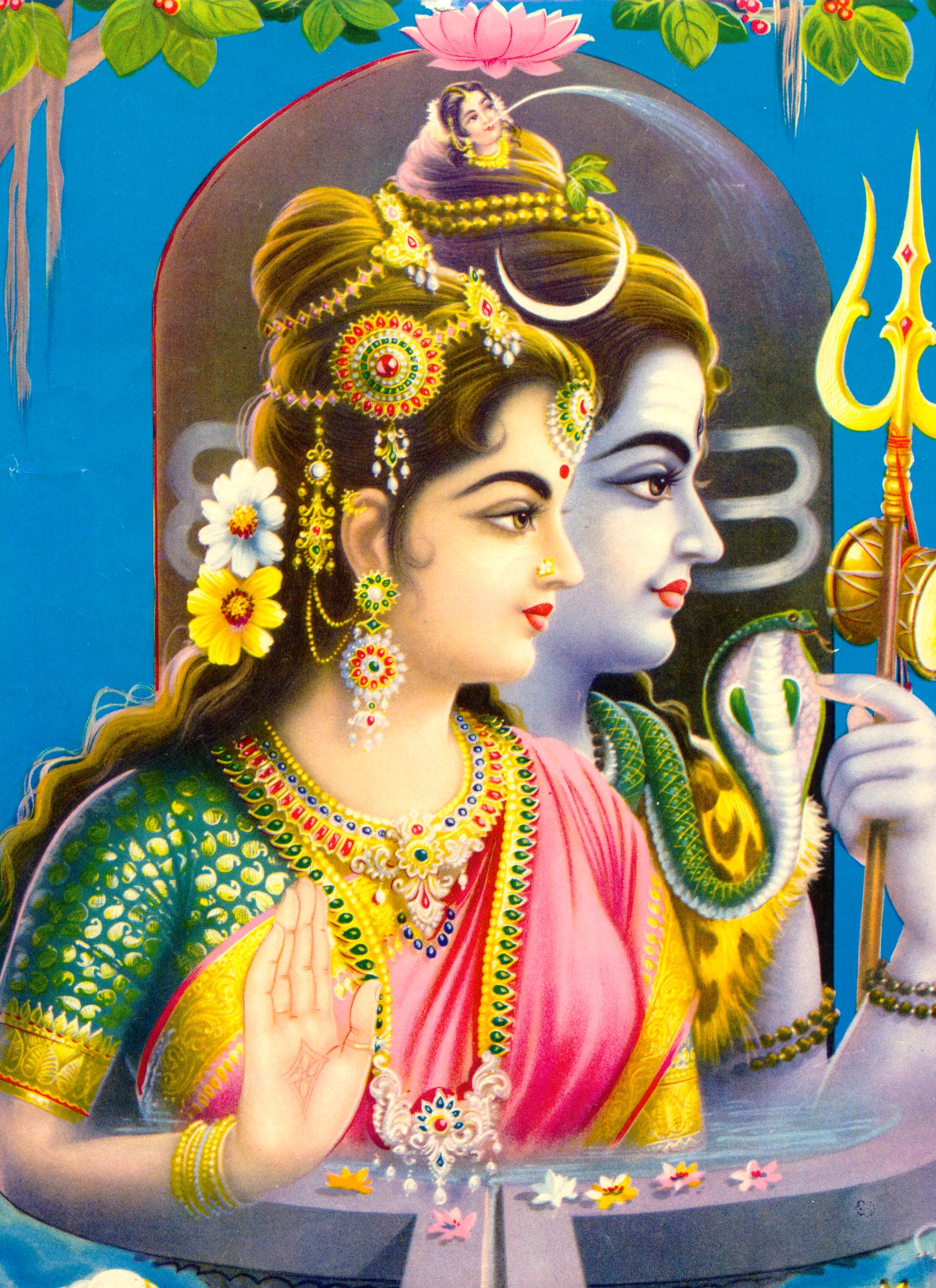
Once I heard a charming story about Shiva and Parvati, and it was lingering in my mind.

I remembered the good-hearted man who only wanted to be of use, and because of his pure, humble heart, and his service to Shiva–without knowing it was the Lord himself he was helping–he achieved spiritual liberation.

Here is the short and sweet story, as I transcribed it for Spirit Voyage (it will open in a new window).