An Interview!

Interview with Donna Quesada
Author of Buddha in the Classroom; Zen Wisdom to Inspire Teachers
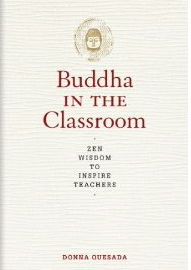
AJ: So take us through the process of this book. When did you first conceptualize the whole idea and how did it flow from there?

DQ: It was the fall semester of 2008. My spirit was declining and I was dragging myself to class each day. I started envisioning a series of vignettes in which I would consider burnout from the point of view of Zen. Little did I know, the coming semester would be the worst yet! It was almost serendipitous, though, because I had just bought a voice recorder, so I started recording myself on the way back to my car each day after class, and the stories just kept coming. Through them, my vision started to transform and as my vision transformed, so did my frustrations. In this book I share what turned out to be a collection of entertaining anecdotes—of the “clicky” girls that never stop talking, the angry guy, the iPod guy, etc., all of which are followed by the treasured eastern wisdom that inspired and lifted me out of my burnout.

AJ: It seems to me that you use the stories as a vehicle through which to intimate these zen lessons. Was that how you saw the book coming together?

DQ: Exactly! I don’t think I could have written it any other way because my spiritual practice is such a huge part of who I am and how I look at problems. Even the very notion of a “problem” makes me think of a famous quote by a Zen master: “Of course I have troubles—it’s just no problem!”

AJ: Can you go into a bit of detail about your background as a Zen Buddhist?

DQ: It was an instant love-affair. It started when I spied the cover of an Alan Watts book, sitting on a friend’s kitchen counter. It was The Wisdom of Insecurity, which at that time, had a groovy green and purple cover which caught my eye, while the title captured my imagination. I was intrigued by its ironic and surprising promise. I started temple-hopping and then got lucky enough to land myself in the classroom of a Japanese professor who taught zazen. The nine of us in the class actually got credit for staring at the wall for nearly an hour each day. But then again, it’s more challenging than the typical academic work my friends were doing in other classes. Years later, I would find my way to The Hazy Moon and to the last disciple of Taizan Maezumi Roshi, in a charming little zendo in Los Angeles, where I finally took my Zen vows. My Yoga practice was deepening alongside my Zen practice all the while—the two are an interwoven and integral part of my life today.

AJ: I was particularly struck with the non-religious feel of the book. It felt more like you and I were having a conversation over coffee, sharing fun stories here and there. Can you speak to that feel of the book for a bit?

DQ: I’m happy it feels that way to the reader! And I’m glad you mentioned the non-religious feel. It’s as I say in the preface, the wisdom is for everyone! Zen expects nothing and insists on no beliefs at all, so it doesn’t matter what the reader’s religious background (or lack thereof) is. That’s one of the interesting things about Zen temples—you walk in and find Christians practicing next to Jews! What Zen asks of you is that you be present for your life, and any discipline that helps us do that is doing us a great service.

AJ: Did you have a particular reader in mind as you were writing the book?

DQ: It’s funny. Everyone, but me, seemed to peg this book right away, as a book for teachers. But, I never thought of myself as someone who had a right to write a book for teachers. I never thought of myself—and still don’t—as an education expert. I only wanted to share these special, golden-nuggets of Zen and Yogic wisdom, alongside entertaining stories. I thought Zen enthusiasts would appreciate the elements that have only been heard in Dharma talks. But it is being marketed as a gift for teachers, and I now see that it can be of great service to teachers that are feeling the same way I felt. My hope now is that it inspires many!

AJ: What would you say is the “take home message” of your book?

DQ: To remember that we’re here to uplift others and that goes beyond the words and the whiteboard and even the grades. And we do that by shifting our perspective and by doing the opposite of what we’ve always been told to do in the west—by getting out of our heads and out of our own way! Our presence itself is a great teacher.

Interview with Amy Jacobowitz
freelance marketing
www.amyrose.us.

Excerpt from Buddha in the Classroom (Our Fixation on Passion)

Excerpt from Chapter 19—Passion; Accept, Adapt, and Abandon Hope

The real problem with our fixation on passion is the near certainty that even a blazing fire will dim with time.

Then what?

Even when passion is pursued and found, the affair won’t last forever. Passion changes. We change. A dancer friend recently shared with me the common experience among the cast members of a famous musical. Far from reveling in prideful accomplishment for having been part of one of the longest-running shows, they’re sick and tired physically, and mentally jaded. Many are dancing on old injuries, and are scarcely able to find the motivation to go onstage night after night; yet somehow they manage to put themselves into their postures and glissade, on tiptoe, onto the stage, one more time, because it’s how they make their living. It is the same motivation that gets most of the world to work every day.

It reminds me of the ancient Greek myth about Sisyphus: He is condemned by the gods to push a gigantic boulder up a hill, over and over, all day long, even as it continuously rolls to the bottom of its own weight as soon as he gets it to the top. The gods understood the futility of wasted labor, so assigning it was the perfect, wicked punishment. In retelling the story, the French philosopher Albert Camus likens the absurdity of the task to the everyday predicament of every single one of us, pushing our rocks in our own way, as we struggle to meet deadlines, deal with coworkers and bosses, and solve the problems that are part and parcel of any workday, anywhere.

But Camus was an optimist.

Despite his fate, it is Sisyphus himself who decides to be happy. He can whistle and hum happy songs while he pushes his rock, or he can lament and endlessly curse his fate. The irony is that as soon as he realizes the power inherent in his own reaction, he is liberated. He makes his fate his own. It is he alone who decides to be happy or miserable. In a nod to our own capacity for liberation, Camus says, “We must imagine Sisyphus smiling.”

Dharma: The Lesson for Teachers

Sisyphus’s existentialist smile resonates with the Buddhist reminder to let go. Sisyphus smiles because he accepts his fate. To let go is to accept. And through acceptance, Sisyphus liberates himself from his sentence. To accept is to simultaneously stop resisting. When you stop resisting, you are able to enjoy your experiences, which is to say, your life.

Accept, adapt, and abandon hope, Zen says…

Mindfulness vs Distraction

Mindfulness vs Distraction

Seventh on Buddha’s eightfold path, Zen buzzword, and greatest hit of Buddhism in general, is mindfulness–which is simply the practice of being here. It at least sounds simple, and it is, but simple is not always easy. Which is why it takes practice. With slightly more elaboration, it is the deliberate, but nonjudgmental, attention we place on the present moment.

A student asked me one day about it, and why it was preferable to distraction, especially in the face of something unpleasant. For example, if you have a headache, what’s wrong with watching TV just to zone out? In brief, distraction immediately separates us from the situation, which might sound desirable, but the problem is, the discomfort remains, and worse, we rob ourselves of the opportunity to surrender, and worse still, of the opportunity to recondition ourselves out of old patterns. And as life is full of discomfort, we’ll simply continue to suffer as a result, as we try in vain to run, time after time, and find, time after time, that wherever we go, there we are.

The question is a bit like the one I was considering the other day.

Presence vs The Big Picture

During the first few days following my book’s release, I found myself checking sales statistics obsessively, looking for sales info and any other sign of excitement that would signify, what was to me, an important event. But, this kind of narrow focus only sets us up for disappointment. I reminded myself how fortunate I was just to be published and how wonderful it is that my book is finally available. Moreover, I reminded myself of the real purpose, which is to inspire other teachers. I marveled at how strange it is that being published—every author’s dream—suddenly wasn’t enough. We are funny creatures that way, endlessly grasping for the next thing while missing everything. This reminder to myself, of what is essentially at the heart of Buddha’s Noble Truths, engendered a swelling of gratitude that left no more room for frustrations.

Funny enough, the very next day, one of my Yoga masters told a story about pain. He described a midwife he knew, who had the habit of telling her screaming clients, while in the grips of agony, to remember that they are having a baby! It might sound like a silly reminder of the obvious, but it indicates importance of putting the pain into perspective.

But, isn’t this a departure from presence? You might ask. After all, the pain is as present as it gets!

But in neither case—my obsessive checking nor the laboring woman—does the reminder to see the big picture negate the importance, or, if I may, the presence of presence. It’s not obvious at first, but the fact is that seeing bigger means seeing more, and seeing more means nothing other than more presence!

You’re looking at everything, you’re in tune with all that is, rather than merely your own hang-up. And by getting in tune, you’re dropping your resistance to the current situation, and since resistance is what magnifies all discomfort and suffering, by dropping the resistance, you’re lessening, at once, your suffering.

As the Taoists would say, don’t push the river.

By coming back into reality, as it is, you’re losing the AVERSION to the discomfort, you’re with what is, rather than fighting what is…and you’re in peace.

Tibet; They Never Invaded Anyone!

It was half time during the Barça-Real Madrid game. I told my husband I had showed the Tibet video in class. “Which one?” he asked. There are many such documentaries—such as, The Yogis of Tibet, Tibetan Refugee, and of course, movies like Kundun—that chronicle the Chinese invasion of Tibet under the Maoist regime, beginning in 1949. The one I showed today focussed on an interview with the Dalai Lama, hence the title, 10 Questions for the Dalai Lama.

Despite the star power behind the issue, many of my students bravely and humbly admitted to never having heard of this critical situation. Yet, the average person surely knows what kind of dress Kate Middleton wore at the Royal Wedding, I wryly joked.

The problem of media coverage comes in to play when you consider that in order to care about any injustice, you’ve got to first be aware that the injustice even exists.

Despite the lively discussion the video engendered, and the gratitude most students expressed to me after class for having showed the video, I mentioned to my husband that one student had called the video one-sided.

The game was back and Messi had the ball, so my husband went straight to the heart of it: Tibet never invaded anyone. The suggestion of bias makes it sound as if somehow, one could justify the deaths of hundreds of thousands of Tibetans, the destruction of over 6,000 monasteries, nunneries and temples, and the imprisonment and torture of thousands of other Tibetans.

I don’t see any more justification for this than I do the murder of 6 million Jews, nor nearly 1 million Armenians by the Turks, nor any of the other cultural genocides that darken the pages of our history books.

Someone wondered whether the film had an anti-communist tone. Whether it did or didn’t isn’t really the point. And the fact that Mao was one isn’t really the point (besides giving Mao an extra dash of bitterness toward the Tibetans just for being religious). The point is tyranny and injustice and communists lay no claim to either—oppressors come in all shapes, sizes and political affiliation.

I thought of something my favorite journalist—the Persian reporter, Christiane Amanour—asked once: Why can’t we just call a spade a spade? She knew full well why.

In this case, as the BBC points out, China has become a major player in the world market and its businesses have such a strong lobby that officials are reluctant to take substantive measures against its crimes toward Tibet.

In November 2008, the U.N. agreed with Free Tibet’s report on torture, clarifying that it believes that torture is ‘widespread and routine’ in Tibet.

Lest we forget to mention that from China’s perspective, Tibet has always been part of the Republic, let us state simultaneously, that prior to 1950, Tibet was a nation with an established sovereign government, a currency, a postal system, a language, a legal system, and a culture.

The history is complex, but the moral point is simple: There is never an excuse for imperialist aggression.

And lest we falsely assume that for all Chinese authorities, mum’s the word, let’s not forget Hu Yao Bang, the General Secretary of the Communist Party, who visited Tibet in 1980—the first senior official to do so since the invasion. He was so alarmed by the destruction he saw there, he called for immediate reform.

He was forced to resign.

The situation has continued to languish. And other officials dared not come forth. Some, such as Foreign Ministry spokesman Hong Lei, simply deny reports of tensions, calling on the US to stop making “irresponsible remarks.”

All foreigners have been banned from Tibet and from the surrounding provinces in order to close the region to outside eyes.

In 1981, Russian writer Alexander Solzhenytsin described the situation as “more brutal and inhumane than any other communist regime in the world.” And this, by the pen of a Russian novelist!

And lest we falsely lay blame on our friends, the common Chinese people, who have themselves, suffered by the hands of the same regime, I am reprinting part of an article I previously wrote:

The Emptiness of Anger

While working my way through a thick stack of homework papers recently, I came across one, written by a Chinese student who spoke of his hatred toward the Japanese because of the Japanese invasions into China during the 1930s. 

I wondered, if he even knew who he was angry with, and whether the feeling is directed toward today’s generation of Japanese. I even wonder if it is a feeling at all. It is perhaps more like a cultural habit. 

Nonetheless, if the cynicism is directed toward today’s generation, then I wonder whether these young Japanese are even familiar with the history of WWII. If they’re like most young people, it’s just an anecdote in their history books. They are a good three generations removed, with very different cultural concerns, and on a personal level, they’re worried about transferring to a good university, when their boyfriend will call, and whether they’ve used too many minutes on their cell phones. We are all very similar. In this light, it is clearly pointless to be angry at these people.

So, then what about the older generation, those who were in their prime during WWII—The “culprits?” Similarly, my guess is that the average Japanese person back then was waiting for news of the war, like the rest of the world, concerned most immediately, about the safety of her family, and just hoping for things to return to normal. They weren’t personally involved in acts of destruction at all, and chances are, didn’t wish for it, either. So, who should the culprit be? Perhaps the government…

…but that particular assemblage is now nonexistent!

The Chinese aren’t horrible for persisting in their anger toward the Japanese. If they are, then we all are equally horrible. We all do the same thing. The Buddhists call it ignorance.

We condemn the Germans as a whole for the holocaust. But all it takes is remembrance of the many Germans who tried, themselves, to bring down Hitler, and the many others who took in Jews, at their own personal risk.

Ironically, it would be all too easy to direct the same bitterness toward the Chinese, due to their violent seizure of Tibet, but the ordinary Chinese people of today have not seized Tibet, and weren’t even around when the whole thing started. They are getting along like the rest of us, doing the things the rest of us do everyday, and probably don’t know much about it, aside from what their Government, through heavy censure, has allowed them to know.

The point is, with deeper consideration, it becomes increasingly difficult to find a target, and to hold onto anger.

Excerpt from Buddha in the Classroom (No Beginning & No End)

Well, the month has arrived! My book, Buddha in the Classroom; Zen Wisdom to Inspire Teachers, is now available for purchase. In celebration of the event, I will be posting a couple of excerpts this month. Here is the first, taken from one of the Dharma Lessons that follow each of the classroom chronicles I share in the book.

Excerpt from Chapter 7—Grading Papers; There is No Beginning and No End

We’re rushing to our deaths, Zen says.

We go through life forever trying to get to ten. We look to the clock with great expectations, forever asking, even as grown-ups, if we’re there yet. We humor the children when they ask, but we ask too, in our own rushed ways, in all the days of our lives, and in everything we do, forever rushing to the end. The end of what? If this continues throughout every activity, throughout the rest of our lives, the only end in sight is death.

As an experiment, catch yourself the next time you find yourself thinking in terms of quantity. It might be the day’s errands, or the pile of bills, or, like me, the talking stack of papers on your desk. Simply notice the feeling of urgency and the tendency to rush through them. Notice, also, the inclination to shrink back. Although they seem like opposite tendencies, both come from the same feeling of aversion, and serve only to keep us out of touch with the actual task. We’re taken aback by the enormity of what we’ve created in our minds, so we say, I’m just going to plow through it and get it done, or, It’s too overwhelming and I don’t know where to start. See them both as nothing more than habits that come from our skewed way of envisioning time.

Both responses pull us out of the freshness of direct experience. They both bind us to the fantasy of a task rather than the reality of it, warping our sense of what is really required. Wasting energy on head trips is exhausting, and we do it to ourselves. A task is done in steps, because reality is made up of steps, infinitely divided flashes of time that are too small to measure. We come to life and our energy soars when we join that moment, rather than standing separate from it—when we rise to the occasion rather than sink into the pit of resistance. When we join the moment, we join time. We are time.

Ultra distance runner Pam Reed understands this. When running superhuman distances that require her to continue on for three days straight, with no sleep or breaks of any kind, she tells herself she only has to get to the next pole, to the next marker, right there. She keeps herself from getting vacuumed up into the enormity of the distance and ends up at the final mark by employing these little tricks—which are less like tricks than they are reminders of reality itself.

Time is an abstraction that stops and stares right back at us as soon as we separate ourselves from it. To be separated from time is to watch it. It’s a shy child that can’t play naturally, and acts awkwardly when we watch, but as soon as we look away and rejoin our conversations, she continues to play naturally. Time flows when we stop watching it. Staring at the clock is to resist reality. I don’t like this situation—can’t this clock move any faster! Like Pam Reed, we need only put one foot in front of the other, and take a step, right here and now.

Thoughts; Do They Define Us or Not?

We are what we think, The Dhammapada begins. All that we are arises with our thoughts.

Yet, at the same time, a thought is nothing other than a passing wave of the mind, Suzuki Roshi says, in the classic, Zen Mind, Beginner’s Mind. I remember another Zen master likening thoughts to bodily secretions. He was reminding us not to take them seriously. A thought is nothing other than an inconsequential emission, like sweat, which evaporates on its own, or a burp, which is gone as quickly as it arises, without a single trace. It is why, in Zen meditation, we don’t try and stop our thoughts. Like a revolving door, they will come and they will go, of their own accord. Those incessant emissions don’t define us any more than the steam from a boiling cup of tea defines the quality of the tea leaf.

Or do they?

Perhaps thoughts are more like the emissions from an old Chevy…black and heavy, betraying our old, outdated, carburetor engine, and the total lack of smog control. The smoke and soot sullies up everything, and we breathe in all the black pollution. As The Dhammapada suggests, our thoughts give us away, and we can hide our identity no more than a ’57 Chevy can hide its smoke. We think ugly thoughts and we wear them.

The Resolution:

Thoughts are passing waves, but there’s a catch…if we let them pass. They come and they go…if we avoid getting attached to them. And this is where mindfulness starts. With this realization, we can avoid the karma that clings to us, like gum getting stuck to our shoes, every time we fixate on those thoughts.

So both ideas are true. They can live together, side by side, without conflict. Like a light wave, there’s no necessary contradiction with regard the different viewpoints: it’s a wave or a particle, depending on which way you look at it. Our thoughts are only secretions when we recognize them as such and then let them go—a useful trick, when it comes to what Buddhists would call unskillful thoughts, and what the Yogis would refer to as negative thoughts. The problem surfaces when we habituate. Then we get stuck; then we get in our own way; we prevent ourselves from moving along;  we wear it on our faces; we exude it in our demeanor, and it affects every aspect of our relationships, our lives and our worlds.

Seen in this way, our thoughts have tremendous power and define us, if we let them. So we can let them, in a skillful way, or in an unskillful way. That’s where spiritual training comes in. As one of my favorite yogis, Swami Sivananda reminds us, in Thought Power, by raising only thoughts of mercy, love and kindness, we bring happiness upon ourselves and others. Conversely, when we are stewing in hatred, pain is sure to follow. In this way, we use thoughts conscientiously, with deliberate aim.

Similarly, in Kundalini Yoga, we are taught to convert negative thought forms and tendencies, rather than fight against them or wait for them to go away on their own; we use them skillfully to good purpose. For example, we may put the tendency toward anger to good use, by directing that anger toward ourselves for not being more patient, or we may turn our greed into the noble desire to become enlightened.

So, it seems we have two choices, we can let negative thoughts settle on their own, without the validation of judging them, or even naming them. Or, we can convert them. In both cases, we are willfully using our mind rather than the other way around. We are the master and are working with our thoughts in a decisive way.

Whatever you give attention to, thrives—especially habit patterns. Water the grass and it grows. Water the weeds and they grow. Water the thoughts and we become those thoughts.

Poetry Page Updated!

I just uploaded almost all of my poetry. It is divided up based on form.

I have been fascinated with sonnets for a long time and have amassed quite a few through the years, so those are first. Further down are the Haiku, followed by those in loose form. I also included the date of each poem, next to my signature.

I have heard that poetry is a hard sell and this baffles me, for, as each art form does in its own way, poetry provides us with an elusive snapshot of this mysterious thing we call truth, and it does this by going beyond the discourse, debate and argumentation. Thus, as with all art, its valuable place in human life seems to me, unquestionable. I have also heard that poetry is easy to write and this baffles me even more, for, just like prose, a good poem has needs and requirements to tend to. A poem requires knowledge of form, a feeling for meter, a feeling for rhythm and a good sense of rhyme. There are decisions to be made, and like prose, even the decision not to make any at all, is, after all, a decision. And the decision to leave it all behind, requires knowledge of what it is you’re leaving behind. It’s like when someone says, “anybody can sing.” Sure, anybody can sing, but not everybody can sing!
~DQ

What’s New?

I am currently writing a follow-up to the article I recently wrote for Elephant Journal. Like the first article, it takes the reader into my classroom, where together, we explore important questions arising from Buddhist philosophy, like how on earth I’m supposed to be happy when the world is falling apart.

Yesterday, my lecture on Emptiness was filmed. We’ll see how it turns out – hopefully it’ll be uploaded to Youtube within the next week or two.

And although I haven’t added a blog post lately, I have added a POETRY page (see the horizontal index on top), which will allow me to house some of the poetry I’ve written over the years. I have so much, that it will be a project in itself to upload a fair portion of it in some sort of organized way, but that’s next in line, after the Elephant Journal article.

But most exciting of all, is that my publisher just gave me word that my book is expected in their warehouse TODAY! The release date is May 11th, but I should have a copy in hand before that – can’t wait!

Close Your Books! Teaching Meditation in a Community College Classroom

I’m thrilled to be a part of elephant journal!

Following is an excerpt from my article, Close Your Books and Forget the Thinking: Teaching Meditation in a Community College Lecture Hall:

In the East, knowledge is all tangled up with the religious and so it is that the western categories of philosophy and religion don’t quite fit. Knowledge comes via direct experience, rather than cogent arguments. Truth is found in the stillness of the quiet mind, rather than on the pages of competing theories and the very pursuit is to drop the pursuit. We rediscover, rather, what we already know, uncover what was already there—what Zen calls your original face, what Hinduism calls your true self. But we have to get real still, so that we can see without looking and hear without listening.

I explained all of this. Then, I dimmed the lights.

“With your attention only on your breath, jot down, in your project books, each thought you become aware of. But don’t write me a composition! And, as strange as it sounds, don’t try to write stuff—because that means you’re following your thoughts. Just scratch out any key word and come back.”

I tiptoed around and stole glances over their shoulders. Some had no more than five words, even though five minutes had passed, even though we’ve got thousands of thoughts streaming by in the blink of an eye.

I interrupted the silence with two hits of my handheld meditation bell.

“Anybody care to share?” I asked. “Was there some thought you kept coming back to?”

“Yeah, that I can’t wait to eat, after class!” one said.

“Me too–I couldn’t get lunch out of my head,” a girl in the back added.

“Sounds like what we used to call ‘sick dreams’, as kids,” I laughed.

“So, we’ve got burritos on the brain. What kind of thought is that?” I asked.

“A future thought,” offered one quick student in the front.

“Exactly!” I said.

“So, here’s part two of our experiment: Next to each word, write a ‘P’ next to the past thoughts and an ‘F,’ next to the future ones.”

Read the whole article here!

Reincarnation and Presence: A Contradiction?

We talked in class, about the importance of presence, and the role of meditation in bringing us back to the only moment that has ever, and that will ever, exist—Now. And then a student asked a question:

“But Hindus believe in reincarnation—isn’t that a future-worry?”

At the heart of meditation, in Hinduism, and in all the Dharmic traditions, including Buddha Dharma and Sikh Dharma, is the importance placed on nurturing our power of focused awareness. It strengthens the mind’s ability to consciously choose, in anew in each moment, where to focus its attention. As it happens, the best thing to focus on is now, and although there are countless reasons why, these are the three most important ones:

  1. Now is the most incredible and momentous event of our lives.
  2. Now is the only time and place joy lives
  3. Now is the only time and place we can discover how the mind really works, and thus, get it to work better.

Now starts with the simple sensation of our own breath flowing in through our noses, and down into our lungs. Watching this is where presence begins and where true meditation begins.

I can appreciate my student’s concern about reincarnation, and the idea that if it happens at a future time, then thinking about it would seem to constitute future thinking—a direct contradiction to the enterprise of staying present.

However—and this is at the heart of my response—Just because you know the rest of the staircase is there, doesn’t mean you ever walk more than one step at a time!

The subtler nuances of my response concern the idea of reincarnation itself, which may be conceived of in myriad ways.

Ask a Zen Buddhist what she thinks of reincarnation and get one answer. Ask 10 others and get 10 more. Ask a Hindu, get another one still. Life and death happens every moment. It happens because you change every moment. In each and every moment, the forces of creation, preservation and destruction happen within you and without you, on every level of your physical, spiritual and mental existence. On the cellular level there is a war going on, and in the world of our minds, as meditation clearly shows us, we are forever duking it out.

But we only notice the aftermath and inevitable changes that follow, when something moves us and shakes us to such a degree that we’re thrown into shock—when we’re sure nothing will ever be the same again. We must remember though, that at any moment, we may proclaim with absolute certainty, that nothing will ever be the same again. We always notice only later, when, seen through the bittersweet palette of our mind’s eye, we gaze nostalgically back upon the events of our lives.

Reincarnation, conceived of in the most brute sense, as the soul taking up residence in a new physical vessel, after the complete physical death of the prior, is still just an extension of the way life is already—you know there’s a tomorrow, but you don’t live there. You know you’ll die, but you choose to live, while you’re alive.

In this unrefined interpretation of reincarnation, the soul’s rebirth is determined by the karmic balance left after our physical existence is done. But in the meantime, and in realtime, through meditation, we can redeem our innumerable debts. When we say we choose to live, we can really do it, by waking up now. The Hindus call it Moksha. We can all call it liberation.

As written for Spirit Voyage.